92 posters, 1 audios, 567 authors, 81 institutions
ePostersLive by SciGen Technologies S.A. All rights reserved.
Data-driven Cancer Research Conference 2026
24-26 February 2026 | Edinburgh, Scotland

P39
Automatic Pipeline for Accurate Breast Volume Assessment
Poster Presenter
Authors
Dmitrii Lebedev, Tim Rattay, Bo Wang, Adam Webb, Hasan Asfour
Affiliations
Part of Topic
Automatic Breast Volume Assessment Pipeline
Dmitrii Lebedev, Hasan Asfour, Bo Wang, Adam Webb, Christopher Talbot, Paul Symonds and Tim Rattay
University of Leicester, Leicester, United Kingdom
Background
Breast-conserving surgery followed by radiotherapy is a standard treatment for various breast cancers. However, these procedures often alter breast size, shape, and symmetry, affecting appearance and quality of life. Current evaluation methods include automatic 2D tools that cannot provide volumetric data, 3D approaches based on MRI or CT that are costly and rarely acquired for cosmetic follow-up, and commercial 3D systems that require proprietary hardware and expensive licenses, limiting accessibility and transparency. As a result, reliable volumetric assessment remains out of reach for most patients and clinicians, despite its clear clinical relevance. There is, therefore, a need for an automatic, accurate, and open-access pipeline for volumetric breast assessment.
Methods
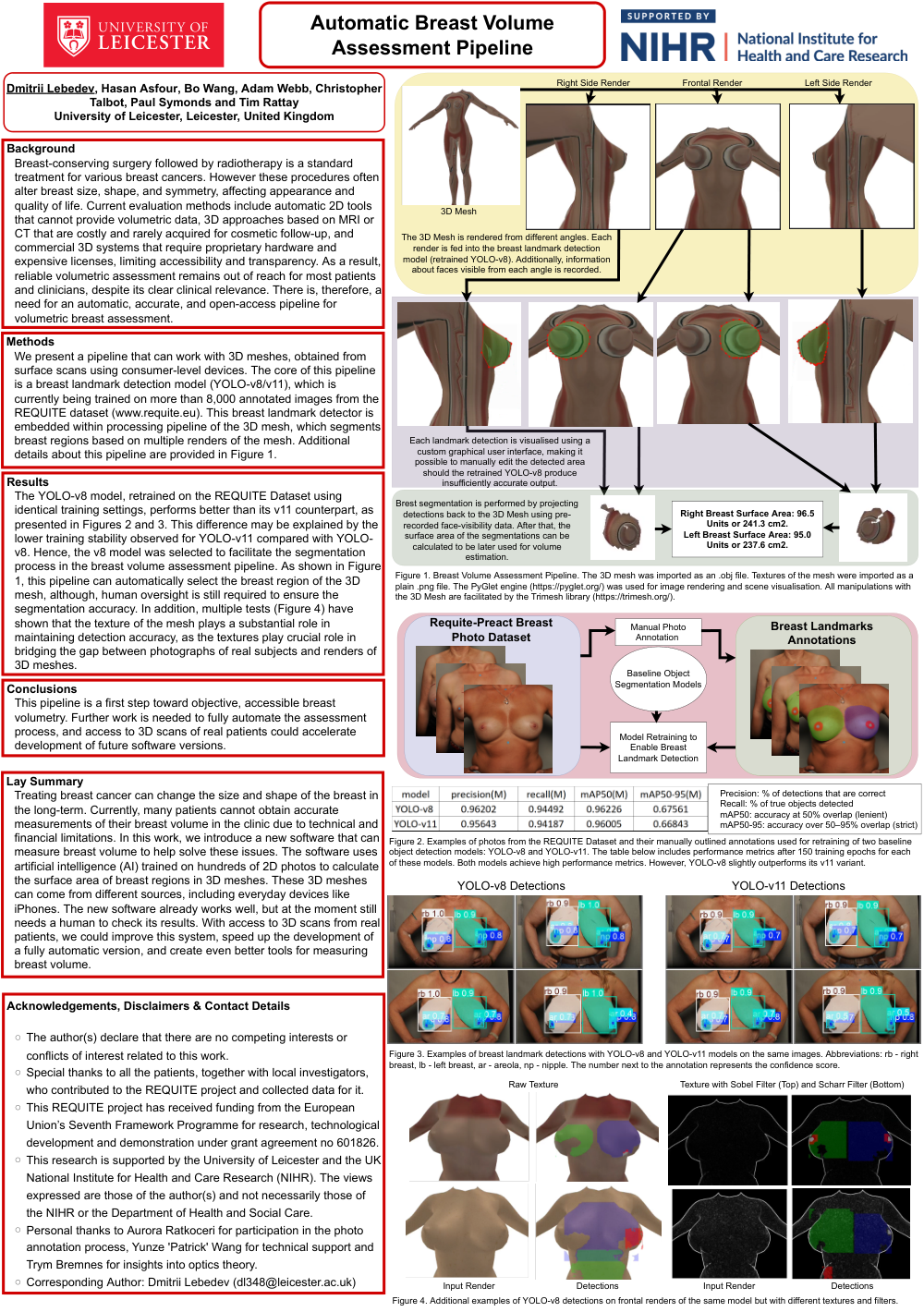
We present a pipeline that can work with 3D meshes, obtained from surface scans using consumer-level devices. The core of this pipeline is a breast landmark detection model (YOLO-v8/v11), which is currently being trained on more than 8,000 annotated images from the REQUITE dataset (www.requite.eu). This breast landmark detector is embedded within the processing pipeline of the 3D mesh, which segments breast regions based on multiple renders of the mesh. Additional details about this pipeline are provided in Figure 1.
Results
The YOLO-v8 model, retrained on the REQUITE Dataset using identical training settings, performs better than its v11 counterpart, as presented in Figures 2 and 3. This difference may be explained by the lower training stability observed for YOLO-v11 compared with YOLO v8. Hence, the v8 model was selected to facilitate the segmentation process in the breast volume assessment pipeline. As shown in Figure 1, this pipeline can automatically select the breast region of the 3D mesh, although human oversight is still required to ensure the segmentation accuracy. In addition, multiple tests (Figure 4) have shown that the texture of the mesh plays a substantial role in maintaining detection accuracy, as the textures play a crucial role in bridging the gap between photographs of real subjects and renders of 3D meshes.
Conclusions
This pipeline is a first step toward objective, accessible breast volumetry. Further work is needed to fully automate the assessment process, and access to 3D scans of real patients could accelerate the development of future software versions.
Lay Summary
Treating breast cancer can change the size and shape of the breast in the long-term. Currently, many patients cannot obtain accurate measurements of their breast volume in the clinic due to technical and financial limitations. In this work, we introduce a new software that can measure breast volume to help solve these issues. The software uses artificial intelligence (AI) trained on hundreds of 2D photos to calculate the surface area of breast regions in 3D meshes. These 3D meshes can come from different sources, including everyday devices like iPhones. The new software already works well, but at the moment still needs a human to check its results. With access to 3D scans from real patients, we could improve this system, speed up the development of a fully automatic version, and create even better tools for measuring breast volume.
Acknowledgements, Disclaimers & Contact
- Details The author(s) declare that there are no competing interests or conflicts of interest related to this work.
- Special thanks to all the patients, together with local investigators, who contributed to the REQUITE project and collected data for it.
- This REQUITE project has received funding from the European Union’s Seventh Framework Programme for research, technological development and demonstration under grant agreement no 601826.
- This research is supported by the University of Leicester and the UK National Institute for Health and Care Research (NIHR). The views expressed are those of the author(s) and not necessarily those of the NIHR or the Department of Health and Social Care.
- Personal thanks to Aurora Ratkoceri for participation in the photo annotation process, Yunze 'Patrick' Wang for technical support and Trym Bremnes for insights into optics theory.
- Corresponding Author: Dmitrii Lebedev (dl348@leicester.ac.uk)
Comments
Email is required but is not shown publicly.
Loading comments...