92 posters, 1 audios, 567 authors, 81 institutions
ePostersLive by SciGen Technologies S.A. All rights reserved.
Data-driven Cancer Research Conference 2026
24-26 February 2026 | Edinburgh, Scotland

P37
QResearch primary care records linked to national hospital and cancer registry data for personalised medicine: a validation study
Poster Presenter
Part of Topic
QResearch primary care records linked to national hospital and cancer registry data: a validation study
Background
•Personalised cancer research increasingly relies on linked real-world population level data from electronic health records (EHRs)
•QResearch is a large, primary care EHR database with data from >1,500 general practices in England and >40 million patients, linked to national cancer registry data1
•Primary care data offer detailed information on comorbidities, medications and lifestyle factors often missing from registries
•With no single national source of primary care data in England, linkage of such data limits analysis to a subset of the English population – validation is essential to ensure representativeness
•As a highly curated dataset, availability of national cancer registry data can lag behind other EHR data sources
•STUDY AIM: to assess the demographic and treatment representativeness of the QResearch-linked cancer dataset against national cancer statistics (NDRS) and evaluate the impact of cancer registry censoring at 2020 on cohort composition
Methods
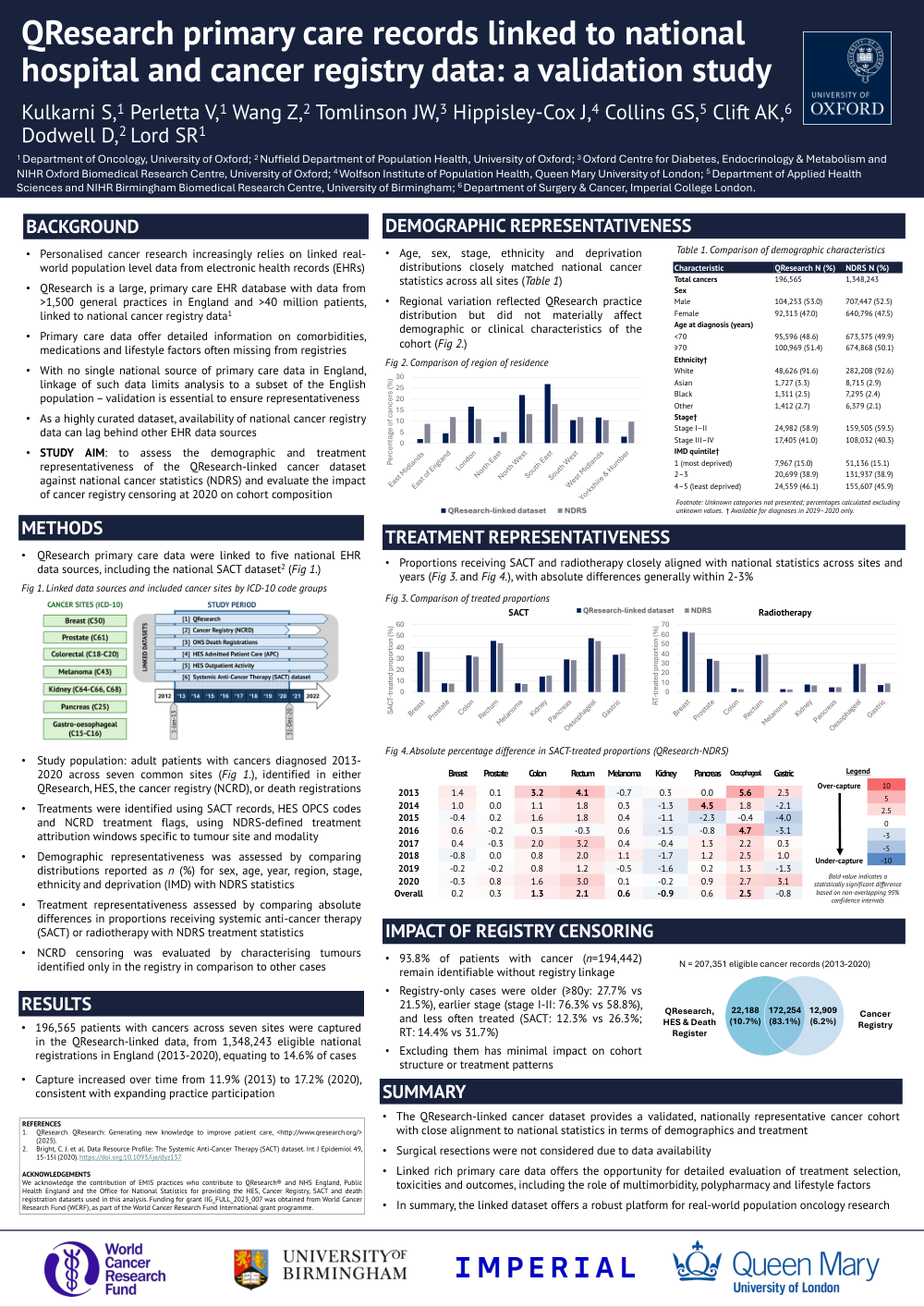
•QResearch primary care data were linked to five national EHR data sources, including the national SACT dataset2 (Fig 1.)
•Study population: adult patients with cancers diagnosed 2013-2020 across seven common sites (Fig 1.), identified in either QResearch, HES, the cancer registry (NCRD), or death registrations
•Treatments were identified using SACT records, HES OPCS codes and NCRD treatment flags, using NDRS-defined treatment attribution windows specific to tumour site and modality
•Demographic representativeness was assessed by comparing distributions reported as n (%) for sex, age, year, region, stage, ethnicity and deprivation (IMD) with NDRS statistics
•Treatment representativeness assessed by comparing absolute differences in proportions receiving systemic anti-cancer therapy (SACT) or radiotherapy with NDRS treatment statistics
•NCRD censoring was evaluated by characterising tumours identified only in the registry in comparison to other cases
Results
•196,565 patients with cancers across seven sites were captured in the QResearch-linked data, from 1,348,243 eligible national registrations in England (2013-2020), equating to 14.6% of cases
•Capture increased over time from 11.9% (2013) to 17.2% (2020), consistent with expanding practice participation
Demographic Representativeness
•Age, sex, stage, ethnicity and deprivation distributions closely matched national cancer statistics across all sites (Table 1)
•Regional variation reflected QResearch practice distribution but did not materially affect demographic or clinical characteristics of the cohort (Fig 2.)
Treatment Representativeness
•Proportions receiving SACT and radiotherapy closely aligned with national statistics across sites and years (Fig 3. and Fig 4.), with absolute differences generally within 2-3%
Impact of Registry Censoring
•93.8% of patients with cancer (n=194,442) remain identifiable without registry linkage
•Registry-only cases were older (≥80y: 27.7% vs 21.5%), earlier stage (stage I-II: 76.3% vs 58.8%), and less often treated (SACT: 12.3% vs 26.3%; RT: 14.4% vs 31.7%)
•Excluding them has minimal impact on cohort structure or treatment patterns
Summary
•The QResearch-linked cancer dataset provides a validated, nationally representative cancer cohort with close alignment to national statistics in terms of demographics and treatment
•Surgical resections were not considered due to data availability
•Linked rich primary care data offers the opportunity for detailed evaluation of treatment selection, toxicities and outcomes, including the role of multimorbidity, polypharmacy and lifestyle factors
•In summary, the linked dataset offers a robust platform for real-world population oncology research
Comments
Email is required but is not shown publicly.
Loading comments...