92 posters, 1 audios, 567 authors, 81 institutions
ePostersLive by SciGen Technologies S.A. All rights reserved.
Data-driven Cancer Research Conference 2026
24-26 February 2026 | Edinburgh, Scotland

P32
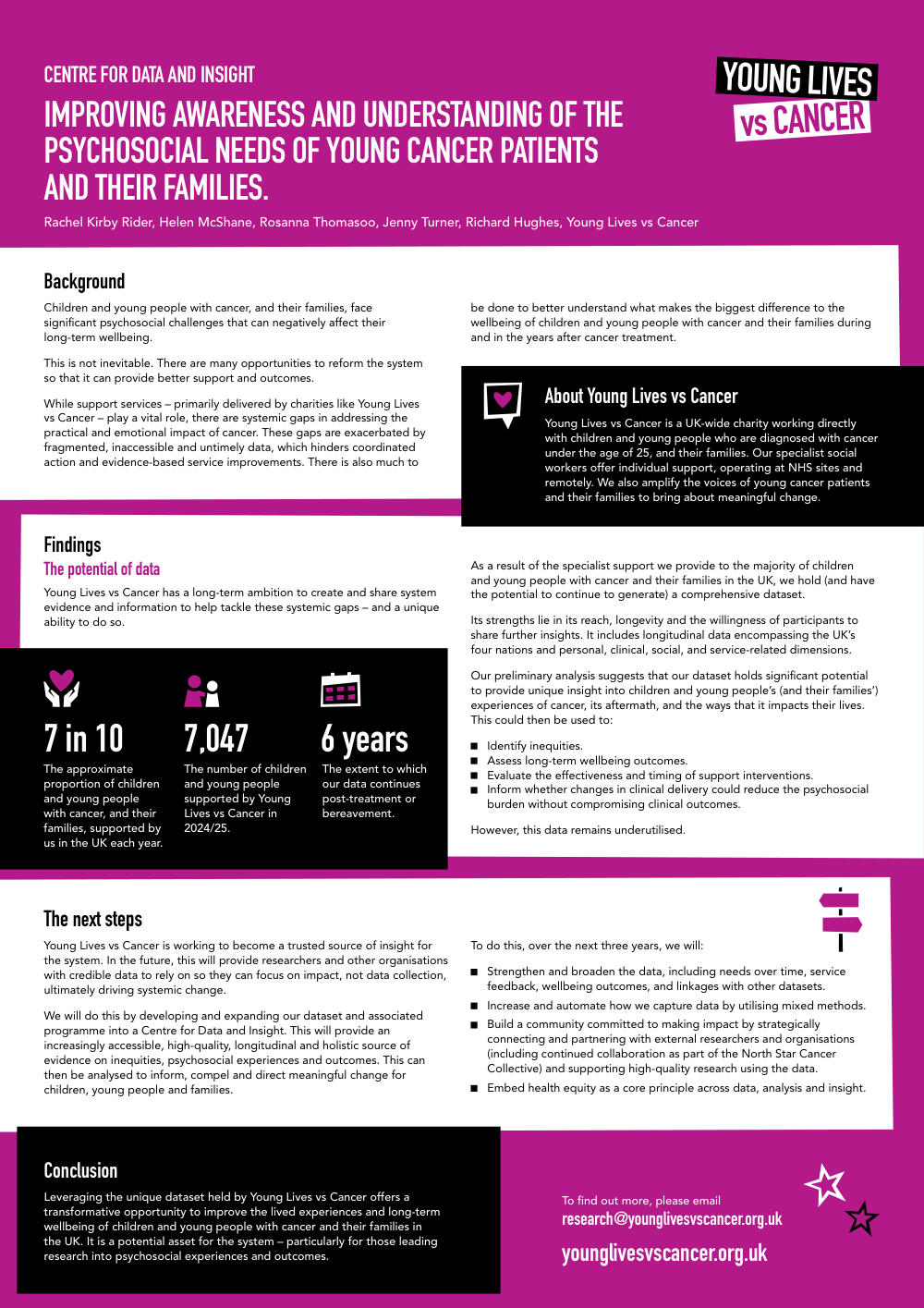
Developing shared insights for the system into the psychosocial needs of children and young people with cancer and their families
Poster Presenter
Authors
Rachel Kirby Rider, Helen McShane, Rosanna Thomasoo, Jenny Turner, Richard Hughes
Affiliations
Part of Topic
Background
Children and young people with cancer, and their families, face significant psychosocial challenges that can negatively affect their long-term wellbeing.
This is not inevitable. There are many opportunities to reform the system so that it can provide better support and outcomes.
While support services – primarily delivered by charities like Young Lives vs Cancer – play a vital role, there are systemic gaps in addressing the
practical and emotional impact of cancer. These gaps are exacerbated by fragmented, inaccessible and untimely data, which hinders coordinated action and evidence-based service improvements. There is also much to be done to better understand what makes the biggest difference to the
wellbeing of children and young people with cancer and their families during and in the years after cancer treatment.
About Young Lives vs Cancer
Young Lives vs Cancer is a UK-wide charity working directly with children and young people who are diagnosed with cancer under the age of 25, and their families. Our specialist social workers offer individual support, operating at NHS sites and remotely. We also amplify the voices of young cancer patients and their families to bring about meaningful change.
Findings - The potential of data
Young Lives vs Cancer has a long-term ambition to create and share system evidence and information to help tackle these systemic gaps – and a unique ability to do so.
As a result of the specialist support we provide to the majority of children and young people with cancer and their families in the UK, we hold (and have the potential to continue to generate) a comprehensive dataset.
Its strengths lie in its reach, longevity and the willingness of participants to share further insights. It includes longitudinal data encompassing the UK’s four nations and personal, clinical, social, and service-related dimensions.
Our preliminary analysis suggests that our dataset holds significant potential to provide unique insight into children and young people’s (and their families’) experiences of cancer, its aftermath, and the ways that it impacts their lives.
This could then be used to:
Identify inequities.
Assess long-term wellbeing outcomes.
Evaluate the effectiveness and timing of support interventions.
Inform whether changes in clinical delivery could reduce the psychosocial burden without compromising clinical outcomes.
However, this data remains underutilised.
The next steps
Young Lives vs Cancer is working to become a trusted source of insight for the system. In the future, this will provide researchers and other organisations with credible data to rely on so they can focus on impact, not data collection, ultimately driving systemic change.
We will do this by developing and expanding our dataset and associated programme into a Centre for Data and Insight. This will provide an increasingly accessible, high-quality, longitudinal and holistic source of evidence on inequities, psychosocial experiences and outcomes. This can then be analysed to inform, compel and direct meaningful change for children, young people and families.
To do this, over the next three years, we will:
Strengthen and broaden the data, including needs over time, service
feedback, wellbeing outcomes, and linkages with other datasets.
Increase and automate how we capture data by utilising mixed methods.
Build a community committed to making impact by strategically
connecting and partnering with external researchers and organisations
(including continued collaboration as part of the North Star Cancer
Collective) and supporting high-quality research using the data.
Embed health equity as a core principle across data, analysis and insight.
Conclusion
Leveraging the unique dataset held by Young Lives vs Cancer offers a transformative opportunity to improve the lived experiences and long-term wellbeing of children and young people with cancer and their families in the UK. It is a potential asset for the system – particularly for those leading research into psychosocial experiences and outcomes.
To find out more, please email: research@younglivesvscancer.org.uk
younglivesvscancer.org.uk
Comments
Email is required but is not shown publicly.
Loading comments...