92 posters, 1 audios, 567 authors, 81 institutions
ePostersLive by SciGen Technologies S.A. All rights reserved.
Data-driven Cancer Research Conference 2026
24-26 February 2026 | Edinburgh, Scotland

P21
Ethnicity and prevalence of risk factors for breast cancer in over 1.3 million women in England.
Poster Presenter
Part of Topic
Introduction
Women from minority ethnic backgrounds are reported to have lower breast cancer incidence rates but poorer outcomes from the disease. Any variations in the prevalence of the known risk factors for breast cancer by ethnicity will influence incidence rates and the risk of certain tumour characteristics that may be associated with poorer outcomes.
There are limited data available on the prevalence of risk factors for breast cancer among women in disaggregated ethnic groups which may explain these observed variations in incidence and tumour characteristics. The Million Women Study (MWS) and UK Biobank (UKB) are two large prospective cohort studies in the UK and provide a unique opportunity to examine the health of middle-aged women from different backgrounds.
Using data from the MWS and UKB, we describe the distribution of common risk factors for breast cancer in women from five ethnic groups of interest (Black African, Black Caribbean, Indian, Pakistani and white).
Methods
Women were recruited into the MWS between 1996 and 2001 and into UKB between 2006 and 2010. In both studies, information about lifestyle, reproductive and sociodemographic factors were collected using self-administered questionnaires.
For MWS participants, ethnicity was assigned combining information from English hospital records and self-reported ethnicity on study questionnaires. For UKB participants, ethnicity was assigned using self-reported ethnicity at recruitment. All analyses were restricted to participants from England.
Odd ratios with 95% confidence intervals were estimated for ten risk factors of interest including educational level, body mass index, smoking history, alcohol consumption, family history of breast cancer, use of oral contraceptives, use of hormone replacement therapy in postmenopausal women, age at menarche, number of full-term pregnancies and age at first birth among parous women in each of the minority ethnic group versus whites adjusted for age, region and deprivation.
Results
Ethnicity was assigned to one of the five groups of interest in 1,085,749 women in the MWS, among which 99% were of white ethnicity, and included 733 Black African women, 2847 Black Caribbean women, 4932 Indian women and 1160 Pakistani women.
Among the 215,996 UKB participants, 96% were of white ethnicity, and included 1595 Black African women, 2709 Black Caribbean women, 2753 Indian women and 645 Pakistani women.
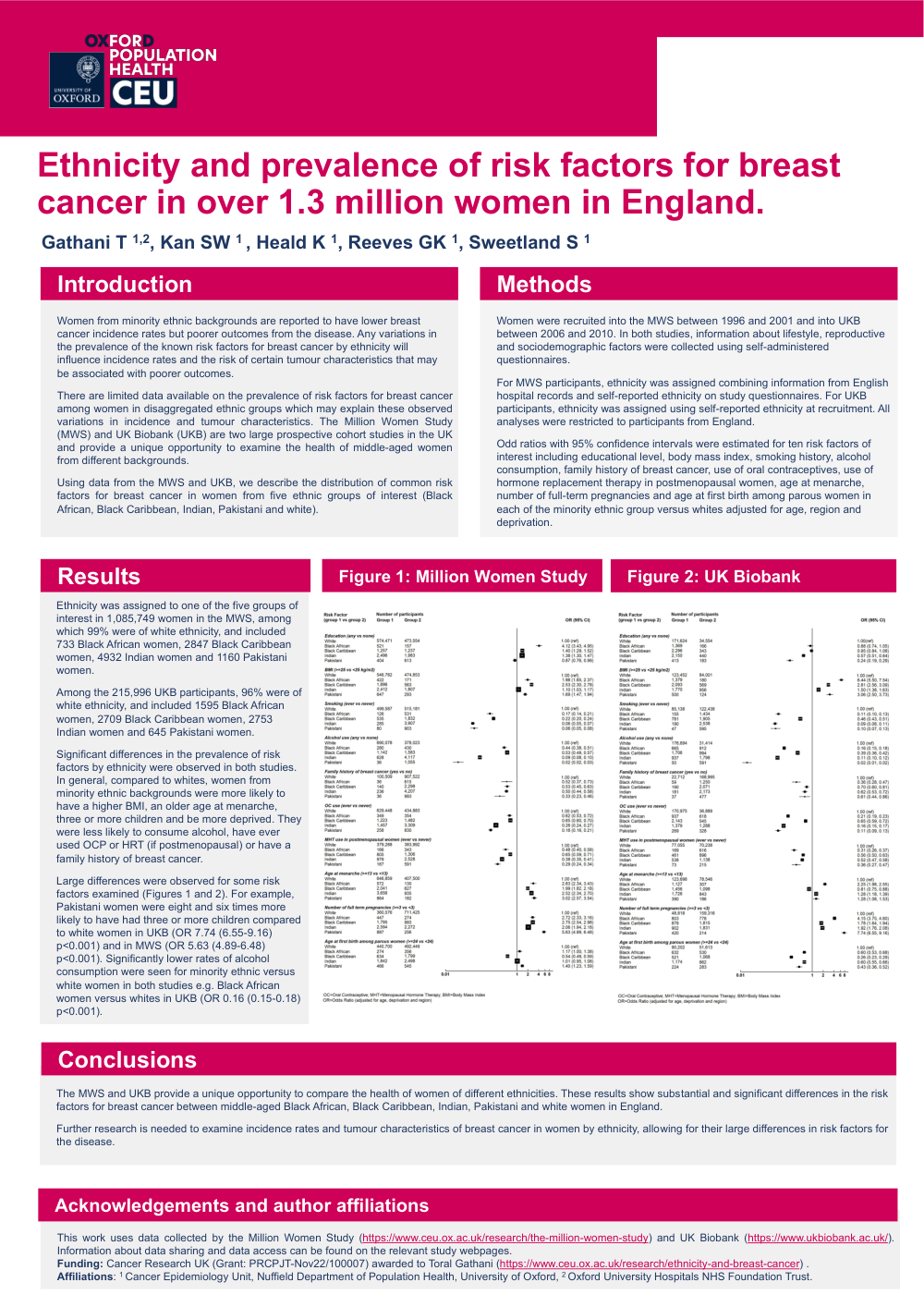
Significant differences in the prevalence of risk factors by ethnicity were observed in both studies. In general, compared to whites, women from minority ethnic backgrounds were more likely to have a higher BMI, an older age at menarche, three or more children and be more deprived. They were less likely to consume alcohol, have ever used OCP or HRT (if postmenopausal) or have a family history of breast cancer.
Large differences were observed for some risk factors examined (Figures 1 and 2). For example, Pakistani women were eight and six times more likely to have had three or more children compared to white women in UKB (OR 7.74 (6.55-9.16) p<0.001) and in MWS (OR 5.63 (4.89-6.48) p<0.001). Significantly lower rates of alcohol consumption were seen for minority ethnic versus white women in both studies e.g. Black African women versus whites in UKB (OR 0.16 (0.15-0.18) p<0.001).
Conclusion
The MWS and UKB provide a unique opportunity to compare the health of women of different ethnicities. These results show substantial and significant differences in the risk factors for breast cancer between middle-aged Black African, Black Caribbean, Indian, Pakistani and white women in England.
Further research is needed to examine incidence rates and tumour characteristics of breast cancer in women by ethnicity, allowing for their large differences in risk factors for the disease.
Comments
Email is required but is not shown publicly.
Loading comments...