92 posters, 1 audios, 567 authors, 81 institutions
ePostersLive by SciGen Technologies S.A. All rights reserved.
Data-driven Cancer Research Conference 2026
24-26 February 2026 | Edinburgh, Scotland

P18
The NHS Proton Real World Data Strategy: Personalising Proton Beam Therapy
Poster Presenter
Authors
Maria Majeed, Yuwei Wang, Simona Gaito, Ed Smith, Anna France
Affiliations
Part of Topic
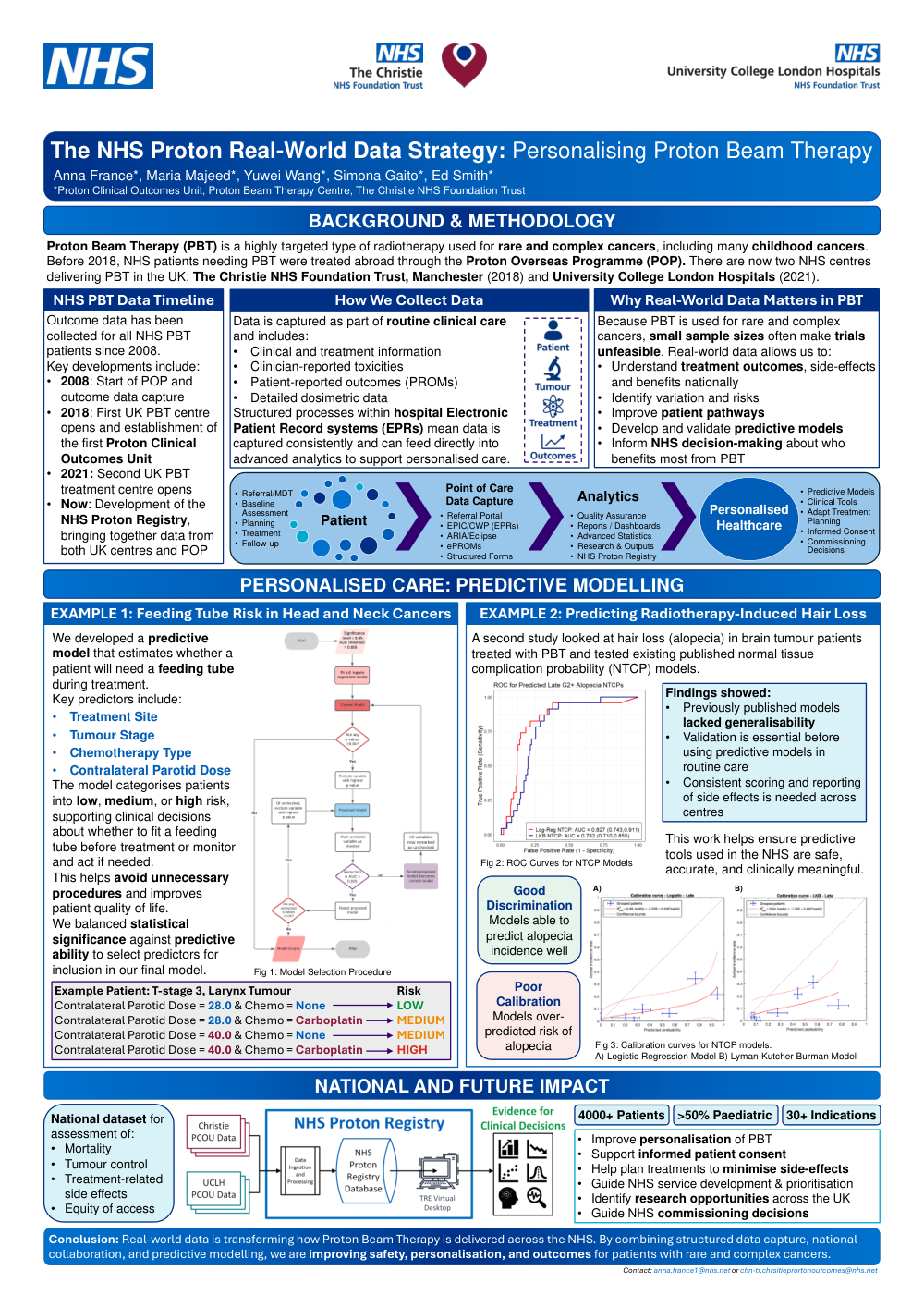
The NHS Proton Real-World Data Strategy: Personalising Proton Beam Therapy
BACKGROUND & METHODOLOGY
Proton Beam Therapy (PBT) is a highly targeted type of radiotherapy used for rare and complex cancers, including many childhood cancers. Before 2018, NHS patients needing PBT were treated abroad through the Proton Overseas Programme (POP). There are now two NHS centres delivering PBT in the UK: The Christie NHS Foundation Trust, Manchester (2018) and University College London Hospitals (2021).
NHS PBT Data Timeline
Outcome data has been collected for all NHS PBT patients since 2008.
Key developments include:
How We Collect Data
Data is captured as part of routine clinical care and includes:
Structured processes within hospital Electronic Patient Record systems (EPRs) mean data is captured consistently and can feed directly into advanced analytics to support personalised care.
Why Real-World Data Matters in PBT
Because PBT is used for rare and complex cancers, small sample sizes often make trials unfeasible. Real‑world data allows us to:
PERSONALISED CARE: PREDICTIVE MODELLING
EXAMPLE 1: Feeding Tube Risk in Head and Neck Cancers
We developed a predictive model that estimates whether a patient will need a feeding tube during treatment.
Key predictors include:
The model categorises patients into low, medium, or high risk, supporting clinical decisions about whether to fit a feeding tube before treatment or monitor and act if needed.
This helps avoid unnecessary procedures and improves patient quality of life.
We balanced statistical significance against predictive ability to select predictors for inclusion in our final model.
EXAMPLE 2: Predicting Radiotherapy-Induced Hair Loss
A second study looked at hair loss (alopecia) in brain tumour patients treated with PBT and tested existing published normal tissue complication probability (NTCP) models.
Findings showed:
This work helps ensure predictive tools used in the NHS are safe, accurate, and clinically meaningful.
Good Discrimination - Models able to predict alopecia incidence well
Poor Calibration - Models over-predicted risk of alopecia
NATIONAL AND FUTURE IMPACT
NHS Proton Registry
National dataset for assessment of:
Conclusion: Real‑world data is transforming how Proton Beam Therapy is delivered across the NHS. By combining structured data capture, national collaboration, and predictive modelling, we are improving safety, personalisation, and outcomes for patients with rare and complex cancers.
Comments
Email is required but is not shown publicly.
Loading comments...