372 posters, 1 audios, 13 topics, 29 sessions, 1,035 authors, 449 institutions
ePostersLive by SciGen Technologies S.A. All rights reserved.
51st Annual Regional Anesthesiology and Acute Pain Medicine Meeting
April 16 - 18, 2026 | Phoenix, Arizona

2314121
Suspected Local Anesthetic Systemic Toxicity after Bilateral Thoracic Paravertebral Catheter Bolus
Poster Presenter
Authors
Affiliations
Part of Topic
Medically Challenging Cases
Suspected Local Anesthetic Systemic Toxicity after Bilateral Thoracic Paravertebral Catheter Bolus
Philip Jung, DO, Jeremy H. Tsui, MD, Devin Daniels, DO, Kristin L. Schreiber, MD, PhD.
Introduction
•We report a case of local anesthetic systemic toxicity (LAST) from bilateral paravertebral catheters approximately 20 minutes after administration of initial ropivacaine bolus.
•Despite acceptable weight-based dose of local anesthetic and negative intermittent aspiration, the patient displayed symptoms of both CNS and CV toxicity and was treated with lipid emulsion.
•This case highlights the difficulty of diagnosing LAST in the setting of sympathectomy, as well as raises questions on truly "safe" weight-based dosing, with further consideration for the variable rate of local anesthetic absorption and peak plasma levels among patients.
Background
•A 63-year-old, 89 kg, 188 cm male with a past medical history of hyperlipidemia, stage 2 follicular lymphoma s/p immunotherapy now under surveillance, GERD, and anxiety was scheduled for mid-LAD myocardial bridge unroofing to treat longstanding and progressively worsening chest pain and left upper extremity discomfort.
•It is our institutional protocol to place paravertebral nerve block catheters in advance of myocardial bridge unroofing procedures, as patients are preadmitted the day prior to surgery, which allows timely provision of post-operative analgesia for patients.
•A day prior to his scheduled surgery, patient uneventfully had bilateral T4-5 paravertebral catheters placed under ultrasound guidance.
•At the time of placement, a test dose of lidocaine with epinephrine was administered through the catheters, which resulted in decreased sensation in a T4-T5 band-like distribution and no increase in heart rate or change in blood pressure.
Case Report
•On the day of surgery, patient arrived in the preoperative area and 20 cc of 0.25% ropivacaine was administered to each paravertebral catheter with negative aspiration of heme every 5 cc administered, for a total of 40 cc of 0.25% ropivacaine.
•Patient was awake, conversant both before, during, and 20 minutes after bolus, and did not endorse ringing in ears, metallic taste in mouth, or any other neurologic symptoms.
•Approximately 20 min after dose, the patient got up to go to the bathroom, and upon returning to his stretcher, he told the nurse that he felt odd, lost consciousness, and then appeared to have some potential seizure-like tonic movements of limbs. Tonic seizure-like activity ensued, lasting approximately 10 seconds, after which intermittent adventitious movements of face/mouth persisted for approximately 20-30 min.
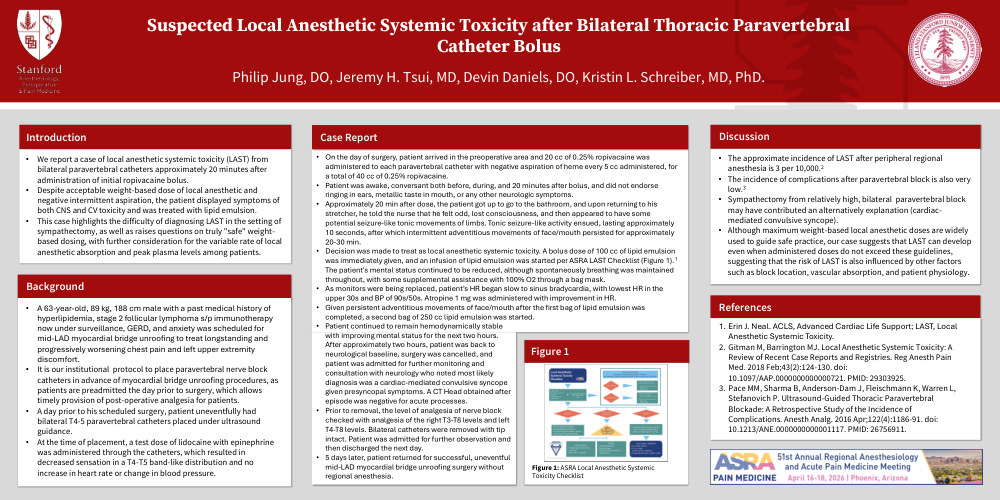
•Decision was made to treat as local anesthetic systemic toxicity. A bolus dose of 100 cc of lipid emulsion was immediately given, and an infusion of lipid emulsion was started per ASRA LAST Checklist (Figure 1).1 The patient's mental status continued to be reduced, although spontaneously breathing was maintained throughout, with some supplemental assistance with 100% O2 through a bag mask.
•As monitors were being replaced, patient’s HR began slow to sinus bradycardia, with lowest HR in the upper 30s and BP of 90s/50s. Atropine 1 mg was administered with improvement in HR.
•Given persistent adventitious movements of face/mouth after the first bag of lipid emulsion was completed, a second bag of 250 cc lipid emulsion was started.
•Patient continued to remain hemodynamically stable with improving mental status for the next two hours. After approximately two hours, patient was back to neurological baseline, surgery was cancelled, and patient was admitted for further monitoring and consultation with neurology who noted most likely diagnosis was a cardiac-mediated convulsive syncope given presyncopal symptoms. A CT Head obtained after episode was negative for acute processes.
•Prior to removal, the level of analgesia of nerve block checked with analgesia of the right T3-T8 levels and left T4-T8 levels. Bilateral catheters were removed with tip intact. Patient was admitted for further observation and then discharged the next day.
•5 days later, patient returned for successful, uneventful mid-LAD myocardial bridge unroofing surgery without regional anesthesia.
Discussion
•The approximate incidence of LAST after peripheral regional anesthesia is 3 per 10,000.2
•The incidence of complications after paravertebral block is also very low.3
•Sympathectomy from relatively high, bilateral paravertebral block may have contributed an alternatively explanation (cardiac-mediated convulsive syncope).
•Although maximum weight-based local anesthetic doses are widely used to guide safe practice, our case suggests that LAST can develop even when administered doses do not exceed these guidelines, suggesting that the risk of LAST is also influenced by other factors such as block location, vascular absorption, and patient physiology.
References
1.Erin J. Neal. ACLS, Advanced Cardiac Life Support; LAST, Local Anesthetic Systemic Toxicity.
2.Gitman M, Barrington MJ. Local Anesthetic Systemic Toxicity: A Review of Recent Case Reports and Registries. Reg Anesth Pain Med. 2018 Feb;43(2):124-130. doi: 10.1097/AAP.0000000000000721. PMID: 29303925.
3.Pace MM, Sharma B, Anderson-Dam J, Fleischmann K, Warren L, Stefanovich P. Ultrasound-Guided Thoracic Paravertebral Blockade: A Retrospective Study of the Incidence of Complications. Anesth Analg. 2016 Apr;122(4):1186-91. doi: 10.1213/ANE.0000000000001117. PMID: 26756911.