372 posters, 1 audios, 13 topics, 29 sessions, 1,035 authors, 449 institutions
ePostersLive by SciGen Technologies S.A. All rights reserved.
51st Annual Regional Anesthesiology and Acute Pain Medicine Meeting
April 16 - 18, 2026 | Phoenix, Arizona

2314035
Lumbar Sympathetic Ganglion Block for treatment of refractory Phantom Limb Pain
Poster Presenter
Authors
Affiliations
Part of Topic
Medically Challenging Cases
Introduction
Materials and Methods
Results/Case Report
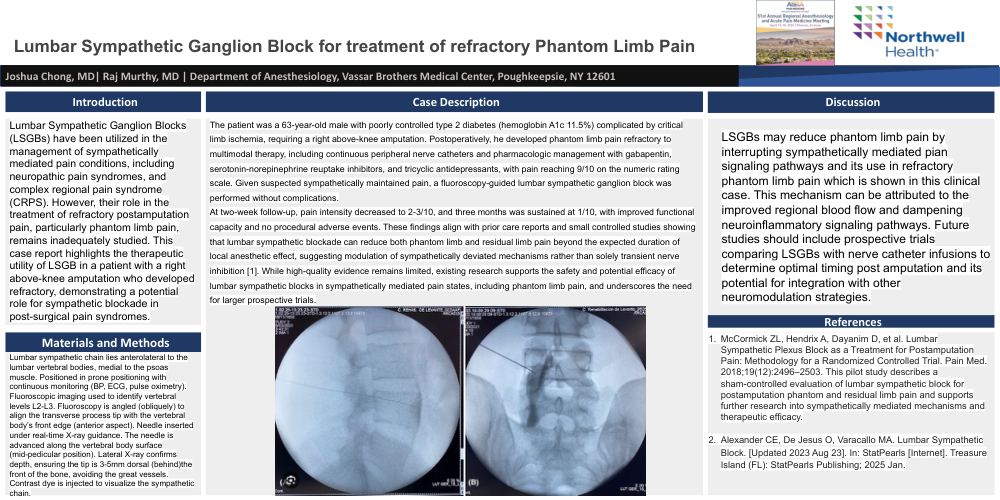
The patient was a 63-year-old male with poorly controlled type 2 diabetes (hemoglobin A1c 11.5%) complicated by critical limb ischemia, requiring a right above-knee amputation. Postoperatively, he developed phantom limb pain refractory to multimodal therapy, including continuous peripheral nerve catheters and pharmacologic management with gabapentin, serotonin-norepinephrine reuptake inhibitors, and tricyclic antidepressants, with pain reaching 9/10 on the numeric rating scale. Given suspected sympathetically maintained pain, a fluoroscopy-guided lumbar sympathetic ganglion block was performed without complications.
At two-week follow-up, pain intensity decreased to 2-3/10, and three months was sustained at 1/10, with improved functional capacity and no procedural adverse events. These findings align with prior care reports and small controlled studies showing that lumbar sympathetic blockade can reduce both phantom limb and residual limb pain beyond the expected duration of local anesthetic effect, suggesting modulation of sympathetically deviated mechanisms rather than solely transient nerve inhibition [1]. While high-quality evidence remains limited, existing research supports the safety and potential efficacy of lumbar sympathetic blocks in sympathetically mediated pain states, including phantom limb pain, and underscores the need for larger prospective trials.
Discussion
References
-
McCormick ZL, Hendrix A, Dayanim D, et al. Lumbar Sympathetic Plexus Block as a Treatment for Postamputation Pain: Methodology for a Randomized Controlled Trial. Pain Med. 2018;19(12):2496–2503. This pilot study describes a sham-controlled evaluation of lumbar sympathetic block for postamputation phantom and residual limb pain and supports further research into sympathetically mediated mechanisms and therapeutic efficacy.
-
Alexander CE, De Jesus O, Varacallo MA. Lumbar Sympathetic Block. [Updated 2023 Aug 23]. In: StatPearls [Internet]. Treasure Island (FL): StatPearls Publishing; 2025 Jan.