372 posters, 1 audios, 13 topics, 29 sessions, 1,035 authors, 449 institutions
ePostersLive by SciGen Technologies S.A. All rights reserved.
51st Annual Regional Anesthesiology and Acute Pain Medicine Meeting
April 16 - 18, 2026 | Phoenix, Arizona

2314017
Stellate Ganglion Block as a Therapeutic Option for Chronic Intractable Hiccups
Poster Presenter
Part of Topic
Medically Challenging Cases
Introduction
Hiccups are mostly tolerable and self-limiting, However, when consults are
requested for persistent hiccups, they are likely represent severe discomfort
and significant disruption in quality of life. When physical maneuvers and
pharmacologic management fail to provide relief, direct intervention at the
level of the phrenic nerve, or surrounding sympathetic fibers of the afferent
limb of the hiccup reflex arc may be employed
1,2
.
Phrenic nerve blocks have been utilized with good results, however it is
difficult to perform and has been associated with respiratory dysfunction
3
.
Few studies have performed a stellate ganglion block as an alternative and
comparatively easier technique. Although its exact mechanism is poorly
understood, it has yielded positive results and carries a lesser risk of
pulmonary complications
4,5
Materials and Methods
As the case report is devoid of patient identifiable information, it is exempt
from IRB review requirements as per Hartford Healthcare policy. Patient
provided signed consent for publication at the time of encounter.
The Case
• A 54-year-old male with end-stage renal disease, coronary artery disease,
gastrointestinal esophageal reflux, and ascending aortic aneurism, status
post repair, presented with a 13-year history of intractable hiccups.
• Review of systems and workup revealed no significant neurologic,
cardiovascular or gastrointestinal findings. Medication history did not
coincide with symptom history. Hiccups first began in the period following
his aortic aneurism repair in 2012, suggesting that as a possible inciting
event.
• The patient was maintained on Chlorpromazine(Thorazine) at a dosage of
25 mg every 8 hours or as needed on a long term basis, yet his symptoms
have shown little to no improvement at the time of the clinical assessment
for SGB procedure.
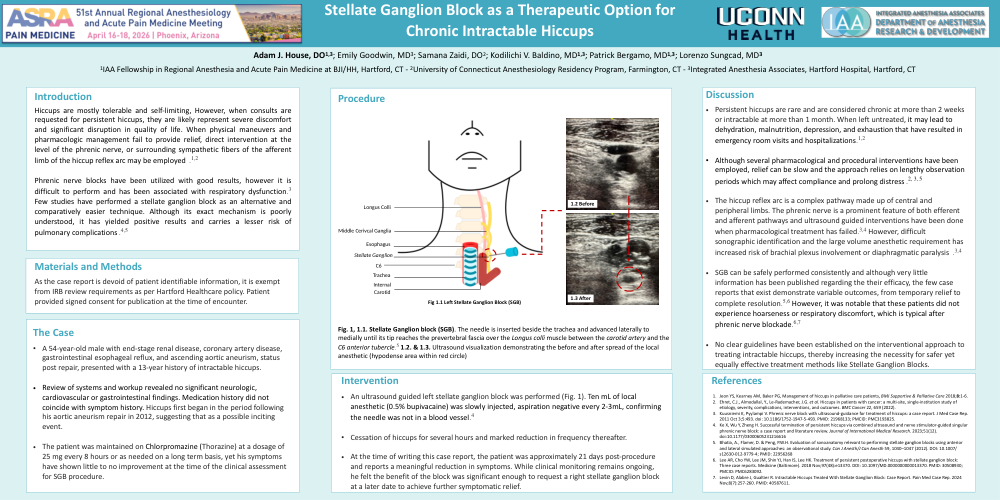
Fig. 1, 1.1. Stellate Ganglion block (SGB). The needle is inserted beside the trachea and advanced laterally to
medially until its tip reaches the prevertebral fascia over the Longus colli muscle between the carotid artery and the
5
C6 anterior tubercle 1.2. & 1.3. Ultrasound visualization demonstrating the before and after spread of the local
.
anesthetic (hypodense area within red circle)
Intervention
• An ultrasound guided left stellate ganglion block was performed (Fig. 1). Ten mL of local
anesthetic (0.5% bupivacaine) was slowly injected, aspiration negative every 2-3mL, confirming
the needle was not in a blood vessel
4
.
• Cessation of hiccups for several hours and marked reduction in frequency thereafter.
• At the time of writing this case report, the patient was approximately 21 days post-procedure
and reports a meaningful reduction in symptoms. While clinical monitoring remains ongoing,
he felt the benefit of the block was significant enough to request a right stellate ganglion block
at a later date to achieve further symptomatic relief.
Discussion
• Persistent hiccups are rare and are considered chronic at more than 2 weeks
or intractable at more than 1 month. When left untreated, it may lead to
dehydration, malnutrition, depression, and exhaustion that have resulted in
emergency room visits and hospitalizations
1,2
.
• Although several pharmacological and procedural interventions have been
employed, relief can be slow and the approach relies on lengthy observation
periods which may affect compliance and prolong distress
2, 3, 5
.
• The hiccup reflex arc is a complex pathway made up of central and
peripheral limbs. The phrenic nerve is a prominent feature of both efferent
and afferent pathways and ultrasound guided interventions have been done
3,4
when pharmacological treatment has failed However, difficult
.
sonographic identification and the large volume anesthetic requirement has
increased risk of brachial plexus involvement or diaphragmatic paralysis
3,4
.
• SGB can be safely performed consistently and although very little
information has been published regarding the their efficacy, the few case
reports that exist demonstrate variable outcomes, from temporary relief to
5,6
complete resolution However, it was notable that these patients did not
.
experience hoarseness or respiratory discomfort, which is typical after
phrenic nerve blockade
6,7
.
• No clear guidelines have been established on the interventional approach to
treating intractable hiccups, thereby increasing the necessity for safer yet
equally effective treatment methods like Stellate Ganglion Blocks.
References
1. Jeon YS, Kearney AM, Baker PG, Management of hiccups in palliative care patients, BMJ Supportive & Palliative Care 2018;8:1-6.
2. Ehret, C.J., Almodallal, Y., Le-Rademacher, J.G. et al. Hiccups in patients with cancer: a multi-site, single-institution study of
etiology, severity, complications, interventions, and outcomes. BMC Cancer 22, 659 (2022).
3. Kuusniemi K, Pyylampi V. Phrenic nerve block with ultrasound-guidance for treatment of hiccups: a case report. J Med Case Rep.
2011 Oct 3;5:493. doi: 10.1186/1752-1947-5-493. PMID: 21968133; PMCID: PMC3193825.
4. Ke X, Wu Y, Zheng H. Successful termination of persistent hiccups via combined ultrasound and nerve stimulator-guided singular
phrenic nerve block: a case report and literature review. Journal of International Medical Research. 2023;51(12).
doi:10.1177/03000605231216616
5. Bhatia, A., Flamer, D. & Peng, P.W.H. Evaluation of sonoanatomy relevant to performing stellate ganglion blocks using anterior
and lateral simulated approaches: an observational study. Can J Anesth/J Can Anesth 59, 1040–1047 (2012). DOI: 10.1007/
s12630-012-9779-4; PMID: 22956268
6. Lee AR, Cho YW, Lee JM, Shin YJ, Han IS, Lee HK. Treatment of persistent postoperative hiccups with stellate ganglion block:
Three case reports. Medicine (Baltimore). 2018 Nov;97(48):e13370. DOI: 10.1097/MD.0000000000013370. PMID: 30508930;
PMCID: PMC6283092.
7. Levin D, Alabre J, Gualtier R. Intractable Hiccups Treated With Stellate Ganglion Block: Case Report. Pain Med Case Rep. 2024
Nov;8(7):257-260. PMID: 40587611.