372 posters, 1 audios, 13 topics, 29 sessions, 1,035 authors, 449 institutions
ePostersLive by SciGen Technologies S.A. All rights reserved.
51st Annual Regional Anesthesiology and Acute Pain Medicine Meeting
April 16 - 18, 2026 | Phoenix, Arizona

2313933
Clinical Decision Making for Neuraxial versus General Anesthesia in Thrombocytopenic Patients
Poster Presenter
Part of Topic
Medically Challenging Cases
Clinical Decision Making for Neuraxial versus General Anesthesia in Thrombocytopenic Patients
Cassandra W. Cu MSc,1 Uchenna O. Umeh MD, FASA, FASRA2,3
1 School of Medicine, Tufts University School of Medicine, Boston, MA, USA; 2 Department of Anesthesiology, Critical Care and Pain Management, Hospital for Special Surgery, New York, NY, USA, 3Department of Anesthesiology, Weill Cornell Medicine, New York, NY, USA
Introduction:
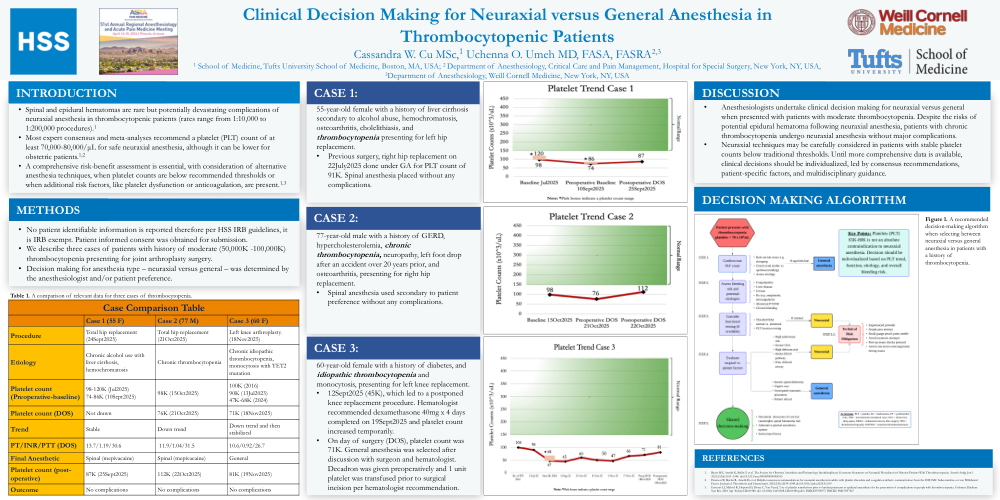
55-year-old female with a history of liver cirrhosis secondary to alcohol abuse, hemochromatosis, osteoarthritis, cholelithiasis, and thrombocytopenia presenting for left hip replacement. Previous surgery, right hip replacement on 22July2025 done under GA for PLT count of 91K. Spinal anesthesia placed without any complications.
Case 2:
55-year-old female with a history of liver cirrhosis secondary to alcohol abuse, hemochromatosis, osteoarthritis, cholelithiasis, and thrombocytopenia presenting for left hip replacement. Previous surgery, right hip replacement on 22July2025 done under GA for PLT count of 91K. Spinal anesthesia placed without any complications.
Case 3:
60-year-old female with a history of diabetes, and idiopathic thrombocytopenia and monocytosis, presenting for left knee replacement. 12Sept2025 (45K), which led to a postponed knee replacement procedure. Hematologist recommended dexamethasone 40mg x 4 days completed on 19Sept2025 and platelet count increased temporarily. On day of surgery (DOS), platelet count was 71K. General anesthesia was selected after discussion with surgeon and hematologist. Decadron was given preoperatively and 1 unit platelet was transfused prior to surgical incision per hematologist recommendation.
Discussion:
1. Bauer ME, Arendt K, Beilin Y, et al. The Society for Obstetric Anesthesia and PerinatologyInterdisciplinary Consensus Statement on Neuraxial Procedures in Obstetric Patients WithThrombocytopenia. Anesth Analg. Jun 1 2021;132(6):1531–1544. doi:10.1213/ane.0000000000005355
2. Peterson W, Martin R, Arnold D, et al. Delphi consensus recommendations for neuraxial anesthesia inadults with platelet disorders and coagulation defects: communication from the ISTH SSC Subcommittee onvon Willebrand Factor. Journal of Thrombosis and Haemostasis. 2025;23(6):2039–2049.doi:10.1016/j.jtha.2025.01.019
3. Estcourt LJ, Malouf R, Hopewell S, Doree C, Van Veen J. Use of platelet transfusions prior to lumbarpunctures or epidural anaesthesia for the prevention of complications in people with thrombocytopenia.Cochrane Database Syst Rev. 2018 Apr 30;4(4):CD011980. doi: 10.1002/14651858.CD011980.pub3. PMID:29709077; PMCID: PMC5957267