372 posters, 1 audios, 13 topics, 29 sessions, 1,035 authors, 449 institutions
ePostersLive by SciGen Technologies S.A. All rights reserved.
51st Annual Regional Anesthesiology and Acute Pain Medicine Meeting
April 16 - 18, 2026 | Phoenix, Arizona

2313374
Intractable Cough After Cervical Plexus Block for Carotid Endarterectomy: A rare trigger for general anesthesia conversion
Poster Presenter
Authors
Affiliations
Part of Topic
Medically Challenging Cases
Intractable Cough After Cervical Plexus Block for Carotid Endarterectomy
A Rare Trigger for General Anesthesia Conversion
Authors: Zhihao Wang, MD; Ammar Siddiqui, MD; Corrie Amos, MD Institution: Westchester Medical Center, Valhalla, NY
1. Introduction
- Background: Cervical plexus blocks (CPB) are frequently utilized for carotid endarterectomy (CEA) due to their low complication profile.
- Conversion to GA: The most common drivers for converting to general anesthesia (GA) are block failure (40%) and patient anxiety (45%).
- Rare Complication: Intractable coughing is an infrequent complication. While previous reports mention paroxysmal coughing leading to increased bleeding, this case focuses on an immediate, primary cough.
- Objective: To present a case where uncontrollable coughing following CPB necessitated urgent GA conversion.
- Patient Consent: Informed consent was obtained from the healthcare proxy; the case is exempt from IRB review per institutional policy.
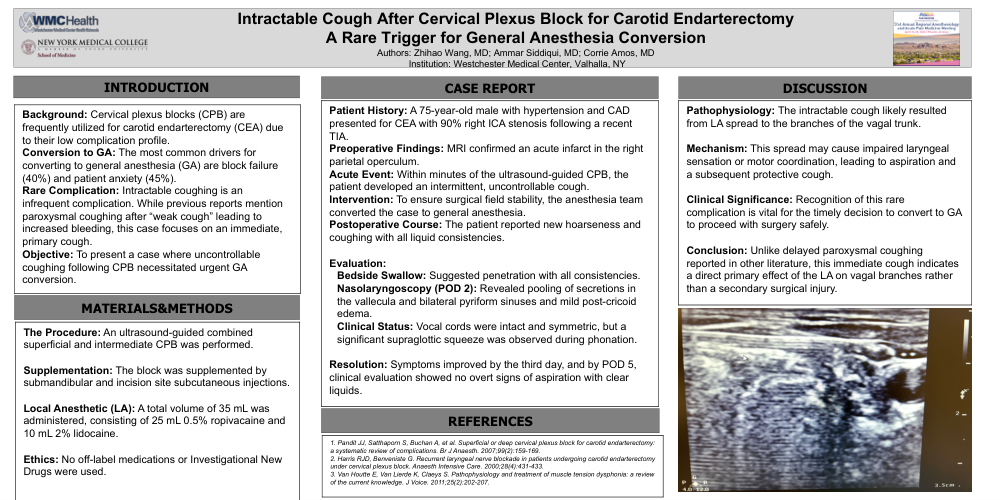
- The Procedure: An ultrasound-guided combined superficial and intermediate CPB was performed.
- Supplementation: The block was supplemented by submandibular and incision site subcutaneous injections.
- Local Anesthetic (LA): A total volume of 35 mL was administered, consisting of 25 mL 0.5% ropivacaine and 10 mL 2% lidocaine.
- Ethics: No off-label medications or Investigational New Drugs were used.
- Patient History: A 75-year-old male with hypertension and CAD presented for CEA with 90% right ICA stenosis following a recent TIA.
- Preoperative Findings: MRI confirmed an acute infarct in the right parietal operculum.
- Acute Event: Within minutes of the ultrasound-guided CPB, the patient developed an intermittent, uncontrollable cough.
- Intervention: To ensure surgical field stability, the anesthesia team converted the case to general anesthesia.
- Postoperative Course: The patient reported new hoarseness and coughing with all liquid consistencies.
- Evaluation:
2. Material and Methods
3. Case Report
o Bedside Swallow: Suggested penetration with all consistencies.
o Nasolaryngoscopy (POD 2): Revealed pooling of secretions in the vallecula and bilateral pyriform sinuses and mild post-cricoid edema.
o Clinical Status: Vocal cords were intact and symmetric, but a significant supraglottic squeeze was observed during phonation.
- Resolution: Symptoms improved by the third day, and by POD 5, clinical evaluation showed no overt signs of aspiration with clear liquids.
- Pathophysiology: The intractable cough likely resulted from LA spread to the branches of the vagal trunk.
- Mechanism: This spread may cause impaired laryngeal sensation or motor coordination, leading to aspiration and a subsequent protective cough.
- Clinical Significance: Recognition of this rare complication is vital for the timely decision to convert to GA to proceed with surgery safely.
- Conclusion: Unlike delayed paroxysmal coughing reported in other literature, this immediate cough indicates a direct primary effect of the LA on vagal branches rather than a secondary surgical stimulus.
4. Discussion
5. References
1. Pandit, J.J. et al. British Journal of Anaesthesia. 2007;99(2):159–169.
2. Harris RJD, Benveniste G. Anaesth Intensive Care. 2000;28(4):431-433.
3. Van Houtte E, et al. J Voice. 2011;25(2):202-207.