372 posters, 1 audios, 13 topics, 29 sessions, 1,035 authors, 449 institutions
ePostersLive by SciGen Technologies S.A. All rights reserved.
51st Annual Regional Anesthesiology and Acute Pain Medicine Meeting
April 16 - 18, 2026 | Phoenix, Arizona

2313308
External Oblique Intercostal Fascial Plane Block for Abdominal Cutaneous Nerve Entrapment Syndrome
Poster Presenter
Authors
Affiliations
Part of Topic
Medically Challenging Cases
Introduction
- Abdominal Cutaneous Nerve Entrapment Syndrome (ACNES) accounts for an estimated 2-3% of cases of chronic abdominal pain and up to 30% of those with idiopathic abdominal wall pain1,2.
- ACNES is defined as a localized, sharp or burning abdominal wall pain that can be precisely pinpointed by the patient.
- ACNES results from the entrapment of the anterior or lateral cutaneous branches of the thoracoabdominal nerves (T7-T12) as they traverse the fibrous abdominal fascia.
- The Carnett’s sign remains a key physical exam finding and can distinguish ACNES from visceral pain3.
- Abdominal tenderness persists or worsens during voluntary tensing of the abdominal.
- The External Oblique Intercostal Fascial Plane (EOIFP) block is a regional anesthetic technique which targets the anterior and lateral branches of the thoracoabdominal nerves5.
- Performed by depositing local anesthetic between the external oblique and intercostal muscles5.
Case report
- A 21-year-old female presented to the Emergency Department with a two-week history of abdominal pain.
- Past Medical history included asthma, celiac disease, hyperlipidemia, and polycystic ovarian syndrome.
- Abdominal pain described as constant, sharp pain in the right upper quadrant (RUQ) without radiation.
- Pain different from previous celiac flares or corpus luteal cyst-related pain.
- Exacerbated by activity and raising her arms above her head
- Limited oral intake due to worsening pain and nausea
- Physical exam:
- Moderate tenderness to palpation in the RUQ without rebound or guarding
- Positive Carnett’s sign (tenderness intensified when lifting head and shoulders off the examination table and contracting abdominal wall muscles)
- Lab values unremarkable
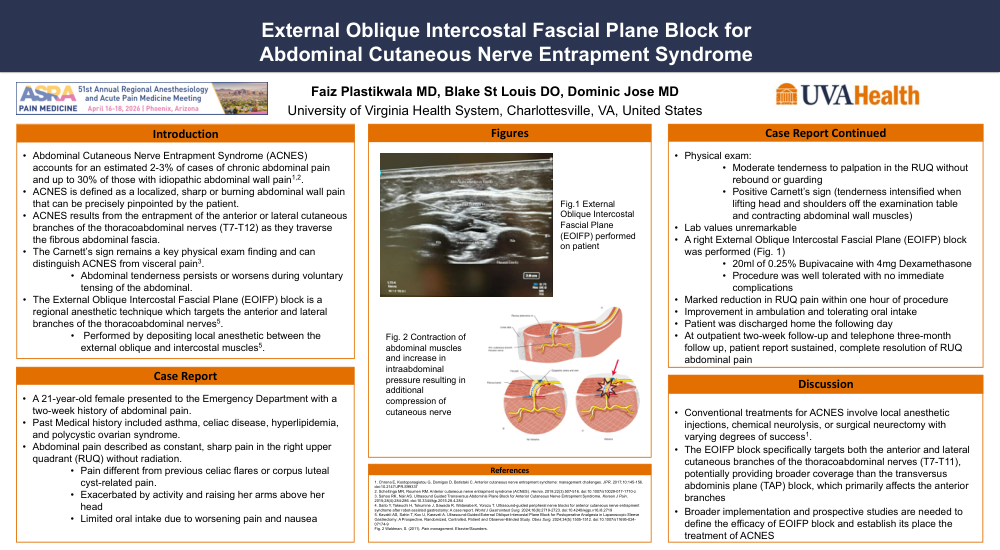
- A right External Oblique Intercostal Fascial Plane (EOIFP) block was performed (Fig. 1)
- 20ml of 0.25% Bupivacaine with 4mg Dexamethasone
- Procedure was well tolerated with no immediate complications
- Marked reduction in RUQ pain within one hour of procedure
- Improvement in ambulation and tolerating oral intake
- Patient was discharged home the following day
- At outpatient two-week follow-up and telephone three-month follow up, patient report sustained, complete resolution of RUQ abdominal pain
Discussion
- Conventional treatments for ACNES involve local anesthetic injections, chemical neurolysis, or surgical neurectomy with varying degrees of success1.
- The EOIFP block specifically targets both the anterior and lateral cutaneous branches of the thoracoabdominal nerves (T7-T11), potentially providing broader coverage than the transversus abdominis plane (TAP) block, which primarily affects the anterior branches
- Broader implementation and prospective studies are needed to define the efficacy of EOIFP block and establish its place the treatment of ACNES