372 posters, 1 audios, 13 topics, 29 sessions, 1,035 authors, 449 institutions
ePostersLive by SciGen Technologies S.A. All rights reserved.
51st Annual Regional Anesthesiology and Acute Pain Medicine Meeting
April 16 - 18, 2026 | Phoenix, Arizona

2312101
Transient Paraplegia Following Lumbar Erector Spinae Plane Block After Anterolateral Lumbosacral Interbody Fusion: A Case Report
Poster Presenter
Authors
Part of Topic
Medically Challenging Cases
This is an 80-year-old woman presenting with refractory lower back and left hip pain with impaired functional mobility and worsening bladder incontinence.
An MRI and clinical exam revealed a combination of upper lumbar spinal stenosis, facet arthropathy, and interspinous synovitis superimposed upon loss of lumbosacral lordosis from her prior surgeries.
The patient was scheduled for a two-staged anterolateral lumbosacral L4-S1interbody fusion, followed by a posterior thoracolumbar-to-pelvis decompression and fusion.
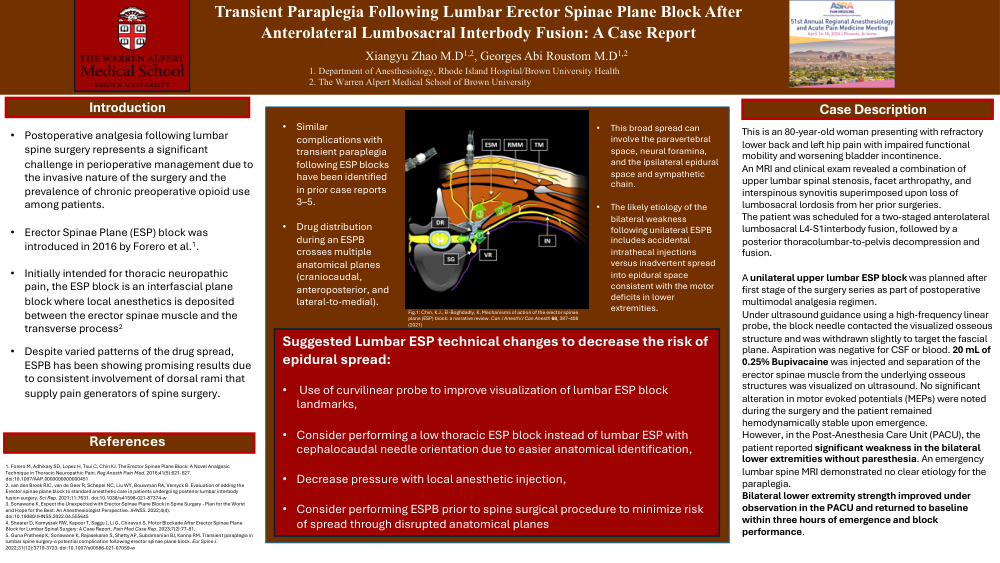
A unilateral upper lumbar ESP block was planned after first stage of the surgery series as part of postoperative multimodal analgesia regimen.
Under ultrasound guidance using a high-frequency linear probe, the block needle contacted the visualized osseous structure and was withdrawn slightly to target the fascial plane. Aspiration was negative for CSF or blood. 20 mL of 0.25% Bupivacaine was injected and separation of the erector spinae muscle from the underlying osseous structures was visualized on ultrasound. No significant alteration in motor evoked potentials (MEPs) were noted during the surgery and the patient remained hemodynamically stable upon emergence.
However, in the Post-Anesthesia Care Unit (PACU), the patient reported significant weakness in the bilateral lower extremities without paresthesia. An emergency lumbar spine MRI demonstrated no clear etiology for the paraplegia.
Bilateral lower extremity strength improved under observation in the PACU and returned to baseline within three hours of emergence and block performance.
Disucssion:
Suggested Lumbar ESP technical changes to decrease the risk of epidural spread: