372 posters, 1 audios, 13 topics, 29 sessions, 1,035 authors, 449 institutions
ePostersLive by SciGen Technologies S.A. All rights reserved.
51st Annual Regional Anesthesiology and Acute Pain Medicine Meeting
April 16 - 18, 2026 | Phoenix, Arizona

2318708
Opioid-Sparing Pain Control in Acute Pancreatitis Using a Single-Shot Erector Spinae Plane Block
Poster Presenter
Authors
Antonio Pereira, Dominique Williams, Elizabeth Kasparov, Oktay Shuminov
Affiliations
Part of Topic
Medically Challenging Cases
Background
-
Gastrointestinal diseases account for over $119 billion dollars in annual healthcare costs in the United States (U.S.).
-
Acute pancreatitis is one of the leading causes of gastrointestinal related inpatient admissions in the US, accounting for over 300,000 annual admissions.
-
Acute pancreatitis is commonly treated with opioid analgesia, which carries risks of adverse effects and prolonged hospitalization.
-
Regional anesthesia techniques such as the Erector Spinae Plane Block (ESPB) offer opioid-sparing alternatives for persistent abdominal pain in patients with pancreatitis.
-
Although use of Erector Spinae Plane Block is described in patients with postoperative and chronic pain, evidence in acute pancreatitis remains limited.
-
We present a case of analgesia and opioid cessation after ESPB in acute-on-chronic pancreatitis
-
A 43-year-old Female with a past medical history of chronic pancreatitis with pancreatic stent, pancreatic divisum, anorexia nervosa with binge-purging, major depressive disorder, anxiety, gastroesophageal reflux disorder and chronic hyponatremia secondary to psychogenic polydipsia presents with acute left lower quadrant abdominal pain with associated nausea, vomiting and fever.
-
A CT abdomen and pelvis with intravenous contrast highlighted a mild increase in a previously visualized fluid collection around the pancreatic tail.
-
Before evaluation by the inpatient Pain Service, the patient was placed on hydromorphone 2mg/4mg tablets every four hours as needed for moderate/severe pain and hydromorphone 1 mg IV push every four hours for breakthrough pain.
-
Despite initial pain regimen patient continued to have persistent pain; given no relief and concern for opioid-related adverse effects, a single-shot erector spinae plane block was offered and accepted.
-
18 mL of Bupivacaine 0.25% and 2 mL of Dexamethasone 5 mg preservative-free were drawn up into a 20 mL syringe.
-
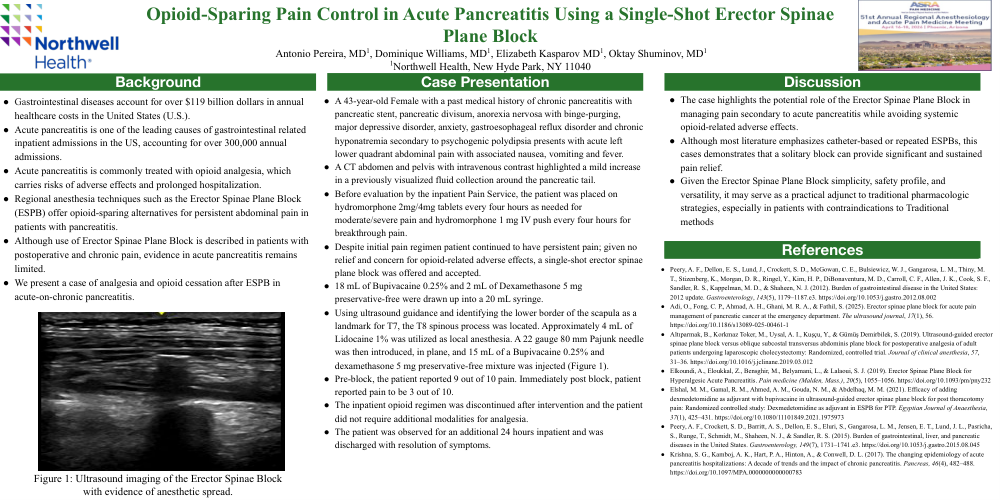
Using ultrasound guidance and identifying the lower border of the scapula as a landmark for T7, the T8 spinous process was located. Approximately 4 mL of Lidocaine 1% was utilized as local anesthesia. A 22 gauge 80 mm Pajunk needle was then introduced, in plane, and 15 mL of a Bupivacaine 0.25% and dexamethasone 5 mg preservative-free mixture was injected (Figure 1).
-
Pre-block, the patient reported 9 out of 10 pain. Immediately post block, patient reported pain to be 3 out of 10.
-
The inpatient opioid regimen was discontinued after intervention and the patient did not require additional modalities for analgesia.
-
The patient was observed for an additional 24 hours inpatient and was discharged with resolution of symptoms.
-
The case highlights the potential role of the Erector Spinae Plane Block in managing pain secondary to acute pancreatitis while avoiding systemic opioid-related adverse effects.
-
Although most literature emphasizes catheter-based or repeated ESPBs, this cases demonstrates that a solitary block can provide significant and sustained pain relief.
-
Given the Erector Spinae Plane Block simplicity, safety profile, and versatility, it may serve as a practical adjunct to traditional pharmacologic strategies, especially in patients with contraindications to Traditional methods
-
Peery, A. F., Dellon, E. S., Lund, J., Crockett, S. D., McGowan, C. E., Bulsiewicz, W. J., Gangarosa, L. M., Thiny, M. T., Stizenberg, K., Morgan, D. R., Ringel, Y., Kim, H. P., DiBonaventura, M. D., Carroll, C. F., Allen, J. K., Cook, S. F., Sandler, R. S., Kappelman, M. D., & Shaheen, N. J. (2012). Burden of gastrointestinal disease in the United States: 2012 update. Gastroenterology, 143(5), 1179–1187.e3. https://doi.org/10.1053/j.gastro.2012.08.002
-
Adi, O., Fong, C. P., Ahmad, A. H., Ghani, M. R. A., & Fathil, S. (2025). Erector spinae plane block for acute pain management of pancreatic cancer at the emergency department. The ultrasound journal, 17(1), 56. https://doi.org/10.1186/s13089-025-00461-1
-
Altıparmak, B., Korkmaz Toker, M., Uysal, A. I., Kuşçu, Y., & Gümüş Demirbilek, S. (2019). Ultrasound-guided erector spinae plane block versus oblique subcostal transversus abdominis plane block for postoperative analgesia of adult patients undergoing laparoscopic cholecystectomy: Randomized, controlled trial. Journal of clinical anesthesia, 57, 31–36. https://doi.org/10.1016/j.jclinane.2019.03.012
-
Elkoundi, A., Eloukkal, Z., Bensghir, M., Belyamani, L., & Lalaoui, S. J. (2019). Erector Spinae Plane Block for Hyperalgesic Acute Pancreatitis. Pain medicine (Malden, Mass.), 20(5), 1055–1056. https://doi.org/10.1093/pm/pny232
-
Elshal, M. M., Gamal, R. M., Ahmed, A. M., Gouda, N. M., & Abdelhaq, M. M. (2021). Efficacy of adding dexmedetomidine as adjuvant with bupivacaine in ultrasound-guided erector spinae plane block for post thoracotomy pain: Randomized controlled study: Dexmedetomidine as adjuvant in ESPB for PTP. Egyptian Journal of Anaesthesia, 37(1), 425–431. https://doi.org/10.1080/11101849.2021.1975973
-
Peery, A. F., Crockett, S. D., Barritt, A. S., Dellon, E. S., Eluri, S., Gangarosa, L. M., Jensen, E. T., Lund, J. L., Pasricha, S., Runge, T., Schmidt, M., Shaheen, N. J., & Sandler, R. S. (2015). Burden of gastrointestinal, liver, and pancreatic diseases in the United States. Gastroenterology, 149(7), 1731–1741.e3. https://doi.org/10.1053/j.gastro.2015.08.045
-
Krishna, S. G., Kamboj, A. K., Hart, P. A., Hinton, A., & Conwell, D. L. (2017). The changing epidemiology of acute pancreatitis hospitalizations: A decade of trends and the impact of chronic pancreatitis. Pancreas, 46(4), 482–488. https://doi.org/10.1097/MPA.0000000000000783