372 posters, 1 audios, 13 topics, 29 sessions, 1,035 authors, 449 institutions
ePostersLive by SciGen Technologies S.A. All rights reserved.
51st Annual Regional Anesthesiology and Acute Pain Medicine Meeting
April 16 - 18, 2026 | Phoenix, Arizona

2318593
Ultrasound-Guided Localization for Complicated LFCN Decompression surgery: The Role of Regional Anesthesiologists in Neurosurgery
Poster Presenter
Authors
Affiliations
Part of Topic
Medically Challenging Cases
Ultrasound-Guided Localization for Complicated LFCN Decompression Surgery
The Role of the Regional Anesthesiologist in Peripheral Nerve Surgery
Authors: Zhihao Wang, MD; Ammar Siddiqui, MD; Jared Pisapia, MD (Neurosurgeon); Jeff Xu, MD (Mentor) Institution: Westchester Medical Center, Valhalla, NY
Introduction
- Meralgia paresthetica (MP): This lateral femoral cutaneous nerve (LFCN) neuropathy affects approximately 32 per 100,000 persons.
- Surgical Indications: Intervention is typically indicated when patients are refractory to conservative treatment.
- Success Rates: Meta-analysis suggests pain relief rates of 22% for infiltration, 63% for decompression, and 85% for neurectomy.
- The Challenge: Identification of the nerve can be difficult due to significant anatomical variability.
- Objective: To utilize ultrasound guidance for marking and placing a sub-neural wire to assist neurosurgeons during complex neurectomies.
Materials and Methods
- Ethics: Informed consent was obtained, and the case was exempt from IRB review as it contained no patient-identifiable information.
- Medications: No Investigational New Drugs or off-label medications were utilized.
- Imaging: A high-frequency linear ultrasound probe was used for surface marking.
- Confirmation: Secondary confirmation was performed intraoperatively inside the incision after opening the fascial layer.
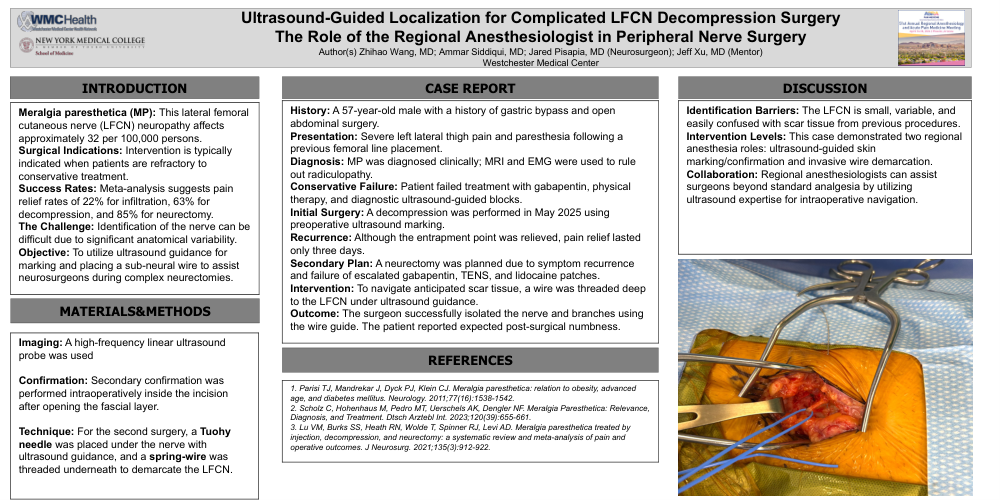
- Technique: For the second surgery, a Tuohy needle was placed under the nerve with ultrasound guidance, and a spring-wire was threaded underneath to demarcate the LFCN.
- Navigation: These techniques provided real-time anatomical navigation for precise dissection.
Case Report
- History: A 57-year-old male with a history of gastric bypass and open abdominal surgery.
- Presentation: Severe left lateral thigh pain and paresthesia following a previous femoral line placement.
- Diagnosis: MP was diagnosed clinically; MRI and EMG were used to rule out radiculopathy.
- Conservative Failure: Patient failed treatment with gabapentin, physical therapy, and diagnostic ultrasound-guided blocks.
- Initial Surgery: A decompression was performed in May 2025 using preoperative ultrasound marking.
- Recurrence: Although the entrapment point was relieved, pain relief lasted only three days.
- Secondary Plan: A neurectomy was planned due to symptom recurrence and failure of escalated gabapentin, TENS, and lidocaine patches.
- Intervention: To navigate anticipated scar tissue, a wire was threaded deep to the LFCN under ultrasound guidance.
- Outcome: The surgeon successfully isolated the nerve and branches using the wire guide. The patient reported expected post-surgical numbness.
Discussion
- Identification Barriers: The LFCN is small, variable, and easily confused with scar tissue from previous procedures.
- Intervention Levels: This case demonstrated two regional anesthesia roles: ultrasound-guided skin marking/confirmation and invasive wire demarcation.
- Collaboration: Regional anesthesiologists can assist surgeons beyond standard analgesia by utilizing ultrasound expertise for intraoperative navigation.
References
- Parisi TJ, et al. Meralgia paresthetica: relation to obesity, advanced age, and diabetes mellitus. Neurology. 2011.
- Scholz C, et al. Meralgia Paresthetica: Relevance, Diagnosis, and Treatment. Dtsch Arztebl Int. 2023.
- Lu VM, et al. Meralgia paresthetica treated by injection, decompression, and neurectomy: a systematic review and meta-analysis. J Neurosurg. 2021.