Loading...

372 posters, 1 audios, 13 topics, 29 sessions, 1,035 authors, 449 institutions

ePostersLive by SciGen Technologies S.A. All rights reserved.

2318407

Geni-vs Block: Novel Continuous Distal Femoral Periosteal Catheter Provides Complete Analgesia After AKA in a Pediatric Patient
Poster Presenter

Vipin Bansal

Authors

Vipin Bansal

Affiliations

Emory

Part of Topic

Medically Challenging Cases

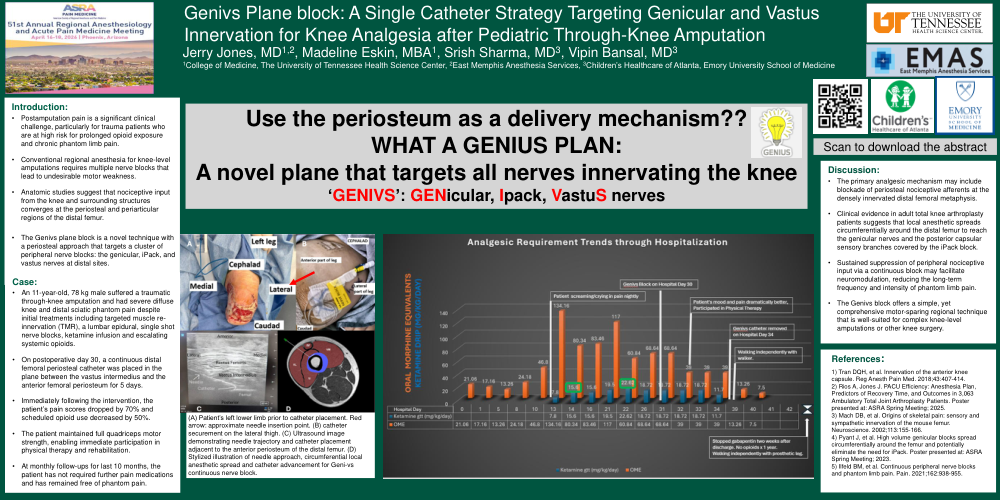
Genivs Plane block: A Single Catheter Strategy Targeting Genicular and Vastus Innervation for Knee Analgesia after Pediatric Through-Knee Amputation

Jerry Jones, MD1,2, Madeline Eskin, MBA1, Srish Sharma, MD3, Vipin Bansal, MD3
1College of Medicine, The University of Tennessee Health Science Center, 2East Memphis Anesthesia Services, 3Children’s Healthcare of Atlanta, Emory University School of Medicine


Use the periosteum as a delivery mechanism??

WHAT A GENIUS PLAN:

A novel plane that targets all nerves innervating the knee

‘GENIVS’: GENicular, Ipack, VastuS nerves


Introduction:

•Postamputation pain is a significant clinical challenge, particularly for trauma patients who are at high risk for prolonged opioid exposure and chronic phantom limb pain.
•Conventional regional anesthesia for knee-level amputations requires multiple nerve blocks that lead to undesirable motor weakness.
•Anatomic studies suggest that nociceptive input from the knee and surrounding structures converges at the periosteal and periarticular regions of the distal femur.
•The Genivs plane block is a novel technique with a periosteal approach that targets a cluster of peripheral nerve blocks: the genicular, iPack, and vastus nerves at distal sites.
 

Case:

•An 11-year-old, 78 kg male suffered a traumatic through-knee amputation and had severe diffuse knee and distal sciatic phantom pain despite initial treatments including targeted muscle re-innervation (TMR), a lumbar epidural, single shot nerve blocks, ketamine infusion and escalating systemic opioids.
•On postoperative day 30, a continuous distal femoral periosteal catheter was placed in the plane between the vastus intermedius and the anterior femoral periosteum for 5 days.
•Immediately following the intervention, the patient’s pain scores dropped by 70% and scheduled opioid use decreased by 50%.
•The patient maintained full quadriceps motor strength, enabling immediate participation in physical therapy and rehabilitation.
•At monthly follow-ups for last 10 months, the patient has not required further pain medications and has remained free of phantom pain.
 

Discussion:

•The primary analgesic mechanism may include blockade of periosteal nociceptive afferents at the densely innervated distal femoral metaphysis.
•Clinical evidence in adult total knee arthroplasty patients suggests that local anesthetic spreads circumferentially around the distal femur to reach the genicular nerves and the posterior capsular sensory branches covered by the iPack block.
•Sustained suppression of peripheral nociceptive input via a continuous block may facilitate neuromodulation, reducing the long-term frequency and intensity of phantom limb pain.
•The Genivs block offers a simple, yet comprehensive motor-sparing regional technique that is well-suited for complex knee-level amputations or other knee surgery.
 

References:

1) Tran DQH, et al. Innervation of the anterior knee capsule. Reg Anesth Pain Med. 2018;43:407-414.

2) Rios A, Jones J. PACU Efficiency: Anesthesia Plan, Predictors of Recovery Time, and Outcomes in 3,063 Ambulatory Total Joint Arthroplasty Patients. Poster presented at: ASRA Spring Meeting; 2025.

3) Mach DB, et al. Origins of skeletal pain: sensory and sympathetic innervation of the mouse femur. Neuroscience. 2002;113:155-166.

4) Pyant J, et al. High volume genicular blocks spread circumferentially around the femur and potentially eliminate the need for iPack. Poster presented at: ASRA Spring Meeting; 2023.

5) Ilfeld BM, et al. Continuous peripheral nerve blocks and phantom limb pain. Pain. 2021;162:938-955.


asraspring2026 banner
Copyright © 2015-2026, ePostersLive® SciGen is a registered trademark of SciGen Technologies S.A. Patent pending.

This website and third-party tools we use rely on cookies for the best user experience. By selecting "I agree", you agree to cookie usage as described in our Privacy Policy.
