372 posters, 1 audios, 13 topics, 29 sessions, 1,035 authors, 449 institutions
ePostersLive by SciGen Technologies S.A. All rights reserved.
51st Annual Regional Anesthesiology and Acute Pain Medicine Meeting
April 16 - 18, 2026 | Phoenix, Arizona

2318376
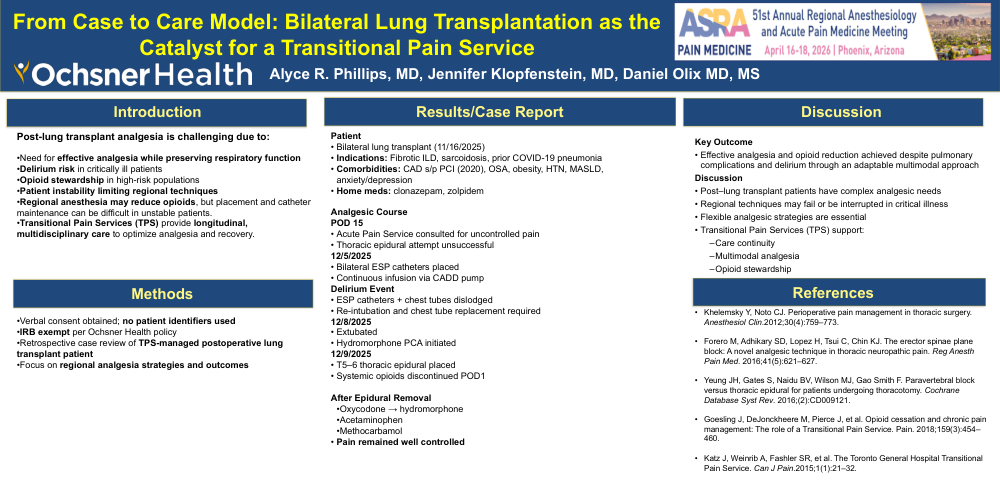
From Case to Care Model: Bilateral Lung Transplantation as the Catalyst for a Transitional Pain Service
Poster Presenter
Authors
Alyce Phillips MD, Jennifer Klopfenstein MD, Daniel Olix MS MD
Affiliations
Part of Topic
Medically Challenging Cases
ABSTRACT: FROM CASE TO CARE MODEL: BILATERAL LUNGTRANSPLANTATION AS THE CATALYST FOR A TRANSITIONAL PAIN SERVICE
Ochsner Health System, Alyce R. Phillips, MD, Jennifer Klopfenstein, MD, Daniel Olix, MD, MS
Introduction
Post-lung transplant analgesia is challenging due to:
Need for effective analgesia while preserving respiratory function
Delirium risk in critically ill patients
Opioid stewardship in high-risk populations
Patient instability limiting regional techniques
Regional anesthesia may reduce opioids, but placement and catheter maintenance can be difficult in unstable patients.
Transitional Pain Services (TPS) provide longitudinal, multidisciplinary care to optimize analgesia and recovery.
Methods
Verbal consent obtained; no patient identifiers used
IRB exempt per Ochsner Health policy
Retrospective case review of TPS-managed postoperative lung transplant patient
Focus on regional analgesia strategies and outcomes
Results/Case Report
Patient
Bilateral lung transplant (11/16/2025)
Indications: Fibrotic ILD, sarcoidosis, prior COVID-19 pneumonia
Comorbidities: CAD s/p PCI (2020), OSA, obesity, HTN, MASLD, anxiety/depression
Home meds: clonazepam, zolpidem
Analgesic Course
POD 15
Acute Pain Service consulted for uncontrolled pain
Thoracic epidural attempt unsuccessful
12/5/2025
Bilateral ESP catheters placed
Continuous infusion via CADD pump
Delirium Event
ESP catheters + chest tubes dislodged
Re-intubation and chest tube replacement required
12/8/2025
Extubated
Hydromorphone PCA initiated
12/9/2025
T5–6 thoracic epidural placed
Systemic opioids discontinued POD1
After Epidural Removal
Oxycodone → hydromorphone
Acetaminophen
Methocarbamol
Pain remained well controlled
Discussion
Key Outcome
Effective analgesia and opioid reduction achieved despite pulmonary complications and delirium through an adaptable multimodal approach
Discussion
Post–lung transplant patients have complex analgesic needs
Regional techniques may fail or be interrupted in critical illness
Flexible analgesic strategies are essential
Transitional Pain Services (TPS) support:Care continuity
Multimodal analgesia
Opioid stewardship
References
Khelemsky Y, Noto CJ. Perioperative pain management in thoracic surgery. Anesthesiol Clin.2012;30(4):759–773.
Forero M, Adhikary SD, Lopez H, Tsui C, Chin KJ. The erector spinae plane block: A novel analgesic technique in thoracic neuropathic pain. Reg Anesth Pain Med. 2016;41(5):621–627.
Yeung JH, Gates S, Naidu BV, Wilson MJ, Gao Smith F. Paravertebral block versus thoracic epidural for patients undergoing thoracotomy. Cochrane Database Syst Rev. 2016;(2):CD009121.
Goesling J, DeJonckheere M, Pierce J, et al. Opioid cessation and chronic pain management: The role of a Transitional Pain Service. Pain. 2018;159(3):454–460.
Katz J, Weinrib A, Fashler SR, et al. The Toronto General Hospital Transitional Pain Service. Can J Pain.2015;1(1):21–32.