372 posters, 1 audios, 13 topics, 29 sessions, 1,035 authors, 449 institutions
ePostersLive by SciGen Technologies S.A. All rights reserved.
51st Annual Regional Anesthesiology and Acute Pain Medicine Meeting
April 16 - 18, 2026 | Phoenix, Arizona

2318166
Clavipectoral Fascial Plane block as a sole anesthetic technique for Midclavicle Surgery
Poster Presenter
Authors
Akshar Tailor, Aishwarya Nedunchezhian, Paul Kim, Arlene Buzon-Tan
Affiliations
Part of Topic
Medically Challenging Cases
Poster text
Introduction
Clavicle fractures represent 2% to 10% of all fractures, with the most easily fractured location being the midshaft of the clavicle (1). Pain management in clavicle surgery remains challenging due to complex sensory innervation to clavicle and clavicular joints by the supraclavicular, subclavian, lateral pectoral nerves. (2). The extensive overlapping pattern of innervation makes complete anesthesia with a single regional block difficult. Currently, superficial cervical plexus block (SCPB) and interscalene brachial plexus block (ISB) are commonly used to provide regional anesthesia for clavicle surgeries. However, ISB is often associated with risk of phrenic nerve blockade leading to hemidiaphragmatic paresis and potential respiratory compromise, while brachial plexus blockade may result in postoperative upper-limb immobility, delaying recovery. The clavipectoral fascial plane block (CFPB) is a novel anesthetic management strategy in which local anesthetic is administered in the anterosuperior region of clavicular periosteum, targeting the terminal sensory branches while sparing motor function and minimizing phrenic nerve involvement (3). This case report evaluates the efficacy and safety of using a standalone CFPB for midshaft clavicle surgery.
Methods
Case: 31 M presenting with mid clavicle fracture following fall from bicycle. Past medical history significant for same side rotator cuff disorder, otherwise healthy.
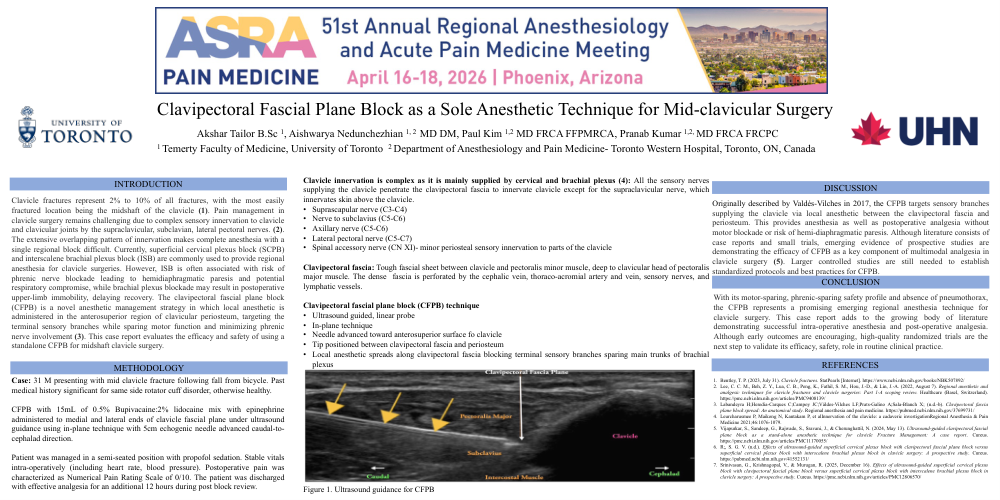
CFPB with 15mL of 0.5% Bupivacaine:2% lidocaine mix with epinephrine administered to medial and lateral ends of clavicle fascial plane under ultrasound guidance using in-plane technique with 5cm echogenic needle advanced caudal-to-cephalad direction.
Patient was managed in a semi-seated position with propofol sedation. Stable vitals intra-operatively (including heart rate, blood pressure). Postoperative pain was characterized as Numerical Pain Rating Scale of 0/10. The patient was discharged with effective analgesia for an additional 12 hours during post block review.
Clavicle innervation is complex as it is mainly supplied by cervical and brachial plexus (4): All the sensory nerves supplying the clavicle penetrate the clavipectoral fascia to innervate clavicle except for the supraclavicular nerve, which innervates skin above the clavicle.
- Suprascapular nerve (C3-C4)
- Nerve to subclavius (C5-C6)
- Axillary nerve (C5-C6)
- Lateral pectoral nerve (C5-C7)
- Spinal accessory nerve (CN XI)- minor periosteal sensory innervation to parts of the clavicle
Clavipectoral fascia: Tough fascial sheet between clavicle and pectoralis minor muscle, deep to clavicular head of pectoralis major muscle. The dense fascia is perforated by the cephalic vein, thoraco-acromial artery and vein, sensory nerves, and lymphatic vessels.
Clavipectoral fascial plane block (CFPB) technique
- Ultrasound guided, linear probe
- In-plane technique
- Needle advanced toward anterosuperior surface fo clavicle
- Tip positioned between clavipectoral fascia and periosteum
- Local anesthetic spreads along clavipectoral fascia blocking terminal sensory branches sparing main trunks of brachial plexus
Discussion
Originally described by Valdés-Vilches in 2017, the CFPB targets sensory branches supplying the clavicle via local anesthetic between the clavipectoral fascia and periosteum. This provides anesthesia as well as postoperative analgesia without motor blockade or risk of hemi-diaphragmatic paresis. Although literature consists of case reports and small trials, emerging evidence of prospective studies are demonstrating the efficacy of CFPB as a key component of multimodal analgesia in clavicle surgery (5). Larger controlled studies are still needed to establish standardized protocols and best practices for CFPB.
Conclusion
With its motor-sparing, phrenic-sparing safety profile and absence of pneumothorax, the CFPB represents a promising emerging regional anesthesia technique for clavicle surgery. This case report adds to the growing body of literature demonstrating successful intra-operative anesthesia and post-operative analgesia. Although early outcomes are encouraging, high-quality randomized trials are the next step to validate its efficacy, safety, role in routine clinical practice.
References
- Bentley, T. P. (2023, July 31). Clavicle fractures. StatPearls [Internet]. https://www.ncbi.nlm.nih.gov/books/NBK507892/
- Lee, C. C. M., Beh, Z. Y., Lua, C. B., Peng, K., Fathil, S. M., Hou, J.-D., & Lin, J.-A. (2022, August 7). Regional anesthetic and analgesic techniques for clavicle fractures and clavicle surgeries: Part 1-A scoping review. Healthcare (Basel, Switzerland). https://pmc.ncbi.nlm.nih.gov/articles/PMC9408139/
- Labandeyra H;Heredia-Carques C;Campoy JC;Váldes-Vilches LF;Prats-Galino A;Sala-Blanch X; (n.d.-b). Clavipectoral fascia plane block spread: An anatomical study. Regional anesthesia and pain medicine. https://pubmed.ncbi.nlm.nih.gov/37699731/
- Leurcharusmee P, Maikong N, Kantakam P, et alInnervation of the clavicle: a cadaveric investigationRegional Anesthesia & Pain Medicine 2021;46:1076-1079.
- Vijapurkar, S., Sandeep, G., Rajwade, S., Sravani, J., & Cherunghattil, N. (2024, May 13). Ultrasound-guided clavipectoral fascial plane block as a stand-alone anesthetic technique for clavicle Fracture Management: A case report. Cureus. https://pmc.ncbi.nlm.nih.gov/articles/PMC11170055/
- R;, S. G. V. (n.d.). Effects of ultrasound-guided superficial cervical plexus block with clavipectoral fascial plane block versus superficial cervical plexus block with interscalene brachial plexus block in clavicle surgery: A prospective study. Cureus. https://pubmed.ncbi.nlm.nih.gov/41552131/
- Srinivasan, G., Krishnagopal, V., & Murugan, R. (2025, December 16). Effects of ultrasound-guided superficial cervical plexus block with clavipectoral fascial plane block versus superficial cervical plexus block with interscalene brachial plexus block in clavicle surgery: A prospective study. Cureus. https://pmc.ncbi.nlm.nih.gov/articles/PMC12806570/