372 posters, 1 audios, 13 topics, 29 sessions, 1,035 authors, 449 institutions
ePostersLive by SciGen Technologies S.A. All rights reserved.
51st Annual Regional Anesthesiology and Acute Pain Medicine Meeting
April 16 - 18, 2026 | Phoenix, Arizona

2318022
Right Sided Stellate Ganglion Catheter for Persistent Electrical Storm in a Patient at High Risk for LAST
Poster Presenter
Part of Topic
Medically Challenging Cases
Right-Sided Stellate Ganglion Catheter for Persistent Electrical Storm in a Patient at High Risk for LAST
INTRODUCTION
The stellate ganglion is implicated in electrical storms that cause ventricular arrhythmias [1].
Left-sided continuous catheter stellate ganglion blocks (SGB) can provide 24 hours of electrical storm cessation [2].
SGB in the presence of ongoing lidocaine infusion can result in local anesthetic systemic toxicity (LAST) [3].
This case report describes a right-sided SGB that provided 48-hour relief from ventricular arrhythmias in a patient with ongoing lidocaine drip.
CASE PRESENTATION
72-year-old male with PMH of combined systolic and diastolic heart failure (NYHA IV), presented after PEA arrest. Hospital course was complicated by recurring ventricular arrhythmias requiring defibrillation.
Lidocaine (1 mg / hour) and amiodarone drips were started to assist with rhythm control.
On day 8 of admission, patient underwent multiple rounds of electrical storms and defibrillation despite anti-arrhythmic therapy.
Regional anesthesia team was consulted for stellate ganglion blockade (SGB) due to refractory arrhythmia
Family consented to SGB despite risk of LAST.
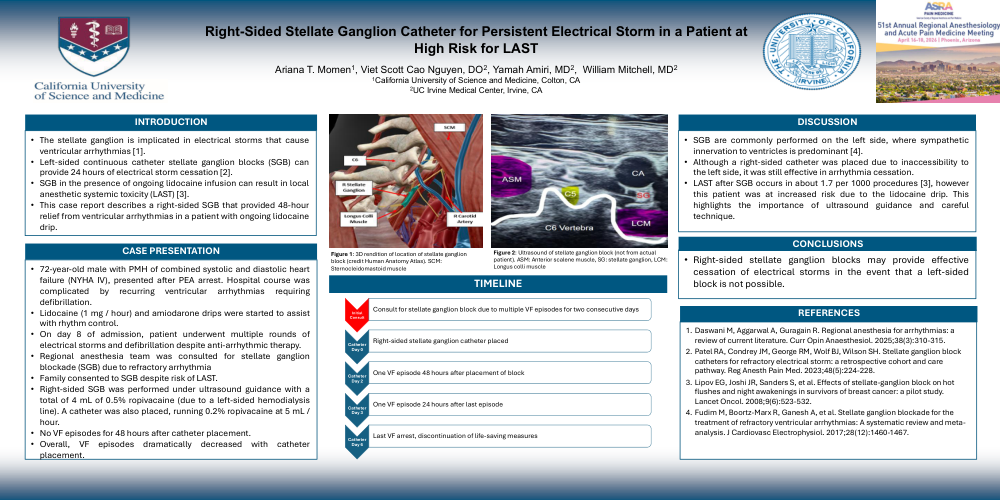
Right-sided SGB was performed under ultrasound guidance with a total of 4 mL of 0.5% ropivacaine (due to a left-sided hemodialysis line). A catheter was also placed, running 0.2% ropivacaine at 5 mL / hour.
No VF episodes for 48 hours after catheter placement.
Overall, VF episodes dramatically decreased with catheter placement.
DISCUSSION
SGB are commonly performed on the left side, where sympathetic innervation to ventricles is predominant [4].
Although a right-sided catheter was placed due to inaccessibility to the left side, it was still effective in arrhythmia cessation.
LAST after SGB occurs in about 1.7 per 1000 procedures [3], however this patient was at increased risk due to the lidocaine drip. This highlights the importance of ultrasound guidance and careful technique.
CONCLUSIONS
Right-sided stellate ganglion blocks may provide effective cessation of electrical storms in the event that a left-sided block is not possible.
REFERENCES
1. Daswani M, Aggarwal A, Guragain R. Regional anesthesia for arrhythmias: a review of current literature. Curr Opin Anaesthesiol. 2025;38(3):310-315.
2. Patel RA, Condrey JM, George RM, Wolf BJ, Wilson SH. Stellate ganglion block catheters for refractory electrical storm: a retrospective cohort and care pathway. Reg Anesth Pain Med. 2023;48(5):224-228.
3. Lipov EG, Joshi JR, Sanders S, et al. Effects of stellate-ganglion block on hot flushes and night awakenings in survivors of breast cancer: a pilot study. Lancet Oncol. 2008;9(6):523-532.
4. Fudim M, Boortz-Marx R, Ganesh A, et al. Stellate ganglion blockade for the treatment of refractory ventricular arrhythmias: A systematic review and meta-analysis. J Cardiovasc Electrophysiol. 2017;28(12):1460-1467.