372 posters, 1 audios, 13 topics, 29 sessions, 1,035 authors, 449 institutions
ePostersLive by SciGen Technologies S.A. All rights reserved.
51st Annual Regional Anesthesiology and Acute Pain Medicine Meeting
April 16 - 18, 2026 | Phoenix, Arizona

2317854
Case Study: Lumbar Plexus Block Performed with Sensory Nerve Stimulation
Poster Presenter
Authors
Affiliations
Part of Topic
Medically Challenging Cases
INTRODUCTION:
We present the successful placement of a pre-operative lumbar plexus block using ultrasound guidance and sensory nerve stimulation, rather than the classic femoral nerve motor response, in a patient with recent hip disarticulation.
CASE DESCRIPTION:
HPI: 52-year-old woman (ASA 3) status post recent hip disarticulation for sarcoma was scheduled for deep surgical debridement due to wound infection and dehiscence. She was obese with BMI 35 and opioid tolerant on 540 OME daily. She preferred to avoid neuraxial anesthesia.
Anesthetic Plan: GA ETT with pre-operative lumbar plexus block for post-operative pain. Distal block (obturator, femoral, lateral cutaneous) was contraindicated due to infection within the amputated stump.
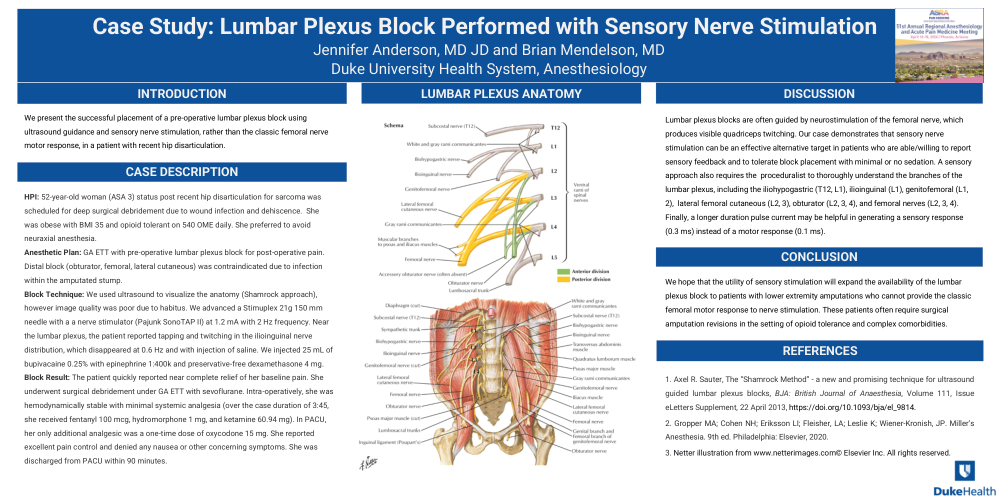
Block Technique: We used ultrasound to visualize the anatomy (Shamrock approach), however image quality was poor due to habitus. We advanced a Stimuplex 21g 150 mm needle with a a nerve stimulator (Pajunk SonoTAP II) at 1.2 mA with 2 Hz frequency. Near the lumbar plexus, the patient reported tapping and twitching in the ilioinguinal nerve distribution, which disappeared at 0.6 Hz and with injection of saline. We injected 25 mL of bupivacaine 0.25% with epinephrine 1:400k and preservative-free dexamethasone 4 mg.
Block Result: The patient quickly reported near complete relief of her baseline pain. She underwent surgical debridement under GA ETT with sevoflurane. Intra-operatively, she was hemodynamically stable with minimal systemic analgesia (over the case duration of 3:45, she received fentanyl 100 mcg, hydromorphone 1 mg, and ketamine 60.94 mg). In PACU, her only additional analgesic was a one-time dose of oxycodone 15 mg. She reported excellent pain control and denied any nausea or other concerning symptoms. She was discharged from PACU within 90 minutes.
DISCUSSION:
Lumbar plexus blocks are often guided by neurostimulation of the femoral nerve, which produces visible quadriceps twitching. Our case demonstrates that sensory nerve stimulation can be an effective alternative target in patients who are able/willing to report sensory feedback and to tolerate block placement with minimal or no sedation. A sensory approach also requires the proceduralist to thoroughly understand the branches of the lumbar plexus, including the iliohypogastric (T12, L1), ilioinguinal (L1), genitofemoral (L1, L2), lateral femoral cutaneous (L2, 3), obturator (L2, 3, 4), and femoral nerves (L2, 3, 4). Finally, a longer duration pulse current may be helpful in generating a sensory response (0.3 ms) instead of a motor response (0.1 ms).
CONCLUSION:
We hope that the utility of sensory stimulation will expand the availability of the lumbar plexus block to patients with lower extremity amputations who cannot provide the classic femoral motor response to nerve stimulation. These patients often require surgical amputation revisions in the setting of opioid tolerance and complex comorbidities.
REFERENCES:
1. Axel R. Sauter, The “Shamrock Method” - a new and promising technique for ultrasound guided lumbar plexus blocks, BJA: British Journal of Anaesthesia, Volume 111, Issue eLetters Supplement, 22 April 2013, https://doi.org/10.1093/bja/el_9814.
2. Gropper MA; Cohen NH; Eriksson LI; Fleisher, LA; Leslie K; Wiener-Kronish, JP. Miller’s Anesthesia. 9th ed. Philadelphia: Elsevier, 2020.
3. Netter illustration from www.netterimages.com© Elsevier Inc. All rights reserved