372 posters, 1 audios, 13 topics, 29 sessions, 1,035 authors, 449 institutions
ePostersLive by SciGen Technologies S.A. All rights reserved.
51st Annual Regional Anesthesiology and Acute Pain Medicine Meeting
April 16 - 18, 2026 | Phoenix, Arizona

2317433
Bilateral External Oblique Intercostal Blocks for Bilateral Lung Transplant Pain Management in Anticoagulated Patient on VV-ECMO
Poster Presenter
Authors
Fatima Serhan, Dennis DJ Jr. Warfield, Sindhu R. Nimma, Hari K. Kalagara
Affiliations
Part of Topic
Medically Challenging Cases
Medically challenging case
Title: Bilateral External Oblique Intercostal Blocks for Bilateral Lung Transplant Pain Management in Anticoagulated Patient on VV-ECMO
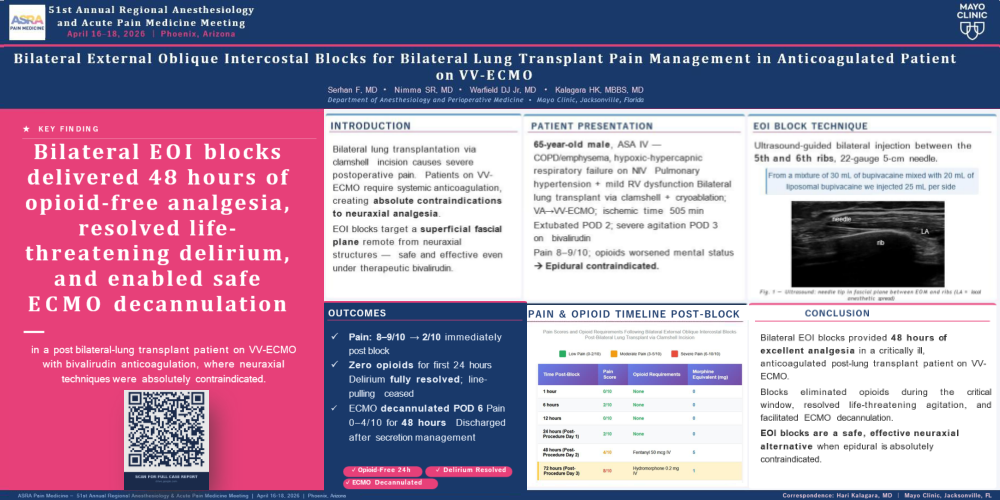
Bilateral lung transplantation via clamshell incision causes severe postoperative pain impairing respiratory recovery (1). Multimodal analgesia relies on regional anesthetic techniques (2). Patients often require VV-ECMO with systemic anticoagulation, creating absolute contraindications to neuraxial techniques (1). While epidural analgesia remains the gold standard for major thoracic surgery (3), External Oblique Intercostal (EOI) blocks offer effective truncal analgesia with favorable safety in anticoagulated patients, performed in a superficial fascial plane distant from neuraxial structures (4).
As the case report is devoid of patient identifiable information, it is exempt from IRB review requirements as per Mayo Clinic policy.
Patient informed consent was obtained via telephone, and data were collected through electronic medical record review from postoperative day (POD) 0 through day 7.
A 65-year-old male (ASA IV) with COPD/emphysema, hypoxic-hypercapnic respiratory failure on non-invasive ventilation, pulmonary hypertension, and mild right ventricular dysfunction underwent bilateral lung transplantation via clamshell incision with intercostal nerve cryoablation. The procedure involved veno-arterial ECMO converted to veno-venous ECMO (VV-ECMO), with total ischemic time of 505 minutes.
Postoperatively, he was successfully extubated on POD 2 but developed severe agitation on POD 3 while still on VV-ECMO and bivalirudin anticoagulation. Opioids worsened his mental status, limiting pain management options. Pain scores reached 8-9/10, and agitation caused dangerous line-pulling behavior.
Epidural analgesia was contraindicated due to bivalirudin and ECMO, instead we performed bilateral external oblique intercostal (EOI) block. Using ultrasound guidance and a 22-gauge 5-cm needle — from a mixture of 30 mL of bupivacaine mixed with 20 mL of liposomal bupivacaine — we injected 25 mL per side, after negative aspiration, targeting the fascial plane between the 5th and 6th ribs.
Pain improved dramatically to 2/10 at rest post-block. Delirium resolved and line-pulling ceased. VV-ECMO was decannulated on POD 6. Pain remained controlled (0-4/10) for 48 hours with minimal opioids. Pain recurred on post-procedure day 6, but respiratory function remained stable. He was discharged after secretion management, and chest tube removal.
Bilateral EOI nerve block with liposomal bupivacaine provided 48 hours of excellent analgesia in this critically ill lung transplant patient on VV-ECMO with therapeutic anticoagulation. The blocks eliminated opioid requirements during the critical early period, resolved life-threatening delirium and agitation, and facilitated successful ECMO decannulation. This case highlights EOI blocks as a safe, effective alternative to neuraxial techniques in post-lung transplant patients with absolute epidural contraindications.
1. Ander M, Mugve N, Crouch C, Kassel C, Fukazawa K, Izaak R, et al. Regional anesthesia for transplantation surgery - A white paper part 1: Thoracic transplantation surgery. Clin Transplant. 2023 Aug;37(8):e15043.
2. Yang M, Zhang X, Liu G, Zhang X, Yan W, Zhang D. Regional Analgesia Techniques Following Thoracic Surgery: A Systematic Review and Network Meta-analysis. Pain Physician. 2024 Nov;27(8):E803–18.
3. Elsharkawy H, Kolli S, Soliman LM, Seif J, Drake RL, Mariano ER, et al. The External Oblique Intercostal Block: Anatomic Evaluation and Case Series. Pain Med. 2021 Nov 26;22(11):2436–42.
4. Erskine RN, White L. A review of the external oblique intercostal plane block - a novel approach to analgesia for upper abdominal surgery. J Clin Anesth. 2022 Nov;82:110953.