372 posters, 1 audios, 13 topics, 29 sessions, 1,035 authors, 449 institutions
ePostersLive by SciGen Technologies S.A. All rights reserved.
51st Annual Regional Anesthesiology and Acute Pain Medicine Meeting
April 16 - 18, 2026 | Phoenix, Arizona

2316646
Case Report: Femoral & Lateral Femoral Cutaneous Nerve Injuries During Kidney Transplant
Poster Presenter
Authors
Affiliations
Part of Topic
Medically Challenging Cases
INTRODUCTION:
Femoral and lateral femoral cutaneous nerve injuries are under-recognized potential complications of kidney transplant surgery that can develop due to intra-operative ischemic compression or direct vascular injury. These neuropathies may be misattributed to neuraxial or peripheral nerve blocks provided for the transplant, which can undermine surgeon and patientconfidence in the safety of these techniques, delay appropriate treatment, and bring unwarranted legal liability to the anesthesia team.
CASE DESCRIPTION:
PMH/PSH: A 63M (ASA III) with ESRD due to ANCA vasculitis was posted for kidney transplant, with surgical history notable for prior inguinal hernia repair.
Anesthetic Plan: CSE at L2-3 with bupivacaine 0.5% and ultrasound-guided TAP block with liposomal bupivacaine 266 mg and bupivacaine 0.5%.
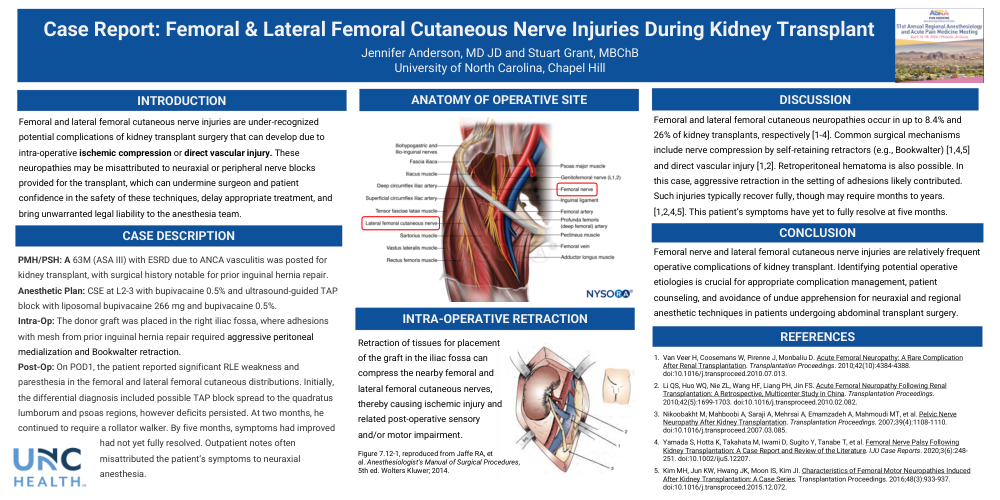
Intra-Op: The donor graft was placed in the right iliac fossa, where adhesions with mesh from prior inguinal hernia repair required aggressive peritoneal medialization and Bookwalter retraction.
Post-Op: On POD1, the patient reported significant RLE weakness and paresthesia in the femoral and lateral femoral cutaneous distributions. Initially, the differential diagnosis included possible TAP block spread to the quadratus lumborum and psoas regions, however deficits persisted. At two months, he continued to require a rollator walker. By five months, symptoms had improved but had not yet fully resolved. Outpatient notes often misattributed the patient’s symptoms to neuraxial anesthesia.
INTRA-OPERATIVE RETRACTION:
Retraction of tissues for placement of the graft in the iliac fossa can compress the nearby femoral and lateral femoral cutaneous nerves, thereby causing ischemic injury and related post-operative sensory and/or motor impairment.
CONCLUSION:
Femoral nerve and lateral femoral cutaneous nerve injuries are relatively frequent operative complications of kidney transplant. Identifying potential operative etiologies is crucial for appropriate complication management, patient counseling, and avoidance of undue apprehension for neuraxial and regional anesthetic techniques in patients undergoing abdominal transplant surgery.
REFERENCES:
1. Van Veer H, Coosemans W, Pirenne J, Monbaliu D. Acute Femoral Neuropathy: A Rare Complication After Renal Transplantation. Transplantation Proceedings. 2010;42(10):4384-4388. doi:10.1016/j.transproceed.2010.07.013.
2. Li QS, Huo WQ, Nie ZL, Wang HF, Liang PH, Jin FS. Acute Femoral Neuropathy Following Renal Transplantation: A Retrospective, Multicenter Study in China. Transplantation Proceedings. 2010;42(5):1699-1703. doi:10.1016/j.transproceed.2010.02.082.
3. Nikoobakht M, Mahboobi A, Saraji A, Mehrsai A, Emamzadeh A, Mahmoudi MT, et al. Pelvic Nerve Neuropathy After Kidney Transplantation. Transplantation Proceedings. 2007;39(4):1108-1110. doi:10.1016/j.transproceed.2007.03.085.
4. Yamada S, Hotta K, Takahata M, Iwami D, Sugito Y, Tanabe T, et al. Femoral Nerve Palsy Following Kidney Transplantation: A Case Report and Review of the Literature. IJU Case Reports. 2020;3(6):248-251. doi:10.1002/iju5.12207.
5. Kim MH, Jun KW, Hwang JK, Moon IS, Kim JI. Characteristics of Femoral Motor Neuropathies Induced After Kidney Transplantation: A Case Series. Transplantation Proceedings. 2016;48(3):933-937. doi:10.1016/j.transproceed.2015.12.072.