372 posters, 1 audios, 13 topics, 29 sessions, 1,035 authors, 449 institutions
ePostersLive by SciGen Technologies S.A. All rights reserved.
51st Annual Regional Anesthesiology and Acute Pain Medicine Meeting
April 16 - 18, 2026 | Phoenix, Arizona

2316369
Perioperative Regional Anesthesia Considerations in a Patient With Hereditary Angioedema Undergoing Orthopedic Surgery
Poster Presenter
Authors
Affiliations
Part of Topic
Medically Challenging Cases
Background
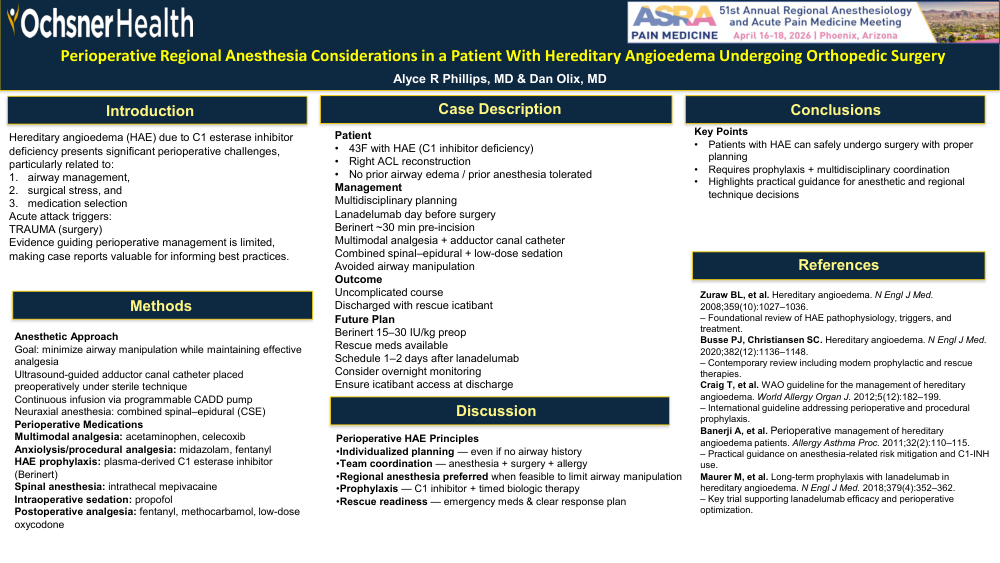
Hereditary angioedema (HAE) due to C1 esterase inhibitor deficiency poses unique perioperative challenges, particularly related to airway management, surgical stress, and medication selection. Acute HAE attacks may be triggered by trauma, procedural interventions, and physiologic stress, making anesthetic and regional anesthesia planning critical. Evidence guiding perioperative management remains limited, and case-based experiences contribute meaningfully to best practices.
Materials and Methods
Regional anesthetic techniques and perioperative management were planned with the goal of minimizing airway manipulation while ensuring effective analgesia. An ultrasound-guided adductor canal catheter was placed in the preoperative area using a standard catheter kit under sterile technique. Continuous peripheral nerve block infusion was delivered via a programmable CADD pump.
Neuraxial anesthesia was performed using a combined spinal–epidural (CSE) technique with a standard CSE kit. Medications administered included acetaminophen and celecoxib as part of preoperative multimodal analgesia; midazolam and fentanyl for anxiolysis and procedural analgesia during catheter placement; plasma-derived C1 esterase inhibitor (Berinert) for HAE prophylaxis; intrathecal mepivacaine for spinal anesthesia; propofol for intraoperative sedation; and fentanyl, methocarbamol, and low-dose oxycodone for postoperative analgesia.
Case Description
A 43-year-old female with hereditary angioedema (HAE) due to C1 esterase inhibitor deficiency, anemia, migraines, and prior orthopedic surgery presented for perioperative anesthetic management for right knee anterior cruciate ligament (ACL) reconstruction. She had no history of laryngeal edema and had previously tolerated anesthesia without perioperative complications.
Preoperatively, an in-depth multidisciplinary discussion was held with the patient and her treating allergist to optimize safety. Her long-acting prophylactic therapy, lanadelumab (Takhzyro), was intentionally administered the day prior to surgery. In the preoperative area, she received standard multimodal analgesia with acetaminophen and celecoxib. Midazolam and fentanyl were administered to facilitate ultrasound-guided adductor canal catheter placement. As additional HAE prophylaxis, weight-based plasma-derived C1 esterase inhibitor (Berinert) was administered intravenously approximately 30 minutes prior to incision.
Anesthetic management consisted of a combined spinal–epidural technique using 45 mg of intrathecal mepivacaine with a low-dose propofol infusion for sedation, avoiding airway manipulation. The procedure was completed uneventfully without evidence of angioedema.
In the post-anesthesia care unit, she received fentanyl for posterior knee pain, methocarbamol, and low-dose oxycodone. After approximately two hours of observation without airway compromise or HAE flare, she was discharged home with access to rescue icatibant.
Perioperative Planning and Recommendations
Based on multidisciplinary correspondence and specialist guidance, the following perioperative strategy was recommended for future procedures:
- Preprocedural prophylaxis: Administration of plasma-derived C1 esterase inhibitor (Berinert) at a dose of 15–30 IU/kg within one hour prior to the procedure.
- Rescue preparedness: Availability of at least two additional doses of Berinert intraoperatively and during the postoperative inpatient period.
- Optimization of baseline therapy: Scheduling surgery within one week of the most recent lanadelumab injection, preferably 1–2 days following administration rather than immediately prior to the next dose.
- Postoperative monitoring: Consideration of overnight observation at a facility with otolaryngology availability.
- Discharge planning: Ensuring the patient has immediate access to and is capable of self-administering icatibant upon discharge if inpatient observation is not feasible.
Discussion
This case highlights the importance of individualized perioperative planning for patients with HAE, even in the absence of prior airway involvement. Coordination among anesthesia, surgical, and allergy/immunology teams is essential to mitigate risk. Regional anesthesia techniques may offer advantages by reducing airway manipulation; however, preparedness for acute angioedema remains paramount regardless of anesthetic modality. Prophylactic C1 esterase inhibitor administration, thoughtful surgical timing relative to long-acting prophylaxis, and robust rescue planning represent key risk-reduction strategies.
Conclusion
Patients with hereditary angioedema can safely undergo orthopedic procedures with careful perioperative planning, prophylaxis, and multidisciplinary coordination. This case underscores practical strategies that may inform anesthetic management and regional anesthesia decision-making in this high-risk population.
References
- Zuraw BL, et al. Hereditary angioedema. N Engl J Med. 2008;359(10):1027–1036.
– Foundational review of HAE pathophysiology, triggers, and treatment. - Busse PJ, Christiansen SC. Hereditary angioedema. N Engl J Med. 2020;382(12):1136–1148.
– Contemporary review including modern prophylactic and rescue therapies. - Craig T, et al. WAO guideline for the management of hereditary angioedema. World Allergy Organ J. 2012;5(12):182–199.
– International guideline addressing perioperative and procedural prophylaxis. - Banerji A, et al. Perioperative management of hereditary angioedema patients. Allergy Asthma Proc. 2011;32(2):110–115.
– Practical guidance on anesthesia-related risk mitigation and C1-INH use. - Maurer M, et al. Long-term prophylaxis with lanadelumab in hereditary angioedema. N Engl J Med. 2018;379(4):352–362.
– Key trial supporting lanadelumab efficacy and perioperative optimization.