372 posters, 1 audios, 13 topics, 29 sessions, 1,035 authors, 449 institutions
ePostersLive by SciGen Technologies S.A. All rights reserved.
51st Annual Regional Anesthesiology and Acute Pain Medicine Meeting
April 16 - 18, 2026 | Phoenix, Arizona

2316333
Transversalis fascia plane rescue block for iliac crest bone harvest pain in PACU after ankle surgery: patient perspective
Poster Presenter
Authors
Affiliations
Part of Topic
Medically Challenging Cases
Introduction
Iliac crest bone graft harvest(ICBGH) is a common component of foot and ankle reconstruction. The harvest site is innervated by branches of the subcostal(T12), iliohypogastric, and ilioinguinal(L1) nerves.[1,2] Iliac crest pain can be a major source of postoperative discomfort, opioid use, and prolonged PACU stay, even when primary surgical site pain is well-controlled.[3,4] The transversalis fascia plane(TFP) block targets the nerves innervating the iliac crest and has emerged as a promising technique for donor-site analgesia.[2,4]
Materials and Methods
The patient provided informed consent for publication. Because no identifiable information is included, this report is exempt from institutional review under UNC policy.
Results/Case Report
A 48-year-old woman with depression, anxiety, fibromyalgia, chronic pain, and opioid-dependence underwent revision subtalar arthrodesis with ICBGH. Her history included two prior ankle surgeries with ICBGH. Both times she reported that popliteal nerve blocks provided excellent lower-extremity analgesia, but failed to address severe postoperative ICBGH pain.
For the current case, a popliteal nerve block was performed preoperatively. In PACU, the patient reported 0/10 pain in the foot, but 8/10 pain at the iliac crest, which she described as “very similar” to her prior surgeries.
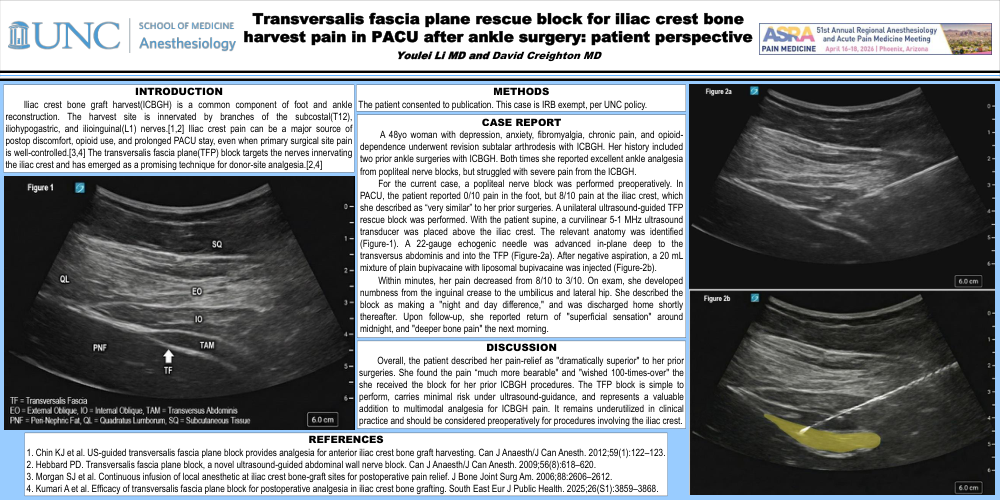
A unilateral ultrasound-guided TFP rescue block was performed. With the patient supine, a curvilinear 5-1MHz ultrasound transducer was placed above the iliac crest. The relevant anatomy was identified(Figure-1). A 22-gauge echogenic needle was advanced in-plane deep to the transversus abdominis and into the TFP(Figure-2a). After negative aspiration, a 20mL mixture of plain bupivacaine with liposomal bupivacaine was injected(Figure-2b).
Within minutes, her pain decreased from 8/10 to 3/10. On exam, she developed numbness from the inguinal crease to the umbilicus and lateral hip. She described the block as making a "night and day difference," and was discharged home shortly thereafter. Upon follow-up, she reported return of "superficial sensation" around midnight, and "deeper bone pain" the next morning.
Discussion
Overall, the patient described her pain-relief as "dramatically superior" to her prior surgeries. She found the pain “much more bearable" and "wished 100-times-over" the she received the block for her prior ICBGH procedures.
The TFP block is simple to perform, carries minimal risk under ultrasound-guidance, and represents a valuable addition to multimodal analgesia for ICBGH pain. It remains underutilized in clinical practice and should be considered preoperatively for any procedure involving the iliac crest.
References
- Chin KJ, Chan V, Hebbard P, Tan JS, Harris M, Factor D. Ultrasound-guided transversalis fascia plane block provides analgesia for anterior iliac crest bone graft harvesting. Can J Anaesth/J Can Anesth. 2012;59(1):122–123. doi:10.1007/s12630-011-9610-7.
- Hebbard PD. Transversalis fascia plane block, a novel ultrasound-guided abdominal wall nerve block. Can J Anaesth/J Can Anesth. 2009;56(8):618–620. doi:10.1007/s12630-009-9110-1
- Morgan SJ, Jeray KJ, Saliman LH, Miller HJ, Williams AE, Tanner SL, et al. Continuous infusion of local anesthetic at iliac crest bone-graft sites for postoperative pain relief: a randomized, double-blind study. J Bone Joint Surg Am. 2006;88:2606–2612. doi:10.2106/JBJS.E.00984.
- Kumari A, Kumar J, Kumar A, Swati, Raghwendra KHR. Efficacy of transversalis fascia plane block for postoperative analgesia in iliac crest bone grafting: a triple blind, prospective randomized study. South East Eur J Public Health. 2025;26(S1):3859–3868.