372 posters, 1 audios, 13 topics, 29 sessions, 1,035 authors, 449 institutions
ePostersLive by SciGen Technologies S.A. All rights reserved.
51st Annual Regional Anesthesiology and Acute Pain Medicine Meeting
April 16 - 18, 2026 | Phoenix, Arizona

2316269
Lumbar Drain: Spinal Cord Protection at a Price
Poster Presenter
Authors
Affiliations
Part of Topic
Medically Challenging Cases
Abstract Title: Lumbar Drain: Spinal Cord Protection at a Price
Introduction
Thoracoabdominal aortic surgery carries the risk of spinal cord ischemia (SCI) and subsequent paraplegia. Lumbar drain (LD) can reduce the risk of SCI by improving spinal cord perfusion pressure; however, it carries a high risk of neuraxial hematoma in this patient population. Balancing the benefits/risks is often challenging. We present a case of a patient in whom a lumbar drain was placed in the setting of SCI and alteplase administration.
Materials and Methods
The information was obtained by reviewing the patient’s chart. The patient died six months after being discharged from the hospital due to an unrelated cause, and the next of kin could not be reached to obtain informed consent. No patient-identifying information was included in the case report, and IRB approval was not required.
Results/Case Report
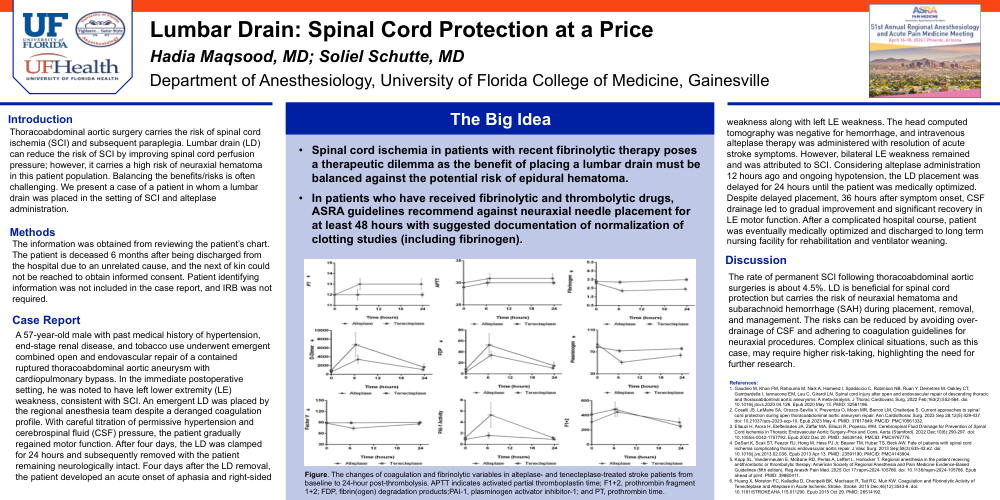
A 57-year-old male with past medical history of hypertension, end-stage renal disease, and tobacco use underwent emergent combined open and endovascular repair of a contained ruptured thoracoabdominal aortic aneurysm with cardiopulmonary bypass. In the immediate postoperative setting, he was noted to have left lower extremity (LE) weakness, consistent with SCI. An emergent LD was placed by the regional anesthesia team despite a deranged coagulation profile. With careful titration of permissive hypertension and cerebrospinal fluid (CSF) pressure, the patient gradually regained motor function. After four days, the LD was clamped for 24 hours and subsequently removed with the patient remaining neurologically intact. Four days after the LD removal, the patient developed an acute onset of aphasia and right-sided weakness along with left LE weakness. The head computed tomography was negative for hemorrhage, and intravenous alteplase therapy was administered with resolution of acute stroke symptoms. However, bilateral LE weakness remained and was attributed to SCI. Considering alteplase administration 12 hours ago and ongoing hypotension, the LD placement was delayed for 24 hours until the patient was medically optimized. Despite delayed placement, 36 hours after symptom onset, CSF drainage led to gradual improvement and significant recovery in LE motor function.
Discussion
The rate of permanent SCI following thoracoabdominal aortic surgeries is about 4.5%. LD is beneficial for spinal cord protection but carries the risk of neuraxial hematoma and subarachnoid hemorrhage (SAH) during placement, removal, and management. The risks can be reduced by avoiding over-drainage of CSF and adhering to coagulation guidelines for neuraxial procedures. Complex clinical situations, such as this case, may require higher risk-taking, highlighting the need for further research.