372 posters, 1 audios, 13 topics, 29 sessions, 1,035 authors, 449 institutions
ePostersLive by SciGen Technologies S.A. All rights reserved.
51st Annual Regional Anesthesiology and Acute Pain Medicine Meeting
April 16 - 18, 2026 | Phoenix, Arizona

2316088
“Double Quarter Turn of the Head and Plumb Bob from the Corner”: A Novel Landmark-Based Approach for Pterygopalatine Fossa Block.
Poster Presenter
Authors
Affiliations
Part of Topic
Medically Challenging Cases
“Double Quarter Turn of the Head and Plumb Bob from the Corner”: A Novel Landmark-Based Approach for Pterygopalatine Fossa Block.
Introduction
Pterygopalatine fossa block (PPFB) is used across a wide range of procedures involving V2-innervated structures, management of primary vascular headaches and post–dural puncture headaches and less frequently, for ophthalmic procedures and as part of scalp blocks for craniotomy. Multiple landmark-based and ultrasound-guided (USG) approaches to PPFB have been described. However, the optimal technique remains undetermined. During a series of USG PPFBs, we identified recurring technical patterns and came up with a simplified, reproducible landmark-based method.
Materials and Methods
Informed consent was obtained from the patient’s mother for submission of case report as patient is a minor. Patient identifying information was not included, therefore no IRB review was required.
Results/Case Report
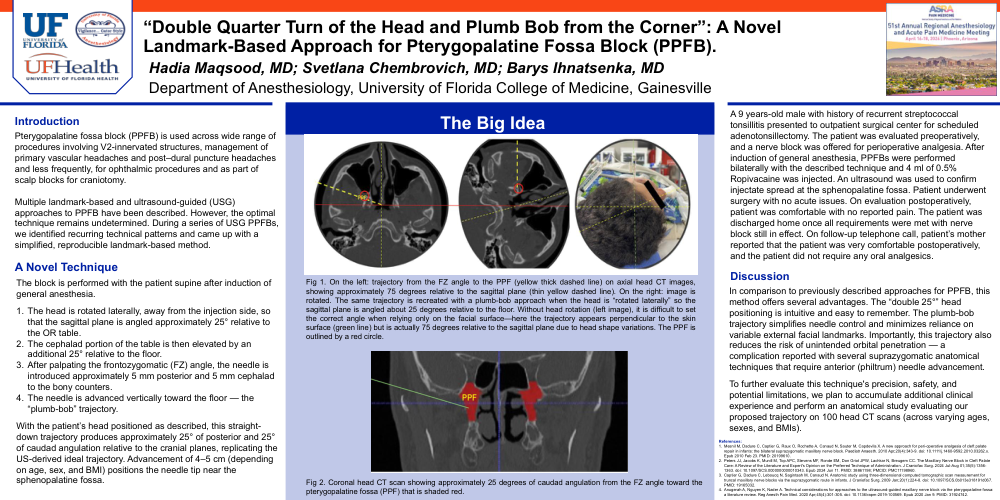
A 9 year-old male with history of recurrent streptococcal tonsillitis presented to outpatient surgical center for scheduled adenotonsillectomy. The patient was seen in the preoperative area and a nerve block was offered for perioperative analgesia. After induction of general anesthesia, PPFBs were performed bilaterally with the patient in supine position. The head was rotated laterally, away from the injection side, so that the sagittal plane was angled approximately 25° relative to the operating table. The cephalad portion of the table was then elevated by an additional 25° relative to the floor. After palpating the frontozygomatic angle, the needle was introduced approximately 5mm posterior and 5mm cephalad to the bony counters. Needle was advanced 4-5 cm vertically toward the floor — the “plumb-bob” trajectory. 4 ml of 0.5% Ropivacaine was injected and an ultrasound was used to confirm injectate spread at the sphenopalatine fossa. Patient underwent surgery with no acute issues. On evaluation postoperatively, patient was comfortable with no reported pain. The patient was discharged home once all requirements were met with nerve block still in effect. On follow-up telephone call, patient’s mother reported that the block lasted for three days postoperatively, and the patient did not require any oral analgesics.
Discussion
In comparison to previously described approaches for PPFB, the method that we are suggesting offers several advantages. The “double 25°” head positioning is intuitive and easy to remember. The plumb-bob trajectory simplifies needle control and minimizes reliance on variable external facial landmarks. Importantly, this trajectory also reduces the risk of unintended orbital penetration — a complication reported with several suprazygomatic anatomical techniques that require anterior (philtrum) needle advancement.
References
- Mesnil M, Dadure C, Captier G, Raux O, Rochette A, Canaud N, Sauter M, Capdevila X. A new approach for peri-operative analgesia of cleft palate repair in infants: the bilateral suprazygomatic maxillary nerve block. Paediatr Anaesth. 2010 Apr;20(4):343-9. doi: 10.1111/j.1460-9592.2010.03262.x. Epub 2010 Feb 23. PMID: 20199610.
- Peters JJ, Jacobs K, Munill M, Top APC, Stevens MF, Ronde EM, Don Griot JPW, Lachkar N, Breugem CC. The Maxillary Nerve Block in Cleft Palate Care: A Review of the Literature and Expert's Opinion on the Preferred Technique of Administration. J Craniofac Surg. 2024 Jul-Aug 01;35(5):1356-1363. doi: 10.1097/SCS.0000000000010343. Epub 2024 Jun 11. PMID: 38861198; PMCID: PMC11198960.
- Captier G, Dadure C, Leboucq N, Sagintaah M, Canaud N. Anatomic study using three-dimensional computed tomographic scan measurement for truncal maxillary nerve blocks via the suprazygomatic route in infants. J Craniofac Surg. 2009 Jan;20(1):224-8. doi: 10.1097/SCS.0b013e318191d067. PMID: 19165032.
- Anugerah A, Nguyen K, Nader A. Technical considerations for approaches to the ultrasound-guided maxillary nerve block via the pterygopalatine fossa: a literature review. Reg Anesth Pain Med. 2020 Apr;45(4):301-305. doi: 10.1136/rapm-2019-100569. Epub 2020 Jan 9. PMID: 31924742.
- Kini YK, Kharkar VR, Kini AY. Transient diplopia with ipsilateral abducent nerve palsy and ptosis following a maxillary local anesthetic injection: a case report and review of literature. Oral Maxillofac Surg. 2012 Dec;16(4):373-5. doi: 10.1007/s10006-011-0304-7. Epub 2011 Nov 12. PMID: 22076250.