Loading...

372 posters, 1 audios, 13 topics, 29 sessions, 1,035 authors, 449 institutions

ePostersLive by SciGen Technologies S.A. All rights reserved.

2316087

Chest Wall Blocks as Anesthetic Adjuncts in Oncologic Surgery for High-Risk Patients
Part of Topic

Medically Challenging Cases

Introduction

- Breast oncologic surgery can contribute to significant intraoperative nociceptive and sympathetic activation.

- High-risk cardiac patients are vulnerable to hemodynamic instability and surgical stress response.

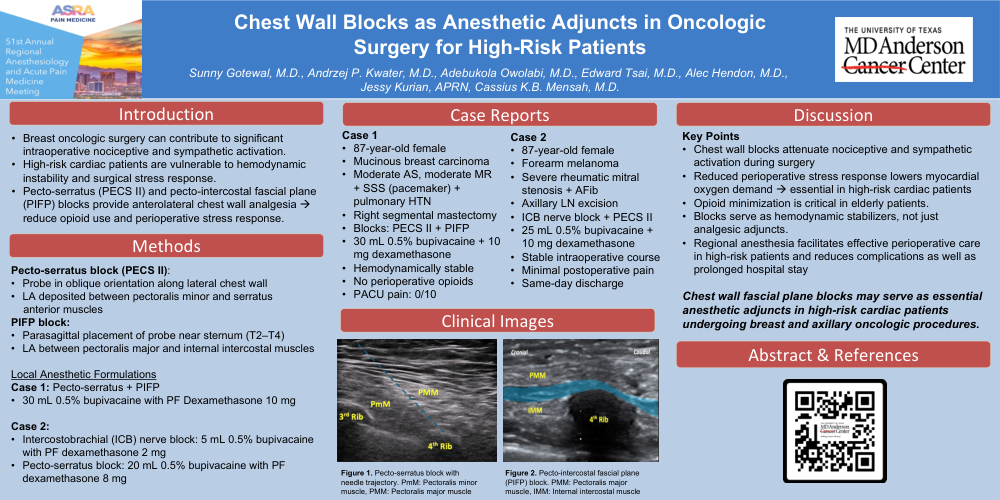
- Pecto-serratus (PECS II) and pecto-intercostal fascial plane (PIFP) blocks provide anterolateral chest wall analgesia à reduce opioid use and perioperative stress response.

Methods

Pecto-serratus block (PECS II):

- Probe in oblique orientation along lateral chest wall
- LA deposited between pectoralis minor and serratus anterior muscles

PIFP block:

- Parasagittal placement of probe near sternum (T2–T4)
- LA between pectoralis major and internal intercostal muscles 

Local Anesthetic Formulations

Case 1: Pecto-serratus + PIFP

- 30 mL 0.5% bupivacaine with PF Dexamethasone 10 mg

Case 2:

- Intercostobrachial (ICB) nerve block: 5 mL 0.5% bupivacaine with PF dexamethasone 2 mg
- Pecto-serratus block: 20 mL 0.5% bupivacaine with PF dexamethasone 8 mg
 

Case Reports

Case 1

- 87-year-old female
- Mucinous breast carcinoma
- Moderate AS, moderate MR + SSS (pacemaker) + pulmonary HTN
- Right segmental mastectomy
- Blocks: PECS II + PIFP
- 30 mL 0.5% bupivacaine + 10 mg dexamethasone
- Hemodynamically stable
- No perioperative opioids
- PACU pain: 0/10

Case 2

- 87-year-old female
- Forearm melanoma
- Severe rheumatic mitral stenosis + AFib
- Axillary LN excision
- ICB nerve block + PECS II
- 25 mL 0.5% bupivacaine + 10 mg dexamethasone
- Stable intraoperative course
- Minimal postoperative pain
- Same-day discharge
 
Discussion

Key Points

- Chest wall blocks attenuate nociceptive and sympathetic activation during surgery
- Reduced perioperative stress response lowers myocardial oxygen demand à essential in high-risk cardiac patients
- Opioid minimization is critical in elderly patients.
- Blocks serve as hemodynamic stabilizers, not just analgesic adjuncts.
- Regional anesthesia facilitates effective perioperative care in high-risk patients and reduces complications as well as prolonged hospital stay

Chest wall fascial plane blocks may serve as essential anesthetic adjuncts in high-risk cardiac patients undergoing breast and axillary oncologic procedures.


asraspring2026 banner
Copyright © 2015-2026, ePostersLive® SciGen is a registered trademark of SciGen Technologies S.A. Patent pending.

This website and third-party tools we use rely on cookies for the best user experience. By selecting "I agree", you agree to cookie usage as described in our Privacy Policy.
