372 posters, 1 audios, 13 topics, 29 sessions, 1,035 authors, 449 institutions
ePostersLive by SciGen Technologies S.A. All rights reserved.
51st Annual Regional Anesthesiology and Acute Pain Medicine Meeting
April 16 - 18, 2026 | Phoenix, Arizona

2315901
Balancing Analgesia and Infection Risk: A Case of a femoral nerve catheter infection in an immunocompromised patient
Poster Presenter
Authors
Erika Taco Vasquez, Alisha Shah, Paola Nathaly Silva Enriquez
Affiliations
Part of Topic
Medically Challenging Cases
Title: Balancing Analgesia and Infection Risk: A Case of a femoral nerve catheter infection in an immunocompromised patient
Co-Author Details:
● Erika Taco-Vasquez, MD
o Co-author and presenting author
o Email: Etacovasquez@ufl.edu
● Alisha Shah, MD
o Co-author
o Email: ashah@anest.ufl.edu
● Paola Nathaly Silva Enriquez, MD
o Co-author
o Email: psilvaenriquez@anest.ufl.edu
Abstract Body
Introduction:
Continuous femoral nerve catheters provide effective postoperative analgesia but carry a risk of bacterial colonization and infection, particularly when used in high-risk patients. This case is focused on femoral catheter–associated soft tissue infection in a patient with multiple infection-predisposing factors including cancer, MRSA colonization, acute deep femoral venous thrombosis. We want to discuss when not proceeding with a nerve catheter placement when the infection risk outweighs the benefits.
Materials and Methods:
Patient informed consent was obtained on the phone, and it is exempt from IRB review requirements as per University of Florida.
Case Report:
A 75-year-old male (BMI 20 kg/m²) with metastatic urothelial bladder carcinoma with bone metastases, prior MRSA infection and sepsis, VP shunt infection requiring removal, chronic tobacco use, and an acute right femoral DVT presented with progressive leg swelling. Evaluation revealed a subacute pathologic fracture of the right proximal femur, and he subsequently underwent operative fixation. For perioperative analgesia, a femoral nerve catheter (StimuCath) was placed one day prior to surgery under sterile technique using ultrasound guidance and nerve stimulation. Placement was achieved in a single attempt without immediate complications, and sterile gown, gloves, and mask were utilized throughout the procedure. Postoperatively, the patient received cefazolin prophylaxis for 24 hours. The catheter remained in place for five days, during which daily examinations described a clean, dry, and nontender insertion site without erythema or drainage. Throughout the dwell period, no neurologic changes or infectious concerns were observed, and analgesia was satisfactorily maintained.
Results:
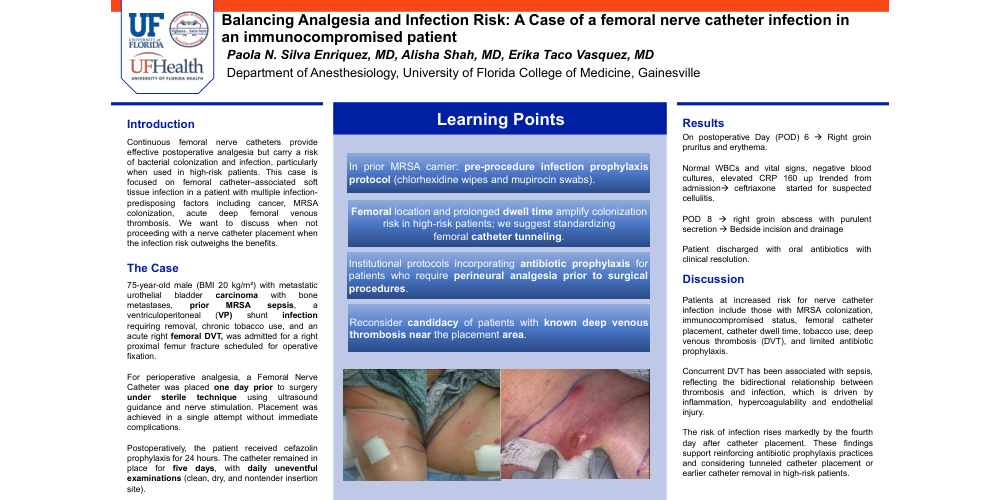
On postoperative day 6, the patient developed pruritus and erythema in the right groin. Vital signs remained stable and the white blood cell count was within normal limits. Blood cultures were obtained and negative. C-reactive protein was elevated to 160, prompting initiation of ceftriaxone for suspected cellulitis. By postoperative day 8, a right groin abscess was noted during a bedside dressing change, with purulent material expressed. A bedside incision and drainage was then performed. The patient was discharged on oral doxycycline and cefpodoxime, with clinical improvement confirmed at a telemedicine follow-up visit two weeks later. Throughout the course, there was no evidence of systemic sepsis, deep soft-tissue extension, or neurologic involvement.
Discussion:
Patients at increased risk for nerve catheter infection include those with MRSA colonization, immunocompromised status, femoral catheter placement, catheter dwell time exceeding 48 hours, tobacco use, deep venous thrombosis (DVT), and limited antibiotic prophylaxis¹. Concurrent DVT has been associated with sepsis², reflecting the bidirectional relationship between thrombosis and infection, which is driven by inflammation, endothelial injury, and hypercoagulability. The risk of infection rises markedly by the fourth day after catheter placement³. These findings support reinforcing antibiotic prophylaxis practices and considering tunneled catheter placement or earlier catheter removal in high-risk patients.
Learning Points:
- Prior MRSA carrier with a history of sepsis should trigger risk-stratified prevention measures for peripheral nerve catheters and reinforce the pre-procedure infection prophylaxis protocol (chlorhexidine wipes and mupirocin swabs).
- Femoral location and prolonged dwell time amplify colonization risk in high-risk patients; we suggest standardizing catheter tunneling.
- Institutional protocols incorporating antibiotic prophylaxis for patients who require perineural analgesia prior to surgical procedures.
- Consider not proceeding with nerve catheter placement in patients with known deep venous thrombosis in the placement area.
References:
- Provenzano DA, Hanes M, Hunt C, et alASRA Pain Medicine consensus practice infection control guidelines for regional anesthesia and pain medicineRegional Anesthesia & Pain Medicine Published Online First: 20 January 2025. doi: 10.1136/rapm-2024-105651
- Yeh YT, Tsai SE, Chen YC, Yang SF, Yeh HW, Wang BY, Yeh LT, Shih NC, Wang YH, Chen YY, Yeh CB. Deep Venous Thrombosis and Risk of Consequent Sepsis Event: A Retrospective Nationwide Population-Based Cohort Study. Int J Environ Res Public Health. 2021 Jul 25;18(15):7879. doi: 10.3390/ijerph18157879. PMID: 34360172; PMCID: PMC8345651.
- Bomberg H, Bayer I, Wagenpfeil S, Kessler P, Wulf H, Standl T, Gottschalk A, Döffert J, Hering W, Birnbaum J, Spies C, Kutter B, Winckelmann J, Liebl-Biereige S, Meissner W, Vicent O, Koch T, Sessler DI, Volk T, Raddatz A. Prolonged Catheter Use and Infection in Regional Anesthesia: A Retrospective Registry Analysis. Anesthesiology. 2018 Apr;128(4):764-773. doi: 10.1097/ALN.0000000000002105. PMID: 29420315.