372 posters, 1 audios, 13 topics, 29 sessions, 1,035 authors, 449 institutions
ePostersLive by SciGen Technologies S.A. All rights reserved.
51st Annual Regional Anesthesiology and Acute Pain Medicine Meeting
April 16 - 18, 2026 | Phoenix, Arizona

2315900
The Challenges of Pain Management in a Case of Purpura Fulminans
Poster Presenter
Authors
David Lester, Alexander Roussos, Usha Saldanha, Kenneth Furukawa
Affiliations
Part of Topic
Medically Challenging Cases
Introduction
Purpura fulminans is a dermatologic emergency characterized by an acute rash with microvascular coagulation and skin necrosis.1Treatment can often resemble that of severe burns, requiring numerous tangential excisions, skin grafting, and even amputations. A multi-modal approach to pain management for these patients is necessary, components of which include analgesic agents of multiple classes and regional analgesia techniques.
Case Description
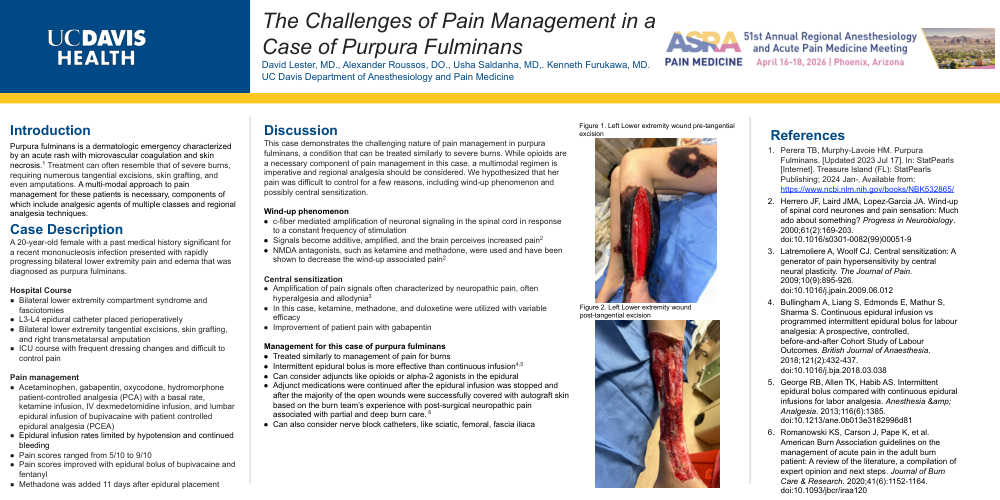
A 20-year-old female with a past medical history significant for a recent mononucleosis infection presented with rapidly progressing bilateral lower extremity pain and edema that was diagnosed as purpura fulminans.
Hospital Course
-
Bilateral lower extremity compartment syndrome and fasciotomies
-
L3-L4 epidural catheter placed perioperatively
-
Bilateral lower extremity tangential excisions, skin grafting, and right transmetatarsal amputation
-
ICU course with frequent dressing changes and difficult to control pain
Pain management
-
Acetaminophen, gabapentin, oxycodone, hydromorphone patient-controlled analgesia (PCA) with a basal rate, ketamine infusion, IV dexmedetomidine infusion, and lumbar epidural infusion of bupivacaine with patient controlled epidural analgesia (PCEA)
-
Epidural infusion rates limited by hypotension and continued bleeding
-
Pain scores ranged from 5/10 to 9/10
-
Pain scores improved with epidural bolus of bupivacaine and fentanyl
-
Methadone was added 11 days after epidural placement
Discussion
This case demonstrates the challenging nature of pain management in purpura fulminans, a condition that can be treated similarly to severe burns. While opioids are a necessary component of pain management in this case, a multimodal regimen is imperative and regional analgesia should be considered. We hypothesized that her pain was difficult to control for a few reasons, including wind-up phenomenon and possibly central sensitization.
Wind-up phenomenon
-
c-fiber mediated amplification of neuronal signaling in the spinal cord in response to a constant frequency of stimulation
-
Signals become additive, amplified, and the brain perceives increased pain2
-
NMDA antagonists, such as ketamine and methadone, were used and have been shown to decrease the wind-up associated pain2
Central sensitization
-
Amplification of pain signals often characterized by neuropathic pain, often hyperalgesia and allodynia3
-
In this case, ketamine, methadone, and duloxetine were utilized with variable efficacy
-
Improvement of patient pain with gabapentin
Management for this case of purpura fulminans
-
Treated similarly to management of pain for burns
-
Intermittent epidural bolus is more effective than continuous infusion4,5
-
Can consider adjuncts like opioids or alpha-2 agonists in the epidural
-
Adjunct medications were continued after the epidural infusion was stopped and after the majority of the open wounds were successfully covered with autograft skin based on the burn team’s experience with post-surgical neuropathic pain associated with partial and deep burn care. 6
-
Can also consider nerve block catheters, like sciatic, femoral, fascia iliaca
References
-
Perera TB, Murphy-Lavoie HM. Purpura Fulminans. [Updated 2023 Jul 17]. In: StatPearls [Internet]. Treasure Island (FL): StatPearls Publishing; 2024 Jan-. Available from: https://www.ncbi.nlm.nih.gov/books/NBK532865/
-
Herrero JF, Laird JMA, Lopez-Garcia JA. Wind-up of spinal cord neurones and pain sensation: Much ado about something? Progress in Neurobiology. 2000;61(2):169-203. doi:10.1016/s0301-0082(99)00051-9
-
Latremoliere A, Woolf CJ. Central sensitization: A generator of pain hypersensitivity by central neural plasticity. The Journal of Pain. 2009;10(9):895-926. doi:10.1016/j.jpain.2009.06.012
-
Bullingham A, Liang S, Edmonds E, Mathur S, Sharma S. Continuous epidural infusion vs programmed intermittent epidural bolus for labour analgesia: A prospective, controlled, before-and-after Cohort Study of Labour Outcomes. British Journal of Anaesthesia. 2018;121(2):432-437. doi:10.1016/j.bja.2018.03.038
-
George RB, Allen TK, Habib AS. Intermittent epidural bolus compared with continuous epidural infusions for labor analgesia. Anesthesia & Analgesia. 2013;116(6):1385. doi:10.1213/ane.0b013e3182996d81
-
Romanowski KS, Carson J, Pape K, et al. American Burn Association guidelines on the management of acute pain in the adult burn patient: A review of the literature, a compilation of expert opinion and next steps. Journal of Burn Care & Research. 2020;41(6):1152-1164. doi:10.1093/jbcr/iraa120