372 posters, 1 audios, 13 topics, 29 sessions, 1,035 authors, 449 institutions
ePostersLive by SciGen Technologies S.A. All rights reserved.
51st Annual Regional Anesthesiology and Acute Pain Medicine Meeting
April 16 - 18, 2026 | Phoenix, Arizona

2315600
Regional Anesthesia Strategies for Recurrent Cryoablation of Shoulder Fibromatosis
Poster Presenter
Authors
Jordan Lange, Arun Muthukumar, Keyuri Popat, Hart Donahue, Asca M. Zavala, Steven M. Yevich, Jessy Kurian, Andrzej P. Kwater
Affiliations
Sam Houston State University College of Osteopathic Medicine, Department of Anesthesiology, Henry Ford Hospital, Department of Anesthesiology and Perioperative Medicine, The University of Texas MD Anderson Cancer Center, Department of Interventional Radiology, The University of Texas MD Anderson Cancer Center
Part of Topic
Medically Challenging Cases
Introduction:
Desmoid type fibromatosis can cause significant pain due to
neurovascular compression and space-occupying effects
Cryoablation is an effective treatment for extra-abdominal
fibromatosis.
However, post-cryoablation pain can present challenges,
with no standardized analgesic strategy.
Case: interscalene brachial plexus blockade (ISB) to
manage chronic and post-procedural pain following
recurrent cryoablation procedures for shoulder fibromatosis.
Methods:
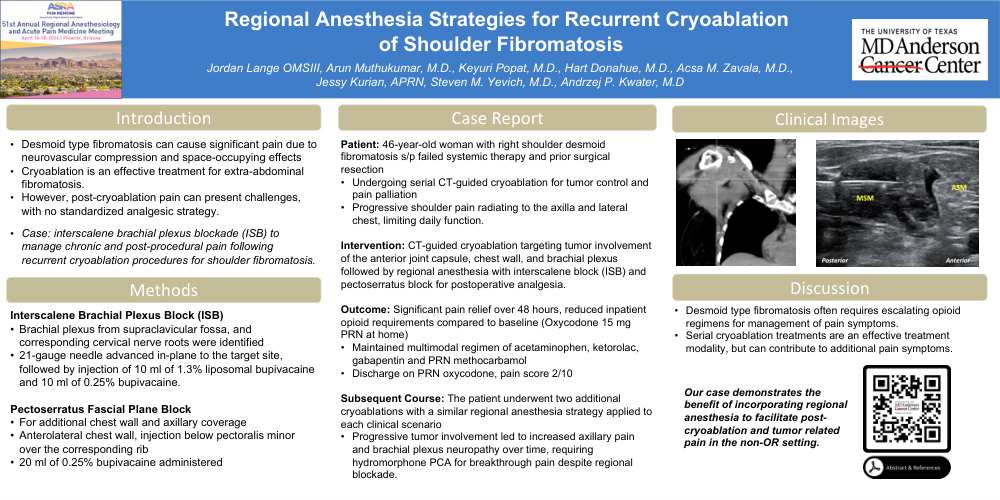
Interscalene Brachial Plexus Block (ISB)
Brachial plexus from supraclavicular fossa, and
corresponding cervical nerve roots were identified
21-gauge needle advanced in-plane to the target site,
followed by injection of 10 ml of 1.3% liposomal bupivacaine
and 10 ml of 0.25% bupivacaine.
Pectoserratus Fascial Plane Block
For additional chest wall and axillary coverage
Anterolateral chest wall, injection below pectoralis minor
over the corresponding rib
20 ml of 0.25% bupivacaine administered
Case Report:
Patient: 46-year-old woman with right shoulder desmoid
fibromatosis s/p failed systemic therapy and prior surgical
resection
Undergoing serial CT-guided cryoablation for tumor control and
pain palliation
Progressive shoulder pain radiating to the axilla and lateral
chest, limiting daily function.
Intervention: CT-guided cryoablation targeting tumor involvement
of the anterior joint capsule, chest wall, and brachial plexus
followed by regional anesthesia with interscalene block (ISB) and
pectoserratus block for postoperative analgesia.
Outcome: Significant pain relief over 48 hours, reduced inpatient
opioid requirements compared to baseline (Oxycodone 15 mg
PRN at home)
Maintained multimodal regimen of acetaminophen, ketorolac,
gabapentin and PRN methocarbamol
Discharge on PRN oxycodone, pain score 2/10
Subsequent Course: The patient underwent two additional
cryoablations with a similar regional anesthesia strategy applied to
each clinical scenario
Progressive tumor involvement led to increased axillary pain
and brachial plexus neuropathy over time, requiring
hydromorphone PCA for breakthrough pain despite regional
blockade.
Discussion:
Desmoid type fibromatosis often requires escalating opioid
regimens for management of pain symptoms.
Serial cryoablation treatments are an effective treatment
modality, but can contribute to additional pain symptoms.
Our case demonstrates the
benefit of incorporating regional
anesthesia to facilitate
post-cryoablation and tumor
related pain in the non-OR
setting.