372 posters, 1 audios, 13 topics, 29 sessions, 1,035 authors, 449 institutions
ePostersLive by SciGen Technologies S.A. All rights reserved.
51st Annual Regional Anesthesiology and Acute Pain Medicine Meeting
April 16 - 18, 2026 | Phoenix, Arizona

2315488
Atypical Thoracic Epidural Hematoma Presenting with Fluctuating Unilateral Deficits
Poster Presenter
Authors
Affiliations
Part of Topic
Medically Challenging Cases
Introduction
Intermittent neurologic deficits following thoracic epidural placement present a diagnostic challenge and may delay recognition of serious complications. We report a medically challenging case involving a patient who developed waxing and waning unilateral motor and sensory deficits with urinary retention four days after T6–7 epidural catheter placement, ultimately found to have a compressive T5–T8 epidural hematoma despite absence of back or radicular pain.
Case report
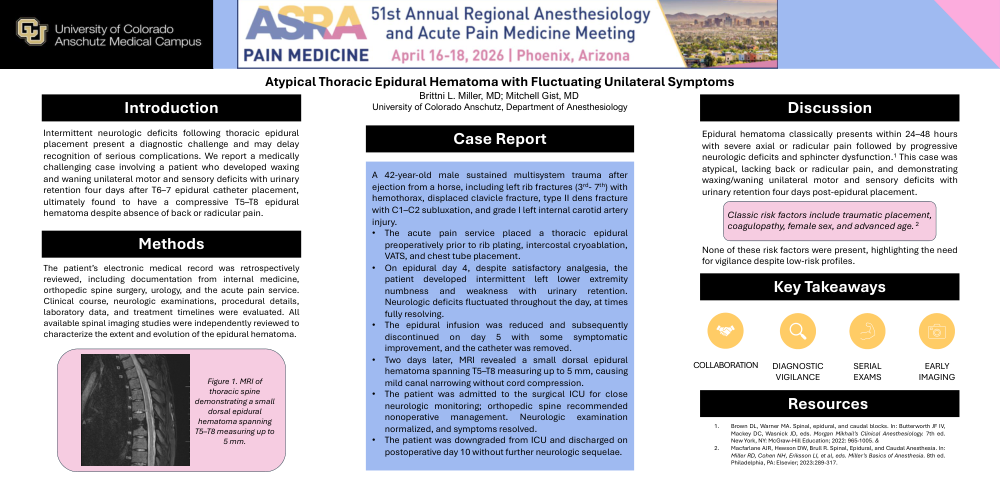
A 42-year-old male sustained multisystem trauma after ejection from a horse, including left rib fractures (3rd- 7th) with hemothorax, displaced clavicle fracture, type II dens fracture with C1–C2 subluxation, and grade I left internal carotid artery injury. The acute pain service placed a thoracic epidural preoperatively prior to rib plating, intercostal cryoablation, VATS, and chest tube placement. On epidural day 4, despite satisfactory analgesia, the patient developed intermittent left lower extremity numbness and weakness with urinary retention. Neurologic deficits fluctuated throughout the day, at times fully resolving. The epidural infusion was reduced and subsequently discontinued on day 5 with some symptomatic improvement, and the catheter was removed. Two days later, MRI revealed a small dorsal epidural hematoma spanning T5–T8 measuring up to 5 mm, causing mild canal narrowing without cord compression. The patient was admitted to the surgical ICU for close neurologic monitoring; orthopedic spine recommended nonoperative management. Neurologic examination normalized, and symptoms resolved. The patient was downgraded from ICU and discharged on postoperative day 10 without further neurologic sequelae.
Discussion
Epidural hematoma classically presents within 24–48 hours with severe axial or radicular pain followed by progressive neurologic deficits and sphincter dysfunction. This case was atypical, lacking back or radicular pain, and demonstrating waxing/waning unilateral motor and sensory deficits with urinary retention four days post-epidural placement. Classic risk factors include traumatic placement, coagulopathy, female sex, and advanced age. None of these risk factors were present, highlighting the need for vigilance despite low-risk profiles.