372 posters, 1 audios, 13 topics, 29 sessions, 1,035 authors, 449 institutions
ePostersLive by SciGen Technologies S.A. All rights reserved.
51st Annual Regional Anesthesiology and Acute Pain Medicine Meeting
April 16 - 18, 2026 | Phoenix, Arizona

2315089
Iatrogenic Pneumothorax from General Anesthesia: A Case for Regional Anesthesia in High-Risk Patients
Poster Presenter
Authors
Affiliations
Part of Topic
Medically Challenging Cases
Introduction
•Pneumothorax during general anesthesia is a rare event, though can be life threatening, especially if it develops into tension pneumothorax
•We present the case of a patient with multiple comorbidities, who suffered a massive iatrogenic pneumothorax immediately following intubation for a lower extremity orthopedic procedure.
•We hope this case emphasizes the risk of barotrauma in patients with restrictive pulmonary pathology, advocating for the use of regional anesthesia in these situations to avoid positive pressure ventilation.
Case Description
•An 80 year old female with a PMH of childhood polio, moderate pulmonary hypertension, prior stroke, thoracic kyphoscoliosis, and wheelchair-bound, was admitted after a fall resulting in a left tibial fracture.
•She was scheduled for intramedullary nailing.
•Preoperative physical exam noted clear lungs.
•A decision was made to proceed with general anesthesia with an ETT.
Case Description Cont’d
•After intubation, no end-tidal CO2 was detected. The patient was immediately extubated and bag-masked with return of ETCO2. She was noted to be hypoxic in the 80s with minimal improvement despite manual ventilation. A second attempt at intubation was similar with no end-tidal CO2 detected on intubation. She was extubated and gently masked.
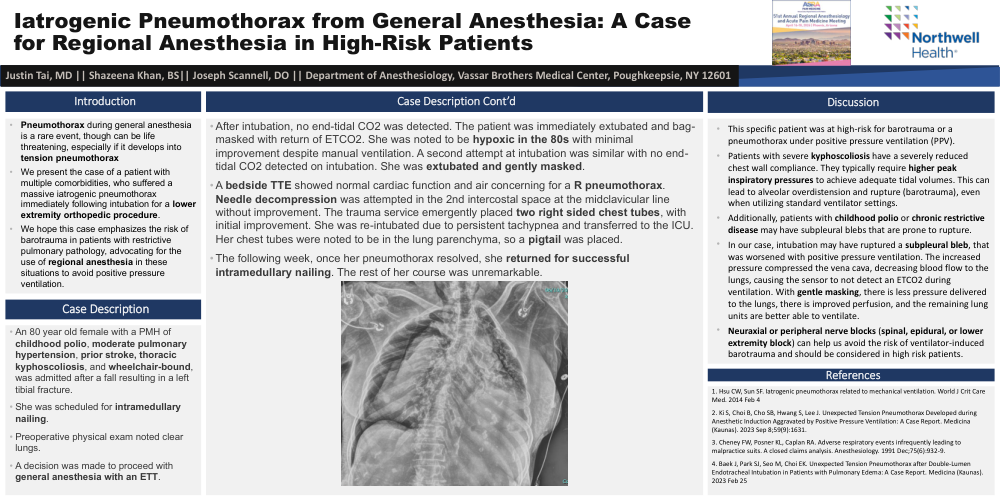
•A bedside TTE showed normal cardiac function and air concerning for a R pneumothorax. Needle decompression was attempted in the 2nd intercostal space at the midclavicular line without improvement. The trauma service emergently placed two right sided chest tubes, with initial improvement. She was re-intubated due to persistent tachypnea and transferred to the ICU. Her chest tubes were noted to be in the lung parenchyma, so a pigtail was placed.
•The following week, once her pneumothorax resolved, she returned for successful intramedullary nailing. The rest of her course was unremarkable.
Discussion
•This specific patient was at high-risk for barotrauma or a pneumothorax under positive pressure ventilation (PPV).
•Patients with severe kyphoscoliosis have a severely reduced chest wall compliance. They typically require higher peak inspiratory pressures to achieve adequate tidal volumes. This can lead to alveolar overdistension and rupture (barotrauma), even when utilizing standard ventilator settings.
•Additionally, patients with childhood polio or chronic restrictive disease may have subpleural blebs that are prone to rupture.
•In our case, intubation may have ruptured a subpleural bleb, that was worsened with positive pressure ventilation. The increased pressure compressed the vena cava, decreasing blood flow to the lungs, causing the sensor to not detect an ETCO2 during ventilation. With gentle masking, there is less pressure delivered to the lungs, there is improved perfusion, and the remaining lung units are better able to ventilate.
•Neuraxial or peripheral nerve blocks (spinal, epidural, or lower extremity block) can help us avoid the risk of ventilator-induced barotrauma and should be considered in high risk patients.