383 posters, 2 videos, 1 audios, 8 topics, 28 sessions, 328 authors, 225 institutions
ePostersLive by SciGen Technologies S.A. All rights reserved.
50th Annual Regional Anesthesiology and Acute Pain Medicine Meeting
May 1 - 3, 2025 | Orlando, Florida

6552
FLUOROSCOPY-GUIDED EPIDURAL BLOOD PATCH FOR A SPONTANEOUS CSF LEAK
Poster Presenter
Authors
Affiliations
Part of Topic
Medically Challenging Cases
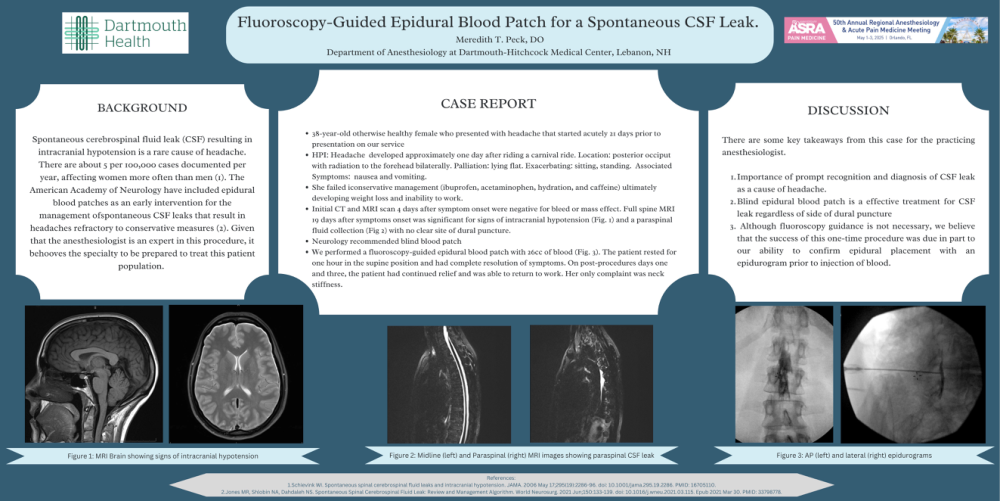
Fluoroscopy-Guided Epidural Blood Patch for a Spontaneous CSF Leak.
Meredith T. Peck, DO
Department of Anesthesiology at Dartmouth-Hitchcock Medical Center, Lebanon, NH
Background
Spontaneous cerebrospinal fluid leak (CSF) resulting in intracranial hypotension is a rare cause of headache. There are about 5 per 100,000 cases documented per year, affecting women more often than men (1). The American Academy of Neurology have included epidural blood patches as an early intervention for the management ofspontaneous CSF leaks that result in headaches refractory to conservative measures (2). Given that the anesthesiologist is an expert in this procedure, it behooves the specialty to be prepared to treat this patient population.
CASE REPORT
- 38-year-old otherwise healthy female who presented with headache that started acutely 21 days prior to presentation on our service
- HPI: Headachedeveloped approximately one day after riding a carnival ride. Location: posterior occiput with radiation to the forehead bilaterally. Palliation: lying flat. Exacerbating: sitting, standing.Associated Symptoms:nausea and vomiting.
- She failed iconservative management (ibuprofen, acetaminophen, hydration, and caffeine) ultimately developing weight loss and inability to work.
- Initial CT and MRI scan 4 days after symptom onset were negative for bleed or mass effect. Full spine MRI 19 days after symptoms onset was significant for signs of intracranial hypotension (Fig. 1) and a paraspinal fluid collection (Fig 2) with no clear site of dural puncture.
- Neurology recommended blind blood patch
- We performed a fluoroscopy-guided epidural blood patch with 26cc of blood (Fig. 3). The patient rested for one hour in the supine position and had complete resolution of symptoms. On post-procedures days one and three, the patient had continued relief and was able to return to work. Her only complaint was neck stiffness.
DISCUSSION
There are some key takeaways from this case for the practicing anesthesiologist.
- Importance of prompt recognition and diagnosis of CSF leak as a cause of headache.
- Blind epidural blood patch is a effective treatment for CSF leak regardless of side of dural puncture
- Although fluoroscopy guidance is not necessary, we believe that the success of this one-time procedure was due in part to our ability to confirm epidural placement with an epidurogram prior to injection of blood.
References:
1.Schievink WI. Spontaneous spinal cerebrospinal fluid leaks and intracranial hypotension. JAMA. 2006 May 17;295(19):2286-96. doi: 10.1001/jama.295.19.2286. PMID: 16705110.
2.Jones MR, Shlobin NA, Dahdaleh NS. Spontaneous Spinal Cerebrospinal Fluid Leak: Review and Management Algorithm. World Neurosurg. 2021 Jun;150:133-139. doi: 10.1016/j.wneu.2021.03.115. Epub 2021 Mar 30. PMID: 33798778.