383 posters, 2 videos, 1 audios, 8 topics, 28 sessions, 328 authors, 225 institutions
ePostersLive by SciGen Technologies S.A. All rights reserved.
50th Annual Regional Anesthesiology and Acute Pain Medicine Meeting
May 1 - 3, 2025 | Orlando, Florida

6376
SUCCESSFUL NEURAXIAL ANESTHESIA FOR COMPLEX GYNECOLOGIC SURGERY IN A PATIENT WITH SEVERE COPD
Poster Presenter
Authors
Affiliations
Part of Topic
Medically Challenging Cases
Ovarian cysts are common benign growths on the ovaries, affecting a significant proportion of women during their reproductive years. While most are asymptomatic and resolve spontaneously, a subset can present with symptoms such as pelvic pain, bloating, or irregular menstrual cycles. A small percentage of these cysts, particularly complex ovarian cysts, may harbor malignant potential.
Typically, a laparoscopic approach under general anesthesia is the preferred method for surgical management of ovarian cysts due to its minimally invasive nature, reduced postoperative pain, and faster recovery time. However, in certain cases, such as patients with significant comorbidities, a different anesthetic approach may be necessary to ensure patient safety and optimal outcomes.
-
50-year-old female scheduled for laparoscopic bilateral salpingo-oophorectomy for a 7 cm complex cyst of the right ovary in preparation for lung transplantation, where an open approach under neuraxial anesthesia was chosen
-
Significant past medical history: stage IV COPD with chronic hypoxic respiratory failure on 4L nasal cannula at baseline and listed for lung transplantation, HTN, HLD, IBS, and endometriosis, without significant surgical history to suggest a contraindication to neuraxial anesthesia.
-
Significant social history: 25 years smoking history (quit 7 year prior).
-
Preoperative physical examination without gross deformities of the lumbar spine.
-
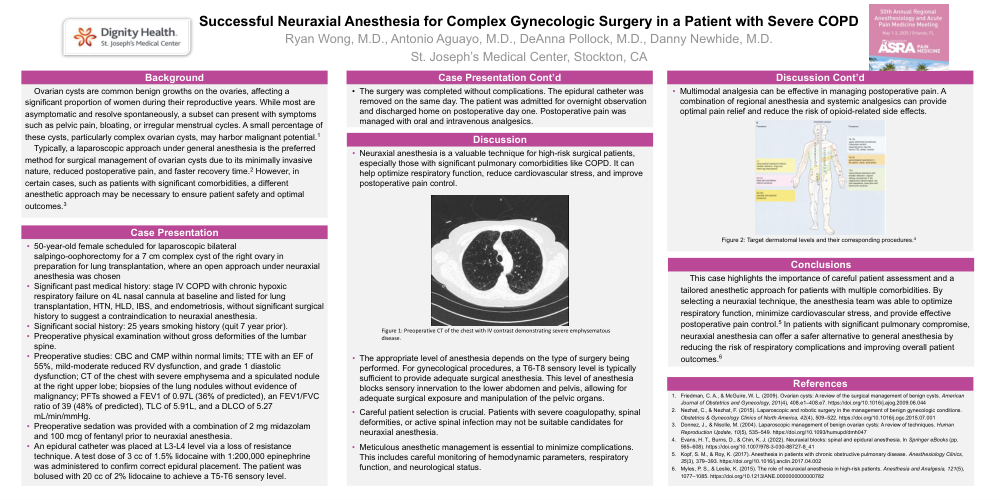
Preoperative studies: CBC and CMP within normal limits; TTE with an EF of 55%, mild-moderate reduced RV dysfunction, and grade 1 diastolic dysfunction; CT of the chest with severe emphysema and a spiculated nodule at the right upper lobe; biopsies of the lung nodules without evidence of malignancy; PFTs showed a FEV1 of 0.97L (36% of predicted), an FEV1/FVC ratio of 39 (48% of predicted), TLC of 5.91L, and a DLCO of 5.27 mL/min/mmHg.
-
Preoperative sedation was provided with a combination of 2 mg midazolam and 100 mcg of fentanyl prior to neuraxial anesthesia.
-
An epidural catheter was placed at L3-L4 level via a loss of resistance technique. A test dose of 3 cc of 1.5% lidocaine with 1:200,000 epinephrine was administered to confirm correct epidural placement. The patient was bolused with 20 cc of 2% lidocaine to achieve a T5-T6 sensory level.
-
The surgery was completed without complications. The epidural catheter was removed on the same day. The patient was admitted for overnight observation and discharged home on postoperative day one. Postoperative pain was managed with oral and intravenous analgesics.
-
Neuraxial anesthesia is a valuable technique for high-risk surgical patients, especially those with significant pulmonary comorbidities like COPD. It can help optimize respiratory function, reduce cardiovascular stress, and improve postoperative pain control.
-
The appropriate level of anesthesia depends on the type of surgery being performed. For gynecological procedures, a T6-T8 sensory level is typically sufficient to provide adequate surgical anesthesia. This level of anesthesia blocks sensory innervation to the lower abdomen and pelvis, allowing for adequate surgical exposure and manipulation of the pelvic organs.
-
Careful patient selection is crucial. Patients with severe coagulopathy, spinal deformities, or active spinal infection may not be suitable candidates for neuraxial anesthesia.
-
Meticulous anesthetic management is essential to minimize complications. This includes careful monitoring of hemodynamic parameters, respiratory function, and neurological status.
-
Multimodal analgesia can be effective in managing postoperative pain. A combination of regional anesthesia and systemic analgesics can provide optimal pain relief and reduce the risk of opioid-related side effects.
-
This case highlights the importance of careful patient assessment and a tailored anesthetic approach for patients with multiple comorbidities. By selecting a neuraxial technique, the anesthesia team was able to optimize respiratory function, minimize cardiovascular stress, and provide effective postoperative pain control.5 In patients with significant pulmonary compromise, neuraxial anesthesia can offer a safer alternative to general anesthesia by reducing the risk of respiratory complications and improving overall patient outcomes.6