383 posters, 2 videos, 1 audios, 8 topics, 28 sessions, 328 authors, 225 institutions
ePostersLive by SciGen Technologies S.A. All rights reserved.
50th Annual Regional Anesthesiology and Acute Pain Medicine Meeting
May 1 - 3, 2025 | Orlando, Florida

6351
STELLATE GANGLION BLOCK FOR ELECTRICAL STORM IN A PATIENT WITH A BIVAD
Poster Presenter
Authors
Affiliations
Part of Topic
Medically Challenging Cases
Stellate Ganglion Block for Electrical Storm in a patient with a BiVAD
Introduction:
Electrical storm (ES) is a medical emergency comprised of recurrent ventricular arrythmias (VF/VT) within a 24-hour period and has previously been treated with stellate ganglion blocks (SGB) (1,2). Few case reports have demonstrated SGB as treatment for ES in patients with left ventricular assist devices (VAD), with even less literature in patients with BiVADs (3,4). We therefore present a case of refractory ES managed with bilateral SGB in a patient with a durable LVAD and a temporary RVAD.
Materials and Methods:
Patient informed consent was obtained for submission of a case report. As the case report is devoid of patient identifiable information, it is exempt from IRB review requirements per Columbia University policy.
Results/Case Report:
A 57-year-old man was transferred to the ICU with an Impella and VA-ECMO (EC-PELLA) from an outside hospital in the setting of mixed cardiogenic versus vasodilatory shock from an NSTEMI and a concurrent pneumonia. He had a past medical history notable for hypertension, hyperlipidemia, former tobacco use, and a recent LAD STEMI 1.5 months prior complicated by VF arrest with resultant ischemic cardiomyopathy (EF 35%).
The patient’s EC-PELLA was initially converted to a temporary BiVAD on hospital day (HD) 1. On HD 23, his temporary BiVAD was converted to a durable LVAD, at which time aortic hemi-arch replacement was done due to dense aortic adhesions encountered during dissection. He later underwent chest closure on HD 25 but developed severe right ventricular dysfunction prompting replacement of a temporary RVAD in conjunction with his pre-existing LVAD (Figure 1).
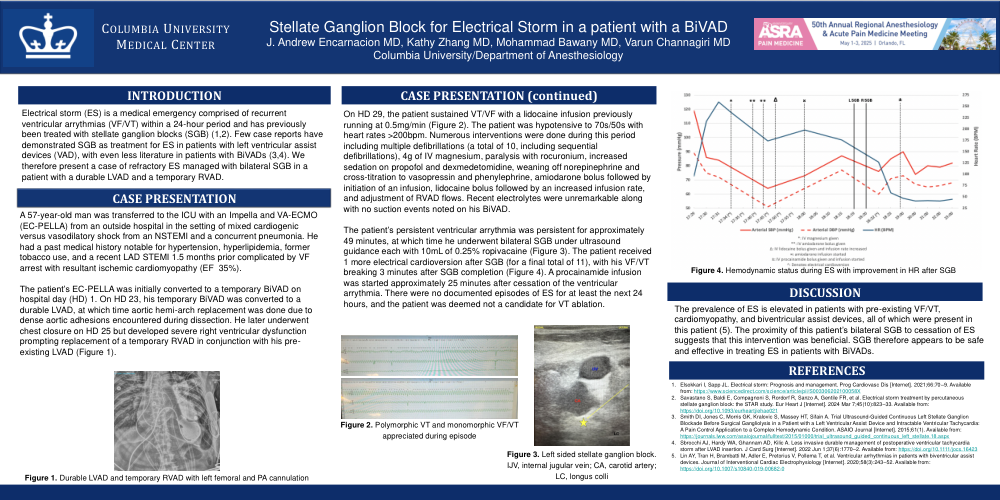
On HD 29, the patient sustained VT/VF with a lidocaine infusion previously running at 0.5mg/min (Figure 2). The patient was hypotensive to 70s/50s with heart rates >200bpm. Numerous interventions were done during this period including multiple defibrillations (a total of 10, including sequential defibrillations), 4g of IV magnesium, paralysis with rocuronium, increased sedation on propofol and dexmedetomidine, weaning off norepinephrine and cross-titration to vasopressin and phenylephrine, amiodarone bolus followed by initiation of an infusion, lidocaine bolus followed by an increased infusion rate, and adjustment of RVAD flows. Recent electrolytes were unremarkable along with no suction events noted on his BiVAD.
The patient’s persistent ventricular arrythmia was persistent for approximately 49 minutes, at which time he underwent bilateral SGB under ultrasound guidance each with 10mL of 0.25% ropivacaine (Figure 3). The patient received 1 more electrical cardioversion after SGB (for a final total of 11), with his VF/VT breaking 3 minutes after SGB completion (Figure 4). A procainamide infusion was started approximately 25 minutes after cessation of the ventricular arrythmia. There were no documented episodes of ES for at least the next 24 hours, and the patient was deemed not a candidate for VT ablation.
Discussion:
The prevalence of ES is elevated in patients with pre-existing VF/VT, cardiomyopathy, and biventricular assist devices, all of which were present in this patient (5). The proximity of this patient’s bilateral SGB to cessation of ES suggests that this intervention was beneficial. SGB therefore appears to be safe and effective in treating ES in patients with BiVADs.