383 posters, 2 videos, 1 audios, 8 topics, 28 sessions, 328 authors, 225 institutions
ePostersLive by SciGen Technologies S.A. All rights reserved.
50th Annual Regional Anesthesiology and Acute Pain Medicine Meeting
May 1 - 3, 2025 | Orlando, Florida

6551
INTRATHECAL CATHETER PLACEMENT FOR PATIENT WITH EXTENSIVE SPINAL HARDWARE UNDERGOING RIGHT HIP DISARTICULATION: A CASE REPORT
Poster Presenter
Authors
Affiliations
Part of Topic
Medically Challenging Cases
Authors: Radosevic, Hoie, Marshall, Maty
Title-
Intrathecal catheter placement for patient with extensive spinal hardware undergoing right hip disarticulation: A Case Report
Introduction-
An intrathecal catheter is inserted in the intrathecal space where the cerebrospinal fluid surrounds the spinal cord. They have been used for many years, primarily to treat severe and chronic pain that has been resistant to conventional treatment modalities.(1) Its use has also been noted in the obstetrics world with intentional placement of the catheter in the intrathecal space after an accidental dural puncture. We report a patient with extensive spinal hardware who received an intrathecal catheter for postoperative pain control management.
Materials and Methods-
A literature review was performed to investigate the use of intrathecal catheters for hip disarticulation operations. The patient gave verbal consent to write the case report to the acute pain fellow at the time of the procedure. The patient’s medical records were reviewed and the summary is reported here. This case report does not contain any identifiable patient information, thus it is exempt from the IRB review as per Colorado Multiple Institutional Review Board (COMIRB) policy.
Case Report-
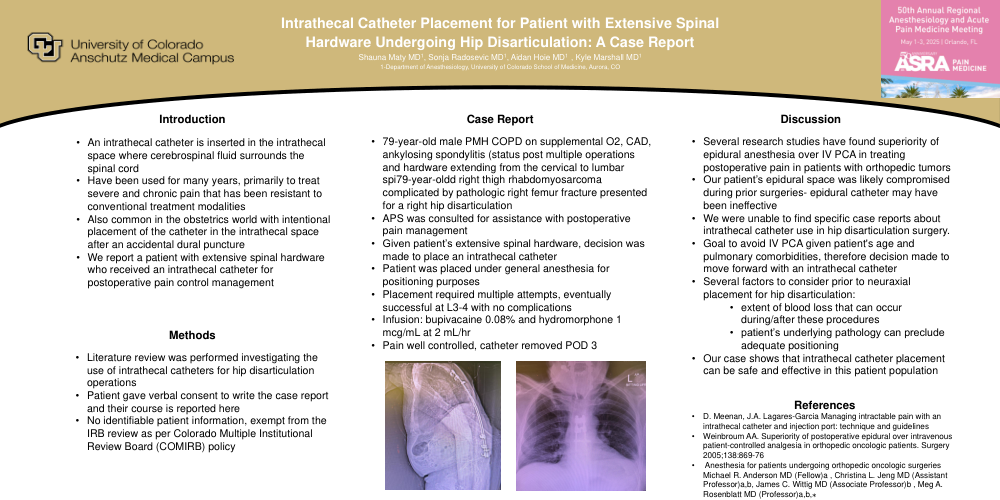
A 79 year old male with a history of COPD on supplemental oxygen, CAD, ankylosing spondylitis (status post multiple operations and hardware extending from the cervical to lumbar spine) and metastatic right thigh rhabdomyosarcoma complicated by pathologic right femur fracture presented for a right hip disarticulation. The acute pain service was consulted for assistance with postoperative pain management. Given the patient’s extensive spinal hardware, the decision was made to forgo an epidural and instead place an intrathecal catheter. The patient was taken back to the operating room and placed under general anesthesia as he could not tolerate positioning while awake. Although placement required multiple attempts, the intrathecal catheter was placed at L3-4 with no complications. A continuous infusion was started intraoperatively with bupivacaine 0.08% and hydromorphone 1 mcg/mL at 2 mL/hr. The catheter was left in place for 3 days with the patient rating his pain 0 to 1 out of 10. His postoperative course remained uncomplicated and he was discharged to a long term rehab facility.
Discussion-
Several research studies have found superiority of epidural anesthesia over IV PCA in treating postoperative pain in patients with orthopedic tumors.2 However, our patient's
history of extensive spinal hardware may have resulted in ineffective pain management with an epidural given that the epidural space was likely affected in prior surgeries. The primary team hoped to avoid IV PCA given the patient's age and pulmonary comorbidities. Although intrathecal catheters are used in several areas of anesthesia, we were unable to find specific case reports about intrathecal catheter use in hip disarticulation surgery. After a multidisciplinary discussion, the decision was made to move forward with an intrathecal catheter. There are several factors to consider prior to neuraxial placement for hip disarticulation such as the extent of blood loss that can occur during and after these procedures(3) and how the patient’s underlying pathology can preclude adequate positioning, but our case shows that intrathecal catheter placement can be safe and effective in this patient population.
1 D. Meenan, J.A. Lagares-Garcia
Managing intractable pain with an intrathecal catheter and injection port: technique and guidelines
2 Weinbroum AA. Superiority of postoperative epidural over intravenous patient-controlled analgesia in orthopedic oncologic patients. Surgery 2005;138:869-76
3 Anesthesia for patients undergoing orthopedic oncologic surgeries Michael R. Anderson MD (Fellow)a , Christina L. Jeng MD (Assistant Professor)a,b, James C. Wittig MD (Associate Professor)b , Meg A. Rosenblatt MD (Professor)a,b,⁎