383 posters, 2 videos, 1 audios, 8 topics, 28 sessions, 328 authors, 225 institutions
ePostersLive by SciGen Technologies S.A. All rights reserved.
50th Annual Regional Anesthesiology and Acute Pain Medicine Meeting
May 1 - 3, 2025 | Orlando, Florida

6519
PECS II NERVE BLOCK FOR INTERCOSTOBRACHIAL NERVE COVERAGE DURING UPPER ARM ARTERIOVENOUS FISTULA SURGERY: A CASE SERIES
Poster Presenter
Authors
Affiliations
Part of Topic
Medically Challenging Cases
PECS II Nerve Block for Intercostobrachial Nerve Coverage
During Upper Arm Arteriovenous Fistula Surgery: a Case Series
Zada Liu MD, Shun Yi Wan MD, Catherine Kuza MD, Kevin Dewalt MD, Inderjeet Julka MD
Harbor-UCLA Medical Center, Department of Anesthesiology, Torrance, California, U.S.A.
Introduction
Arteriovenous fistula (AVF) surgeries involving the medial upper arm
and axilla often need supplemental coverage by an intercostobrachial
nerve block in addition to the supraclavicular or infraclavicular nerve
block. The intercostobrachial nerve (ICBN) may branch into multiple
smaller nerves and is typically derived from the 2nd thoracic spinal
nerve (3). There is no official consensus on the type of nerve block
that should be used for anesthetizing the ICBN. PECS II has been
described as a method to anesthetize the upper medial arm (4). We
attempt to show that targeting above rib 3 provides reliable
intercostobrachial nerve coverage for medial upper arm coverage
during AVF creation. Three patients received PECS II block as
supplementation to supraclavicular nerve blocks for AVF surgery
requiring medial upper arm coverage.
Methods
The PECS II nerve block was performed by using a cranial/caudally
directed linear 13-6 Sonosite SII ultrasound transducer probe. First,
the axillary vein was identified over the 2nd rib and then the 3rd rib
was identified. Subsequently 20 mL of 0.2% ropivacaine was injected
into the plane between the pectoralis minor and serratus anterior
above the 3rd rib. Then a supraclavicular nerve block was also
performed with 20-25 mL of ropivacaine 0.5% injected into the
brachial plexus at the supraclavicular level. The medial upper arm
and axilla were then checked with ice pre-operatively to ensure loss
of temperature sensation. Pre-surgically forceps were used to test
analgesia of the arm and axilla. Intraoperative anesthetic choice,
amount of local anesthetic given by the surgeon, post-operative pain,
and post-operative analgesics were examined.
Results
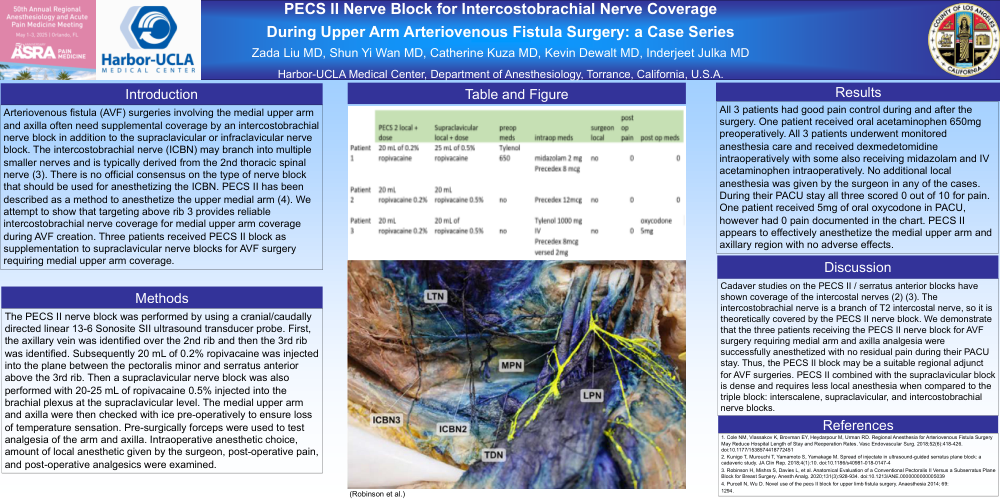
All 3 patients had good pain control during and after the
surgery. One patient received oral acetaminophen 650mg
preoperatively. All 3 patients underwent monitored
anesthesia care and received dexmedetomidine
intraoperatively with some also receiving midazolam and IV
acetaminophen intraoperatively. No additional local
anesthesia was given by the surgeon in any of the cases.
During their PACU stay all three scored 0 out of 10 for pain.
One patient received 5mg of oral oxycodone in PACU,
however had 0 pain documented in the chart. PECS II
appears to effectively anesthetize the medial upper arm and
axillary region with no adverse effects.
Discussion
Cadaver studies on the PECS II / serratus anterior blocks have
shown coverage of the intercostal nerves (2) (3). The
intercostobrachial nerve is a branch of T2 intercostal nerve, so it is
theoretically covered by the PECS II nerve block. We demonstrate
that the three patients receiving the PECS II nerve block for AVF
surgery requiring medial arm and axilla analgesia were
successfully anesthetized with no residual pain during their PACU
stay. Thus, the PECS II block may be a suitable regional adjunct
for AVF surgeries. PECS II combined with the supraclavicular block
is dense and requires less local anesthesia when compared to the
triple block: interscalene, supraclavicular, and intercostobrachial
nerve blocks.
References
1. Cole NM, Vlassakov K, Brovman EY, Heydarpour M, Urman RD. Regional Anesthesia for Arteriovenous Fistula Surgery
May Reduce Hospital Length of Stay and Reoperation Rates. Vasc Endovascular Surg. 2018;52(6):418-426.
doi:10.1177/1538574418772451
2. Kunigo T, Murouchi T, Yamamoto S, Yamakage M. Spread of injectate in ultrasound-guided serratus plane block: a
cadaveric study. JA Clin Rep. 2018;4(1):10. doi:10.1186/s40981-018-0147-4
3. Robinson H, Mishra S, Davies L, et al. Anatomical Evaluation of a Conventional Pectoralis II Versus a Subserratus Plane
Block for Breast Surgery. Anesth Analg. 2020;131(3):928-934. doi:10.1213/ANE.0000000000005039
4. Purcell N, Wu D. Novel use of the pecs II block for upper limb fistula surgery. Anaesthesia 2014; 69:
1294.