383 posters, 2 videos, 1 audios, 8 topics, 28 sessions, 328 authors, 225 institutions
ePostersLive by SciGen Technologies S.A. All rights reserved.
50th Annual Regional Anesthesiology and Acute Pain Medicine Meeting
May 1 - 3, 2025 | Orlando, Florida

6506
CONTINUOUS EXTERNAL OBLIQUE INTERCOSTAL FASCIAL PLANE BLOCK FOR POSTOPERATIVE PAIN MANAGEMENT: A CASE FROM A SAFETY-NET HOSPITAL
Poster Presenter
Authors
Affiliations
Part of Topic
Medically Challenging Cases
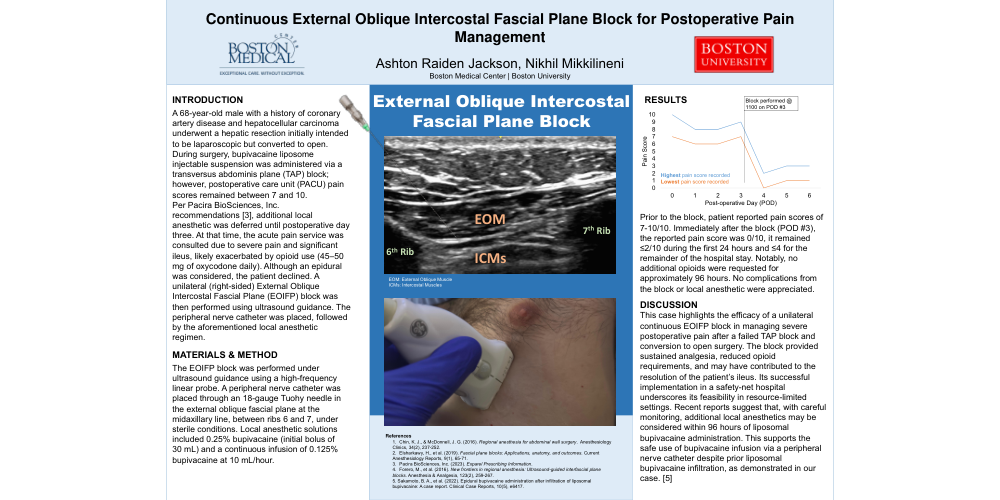
Introduction: A 68-year-old male with a history of coronary artery disease and hepatocellular carcinoma underwent a hepatic resection initially intended to be laparoscopic but converted to open. During surgery, bupivacaine liposome injectable suspension was administered via a transversus abdominis plane (TAP) block; however, postoperative care unit (PACU) pain scores remained between 7 and 10. Per Pacira BioSciences, Inc. recommendations [3], additional local anesthetic was deferred until postoperative day three. At that time, the acute pain service was consulted due to severe pain and significant ileus, likely exacerbated by opioid use (45–50 mg of oxycodone daily). Although an epidural was considered, the patient declined. A unilateral (right-sided) External Oblique Intercostal Fascial Plane (EOIFP) block was then performed using ultrasound guidance. The peripheral nerve catheter was placed, followed by the aforementioned local anesthetic regimen.
Materials & Methods: The EOIFP block was performed under ultrasound guidance using a high-frequency linear probe. A peripheral nerve catheter was placed through an 18-gauge Tuohy needle in the external oblique fascial plane at the midaxillary line, between ribs 6 and 7, under sterile conditions. Local anesthetic solutions included 0.25% bupivacaine (initial bolus of 30 mL) and a continuous infusion of 0.125% bupivacaine at 10 mL/hour.
Results: Prior to the block, patient reported pain scores of 7-10/10. Immediately after the block (POD #3), the reported pain score was 0/10, it remained ≤2/10 during the first 24 hours and ≤4 for the remainder of the hospital stay. Notably, no additional opioids were requested for approximately 96 hours. No complications from the block or local anesthetic were appreciated.
Discussion: This case highlights the efficacy of a unilateral continuous EOIFP block in managing severe postoperative pain after a failed TAP block and conversion to open surgery. The block provided sustained analgesia, reduced opioid requirements, and may have contributed to the resolution of the patient’s ileus. Its successful implementation in a safety-net hospital underscores its feasibility in resource-limited settings. Recent reports suggest that, with careful monitoring, additional local anesthetics may be considered within 96 hours of liposomal bupivacaine administration. This supports the safe use of bupivacaine infusion via a peripheral nerve catheter despite prior liposomal bupivacaine infiltration, as demonstrated in our case. [5]
References:
1. Chin, K. J., & McDonnell, J. G. (2016). Regional anesthesia for abdominal wall surgery. Anesthesiology Clinics, 34(2), 237-252.
2. Elsharkawy, H., et al. (2019). Fascial plane blocks: Applications, anatomy, and outcomes. Current Anesthesiology Reports, 9(1), 65-71.
3. Pacira BioSciences, Inc. (2023). Exparel Prescribing Information.
4. Forero, M., et al. (2016). New frontiers in regional anesthesia: Ultrasound-guided interfascial plane blocks. Anesthesia & Analgesia, 123(2), 259-267.
5. Sakamoto, B. A., et al. (2022). Epidural bupivacaine administration after infiltration of liposomal bupivacaine: A case report. Clinical Case Reports, 10(5), e6417.