383 posters, 2 videos, 1 audios, 8 topics, 28 sessions, 328 authors, 225 institutions
ePostersLive by SciGen Technologies S.A. All rights reserved.
50th Annual Regional Anesthesiology and Acute Pain Medicine Meeting
May 1 - 3, 2025 | Orlando, Florida

6404
PERIOPERATIVE MANAGEMENT OF A PATIENT WITH COLD AGGLUTININ DISEASE PRESENTING FOR TOTAL KNEE ARTHROPLASTY UNDER SPINAL ANESTHESIA
Poster Presenter
Authors
Affiliations
Part of Topic
Medically Challenging Cases
PERIOPERATIVE MANAGEMENT OF A PATIENT WITH COLD AGGLUTININ DISEASE PRESENTING FOR TOTAL KNEE ARTHROPLASTY UNDER SPINAL ANESTHESIA
Introduction:
- Idiopathic cold agglutinin disease (CAD) is a form of autoimmune hemolytic anemia (AIHA) characterized by autoantibody mediated red blood cell (RBC) agglutination and hemolytic anemia at cold temperatures1.
- Clinical manifestations include cold-induced circulatory symptoms related to RBC agglutination in cooler parts of the body, including livedo reticularis, Raynaud disease, acrocyanosis and in rare cases cutaneous necrosis1. Therefore, this condition requires unique perioperative considerations due to the risk of hypothermia with anesthesia.
- Hypothermia is seen in both general and regional anesthesia due to impairments in thermoregulatory control, including redistribution of heat from the core to periphery, markedly reduced temperature thresholds for vasoconstriction, and shivering3.
- While there are scant reports describing successful perioperative management of patients with CAD under general anesthesia, a lack of literature exists regarding perioperative management of these patients undergoing neuraxial anesthesia.
- Due to the overall lack of literature on this topic despite the similarities in thermoregulatory inhibition between general and regional anesthesia, there is no clear guidance on selecting between general and regional anesthesia in this patient population.
Case Description:
Preoperative Presentation
- An 83-year-old female with a history of idiopathic cold agglutinin disease presented for an elective robotic assisted right total knee arthroplasty (TKA).
- In the past, she had episodic anemia triggered by sepsis resulting in hospitalizations requiring treatment with IVIG, glucocorticoids, and rituximab.
- For 1 year leading up to TKA, her laboratory studies were stable with no signs of acute exacerbation of her condition.
- Surgery was performed in a community hospital with direct access to a tertiary care center.
Intraoperative Management
- The patient received a spinal anesthetic with 3.2 mL of 2% mepivacaine and a post-operative adductor canal block with 15 mL of 0.5% bupivacaine with epinephrine. A propofol infusion was used for intraoperative sedation.
- Tight temperature control with axillary skin temperature monitoring was employed. Warming strategies included forced air warmers, warm blankets, warmed IV fluids, and warming of the local anesthetics prior to injection.
- Intraoperative temperature range was approximately 35.9-36.6°C.
Postoperative Course and Outcome
- No signs or symptoms of acute hemolysis were observed and the patient discharged on POD 1.
- Repeat laboratory studies 1 month later were within her established baseline.
Discussion:
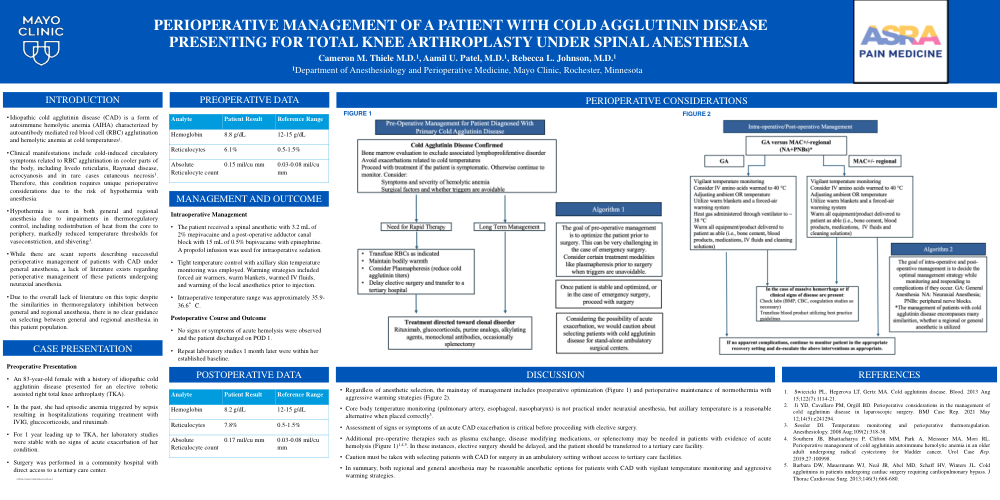
•Regardless of anesthetic selection, the mainstay of management includes preoperative optimization (Figure 1) and perioperative maintenance of normothermia with aggressive warming strategies (Figure 2).
•Core body temperature monitoring (pulmonary artery, esophageal, nasopharynx) is not practical under neuraxial anesthesia, but axillary temperature is a reasonable alternative when placed correctly3.
•Assessment of signs or symptoms of an acute CAD exacerbation is critical before proceeding with elective surgery.
•Additional pre-operative therapies such as plasma exchange, disease modifying medications, or splenectomy may be needed in patients with evidence of acute hemolysis (Figure 1)1,4,5. In these instances, elective surgery should be delayed, and the patient should be transferred to a tertiary care facility.
•Caution must be taken with selecting patients with CAD for surgery in an ambulatory setting without access to tertiary care facilities.
•In summary, both regional and general anesthesia may be reasonable anesthetic options for patients with CAD with vigilant temperature monitoring and aggressive warming strategies.
References:
1. Swiecicki PL, Hegerova LT, Gertz MA. Cold agglutinin disease. Blood. 2013 Aug 15;122(7):1114-21.
2. Ji YD, Cavallaro PM, Orgill BD. Perioperative considerations in the management of cold agglutinin disease in laparoscopic surgery. BMJ Case Rep. 2021 May 12;14(5):e241294.
3. Sessler DI. Temperature monitoring and perioperative thermoregulation. Anesthesiology. 2008 Aug;109(2):318-38.
4.Southern JB, Bhattacharya P, Clifton MM, Park A, Meissner MA, Mori RL. Perioperative management of cold agglutinin autoimmune hemolytic anemia in an older adult undergoing radical cystectomy for bladder cancer. Urol Case Rep. 2019;27:100998.
5.Barbara DW, Mauermann WJ, Neal JR, Abel MD, Schaff HV, Winters JL. Cold agglutinins in patients undergoing cardiac surgery requiring cardiopulmonary bypass. J Thorac Cardiovasc Surg. 2013;146(3):668-680.