383 posters, 2 videos, 1 audios, 8 topics, 28 sessions, 328 authors, 225 institutions
ePostersLive by SciGen Technologies S.A. All rights reserved.
50th Annual Regional Anesthesiology and Acute Pain Medicine Meeting
May 1 - 3, 2025 | Orlando, Florida

6848
CASE REPORT: TWO SUSPECTED MEDIAL ANTEBRACHIAL CUTANEOUS NERVE INJURIES AFTER AXILLARY NERVE BLOCK
Poster Presenter
Part of Topic
Medically Challenging Cases
CASE REPORT: TWO SUSPECTED MEDIAL ANTEBRACHIAL CUTANEOUS NERVE INJURIES AFTER AXILLARY NERVE BLOCK
BACKGROUND
•The brachial plexus block is one of the most common regional anesthesia blocks for patients undergoing shoulder and upper extremity surgery.
•Axillary nerve blocks are useful for procedures of the elbow, forearm, wrist, and hand. This block is typically very safe and well tolerated. However, possible adverse effects include postoperative neurological symptoms such as persistent nerve deficits.
•
CASES
•Patient 1: A 36-year-old with a history of hypertension presented with a thumb hyperextension injury and underwent repair of a complete tear of the radial collateral ligament (RCL) at the metacarpophalangeal (MCP) joint of the left thumb. The patient received a preoperative axillary nerve block with 30 minutes of tourniquet time at 250mmHg intraoperatively. Medial forearm numbness distal to the cubital tunnel was documented at the postoperative day (POD) 30 follow-up visit and was persistent but improving after 4 months.
•Patient 2: A 39-year-old with a history of hypertension, bursitis, and carpal tunnel (with an electromyogram consistent with this diagnosis) presented with a complete tear of the ulnar collateral ligament (UCL) at the MCP joint of the right thumb and underwent repair. The patient also received a preoperative axillary nerve block and 30 minutes of tourniquet time at 250mmHg intraoperatively. On POD 6, the patient reported right forearm numbness and was found to have isolated numbness over the medial aspect of the forearm upon physical evaluation. The patient’s symptoms were persistent after 3 months.
•
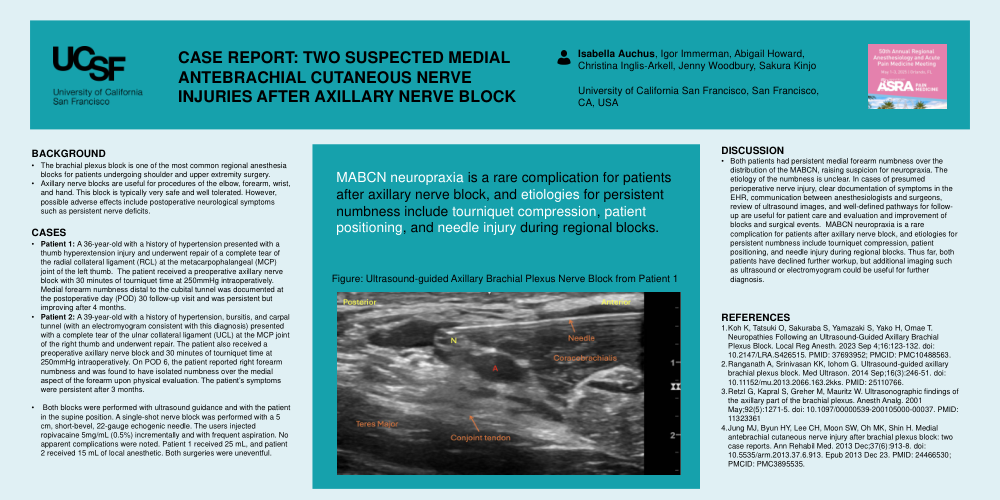
• Both blocks were performed with ultrasound guidance and with the patient in the supine position. A single-shot nerve block was performed with a 5 cm, short-bevel, 22-gauge echogenic needle. The users injected ropivacaine 5mg/mL (0.5%) incrementally and with frequent aspiration. No apparent complications were noted. Patient 1 received 25 mL, and patient 2 received 15 mL of local anesthetic. Both surgeries were uneventful.
MABCN neuropraxia is a rare complication for patients after axillary nerve block, and etiologies for persistent numbness include tourniquet compression, patient positioning, and needle injury during regional blocks.
DISCUSSION
•Both patients had persistent medial forearm numbness over the distribution of the MABCN, raising suspicion for neuropraxia. The etiology of the numbness is unclear. In cases of presumed perioperative nerve injury, clear documentation of symptoms in the EHR, communication between anesthesiologists and surgeons, review of ultrasound images, and well-defined pathways for follow-up are useful for patient care and evaluation and improvement of blocks and surgical events. MABCN neuropraxia is a rare complication for patients after axillary nerve block, and etiologies for persistent numbness include tourniquet compression, patient positioning, and needle injury during regional blocks. Thus far, both patients have declined further workup, but additional imaging such as ultrasound or electromyogram could be useful for further diagnosis.
REFERENCES
1.Koh K, Tatsuki O, Sakuraba S, Yamazaki S, Yako H, Omae T. Neuropathies Following an Ultrasound-Guided Axillary Brachial Plexus Block. Local Reg Anesth. 2023 Sep 4;16:123-132. doi: 10.2147/LRA.S426515. PMID: 37693952; PMCID: PMC10488563.
2.Ranganath A, Srinivasan KK, Iohom G. Ultrasound-guided axillary brachial plexus block. Med Ultrason. 2014 Sep;16(3):246-51. doi: 10.11152/mu.2013.2066.163.2kks. PMID: 25110766.
3.Retzl G, Kapral S, Greher M, Mauritz W. Ultrasonographic findings of the axillary part of the brachial plexus. Anesth Analg. 2001 May;92(5):1271-5. doi: 10.1097/00000539-200105000-00037. PMID: 11323361
4.Jung MJ, Byun HY, Lee CH, Moon SW, Oh MK, Shin H. Medial antebrachial cutaneous nerve injury after brachial plexus block: two case reports. Ann Rehabil Med. 2013 Dec;37(6):913-8. doi: 10.5535/arm.2013.37.6.913. Epub 2013 Dec 23. PMID: 24466530; PMCID: PMC3895535.