383 posters, 2 videos, 1 audios, 8 topics, 28 sessions, 328 authors, 225 institutions
ePostersLive by SciGen Technologies S.A. All rights reserved.
50th Annual Regional Anesthesiology and Acute Pain Medicine Meeting
May 1 - 3, 2025 | Orlando, Florida

6797
ANTERIOR SUPRASCAPULAR NERVE BLOCK FOR REVISION TOTAL SHOULDER ARTHROPLASTY IN A PATIENT WITH SIGNIFICANT RESPIRATORY COMPROMISE
Poster Presenter
Authors
Affiliations
Part of Topic
Medically Challenging Cases
Anterior Suprascapular Nerve Block for Revision Total Shoulder Arthroplasty in a Patient with Significant Respiratory Compromise
INTRODUCTION
Total shoulder arthroplasties, rotator cuff repairs, and subacromial decompression are among the most common and most painful shoulder surgeries performed (1). Higher preoperative pain levels, narcotic use, younger age, female sex, work-related injuries, and revision surgeries are associated with greater postoperative pain (2). Regional anesthesia has gained increasing popularity over the last few decades in multimodal postoperative pain management. Interscalene blocks (ISB) are considered the gold standard for painful shoulder surgeries; however, the incidence of subsequent hemi-diaphragmatic paralysis is reported as high as 97.5% (3), a significant consideration especially in patients with existing respiratory compromise. Here we present a case of a medically complex patient with poorly controlled cardiopulmonary conditions who presented for left shoulder irrigation and debridement (I&D) with revision left total shoulder arthroplasty. We performed a single-shot anterior suprascapular nerve block (ASSB) and achieved our goal of avoiding additional respiratory compromise while providing satisfactory pain control with minimal opioid use.
CASE REPORT
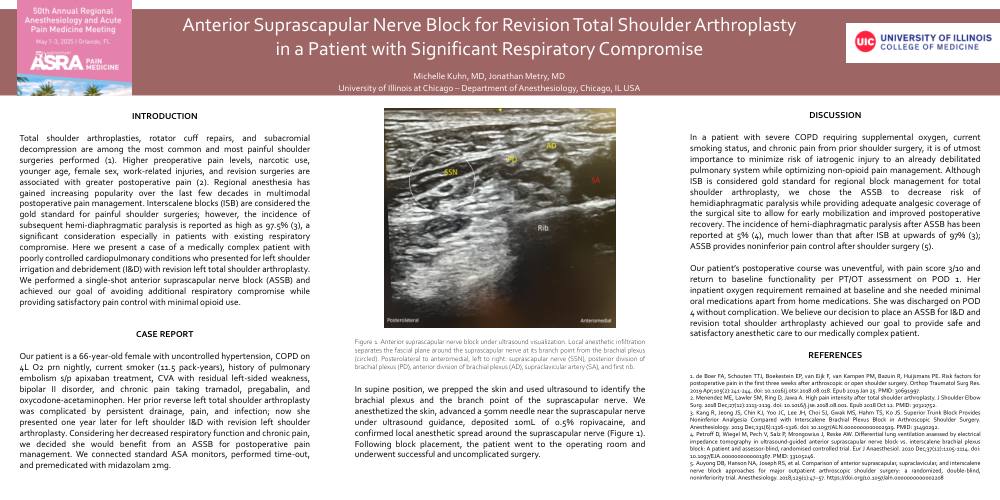
Our patient is a 66-year-old female with uncontrolled hypertension, COPD on 4L O2 prn nightly, current smoker (11.5 pack-years), history of pulmonary embolism s/p apixaban treatment, CVA with residual left-sided weakness, bipolar II disorder, and chronic pain taking tramadol, pregabalin, and oxycodone-acetaminophen. Her prior reverse left total shoulder arthroplasty was complicated by persistent drainage, pain, and infection; now she presented one year later for left shoulder I&D with revision left shoulder arthroplasty. Considering her decreased respiratory function and chronic pain, we decided she would benefit from an ASSB for postoperative pain management. We connected standard ASA monitors, performed time-out, and premedicated with midazolam 2mg. In supine position, we prepped the skin and used ultrasound to identify the brachial plexus and the branch point of the suprascapular nerve. We anesthetized the skin, advanced a 50mm needle near the suprascapular nerve under ultrasound guidance, deposited 10mL of 0.5% ropivacaine, and confirmed local anesthetic spread around the suprascapular nerve (Figure 1). Following block placement, the patient went to the operating room and underwent successful and uncomplicated surgery.
DISCUSSION
In a patient with severe COPD requiring supplemental oxygen, current smoking status, and chronic pain from prior shoulder surgery, it is of utmost importance to minimize risk of iatrogenic injury to an already debilitated pulmonary system while optimizing non-opioid pain management. Although ISB is considered gold standard for regional block management for total shoulder arthroplasty, we chose the ASSB to decrease risk of hemidiaphragmatic paralysis while providing adequate analgesic coverage of the surgical site to allow for early mobilization and improved postoperative recovery. The incidence of hemi-diaphragmatic paralysis after ASSB has been reported at 5% (4), much lower than that after ISB at upwards of 97% (3); ASSB provides noninferior pain control after shoulder surgery (5). Our patient’s postoperative course was uneventful, with pain score 3/10 and return to baseline functionality per PT/OT assessment on POD 1. Her inpatient oxygen requirement remained at baseline and she needed minimal oral medications apart from home medications. She was discharged on POD 4 without complication. We believe our decision to place an ASSB for I&D and revision total shoulder arthroplasty achieved our goal to provide safe and satisfactory anesthetic care to our medically complex patient.