383 posters, 2 videos, 1 audios, 8 topics, 28 sessions, 328 authors, 225 institutions
ePostersLive by SciGen Technologies S.A. All rights reserved.
50th Annual Regional Anesthesiology and Acute Pain Medicine Meeting
May 1 - 3, 2025 | Orlando, Florida

6784
COMPLEX EPIDURAL MANAGEMENT IN A PATIENT WITH ABDOMINAL COMPARTMENT SYNDROME AFTER HERNIA REPAIR SURGERY:
Poster Presenter
Authors
Affiliations
Part of Topic
Medically Challenging Cases
Complex Epidural Management in a Patient with Abdominal Compartment Syndrome After Hernia Repair Surgery: A Case Report
Introduction
Abdominal compartment syndrome (ACS) is a life-threatening condition characterized by increased intra-abdominal pressure, which can cause impaired blood flow to vital organs, leading to severe abdominal pain, organ dysfunction and even death.1
Quick diagnosis and intervention are critical to prevent irreversible organ damage.
We summarize the postoperative course of a patient with a thoracic epidural for postoperative analgesia after complex ventral hernia repair who subsequently developed ACS.
Case Report
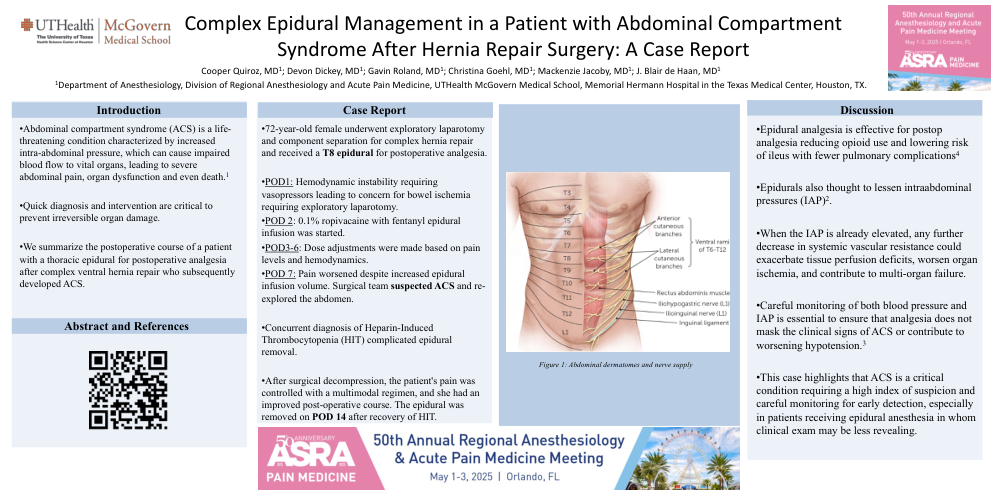
72-year-old female underwent exploratory laparotomy and component separation for complex hernia repair and received a T8 epidural for postoperative analgesia.
POD1: Hemodynamic instability requiring vasopressors leading to concern for bowel ischemia requiring exploratory laparotomy.
POD 2: 0.1% ropivacaine with fentanyl epidural infusion was started.
POD3-6: Dose adjustments were made based on pain levels and hemodynamics.
POD 7: Pain worsened despite increased epidural infusion volume. Surgical team suspected ACS and re-explored the abdomen.
Concurrent diagnosis of Heparin-Induced Thrombocytopenia (HIT) complicated epidural removal.
After surgical decompression, the patient's pain was controlled with a multimodal regimen, and she had an improved post-operative course. The epidural was removed on POD 14 after recovery of HIT.
Discussion
Epidural analgesia is effective for postop analgesia reducing opioid use and lowering risk of ileus with fewer pulmonary complications4
Epidurals also thought to lessen intraabdominal pressures (IAP)2.
When the IAP is already elevated, any further decrease in systemic vascular resistance could exacerbate tissue perfusion deficits, worsen organ ischemia, and contribute to multi-organ failure.
Careful monitoring of both blood pressure and IAP is essential to ensure that analgesia does not mask the clinical signs of ACS or contribute to worsening hypotension.3
This case highlights that ACS is a critical condition requiring a high index of suspicion and careful monitoring for early detection, especially in patients receiving epidural anesthesia in whom clinical exam may be less revealing.