Loading...

383 posters, 2 videos, 1 audios, 8 topics, 28 sessions, 328 authors, 225 institutions

ePostersLive by SciGen Technologies S.A. All rights reserved.

6776

COMPLEX EPIDURAL MANAGEMENT IN A PATIENT WITH HEPARIN-INDUCED THROMBOCYTOPENIA AFTER HERNIA REPAIR SURGERY: A CASE REPORT
Poster Presenter

Cooper Quiroz

Authors

Cooper Quiroz

Affiliations

UT Health

Part of Topic

Medically Challenging Cases

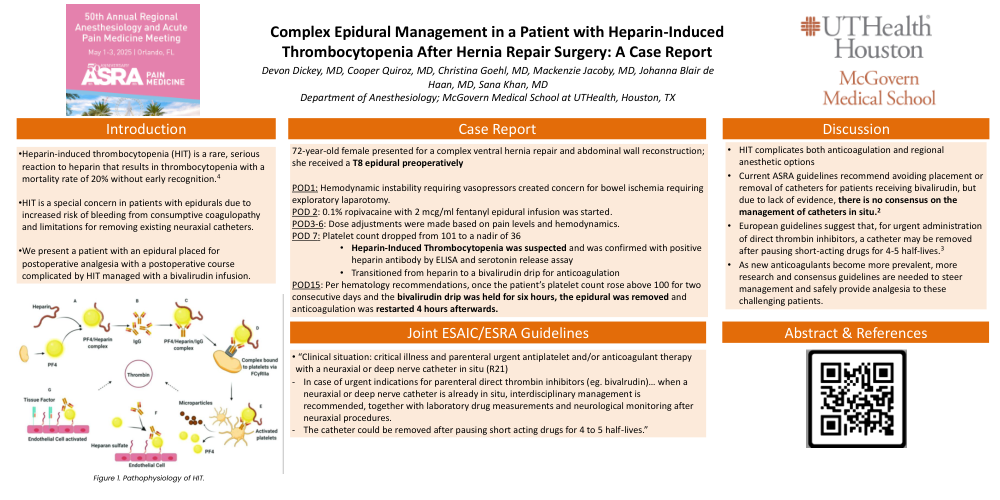
Complex Epidural Management in a Patient with Heparin-Induced Thrombocytopenia After Hernia Repair Surgery: A Case Report 

Devon Dickey, MD, Cooper Quiroz, MD, Christina Goehl, MD, Mackenzie Jacoby, MD, Johanna Blair de Haan, MD, Sana Khan, MD

Department of Anesthesiology; McGovern Medical School at UTHealth, Houston, TX

Introduction:

•Heparin-induced thrombocytopenia (HIT) is a rare, serious reaction to heparin that results in thrombocytopenia with a mortality rate of 20% without early recognition.4

 •HIT is a special concern in patients with epidurals due to increased risk of bleeding from consumptive coagulopathy and limitations for removing existing neuraxial catheters. 

•We present a patient with an epidural placed for postoperative analgesia with a postoperative course complicated by HIT managed with a bivalirudin infusion. 

Case Report:

72-year-old female presented for a complex ventral hernia repair and abdominal wall reconstruction; she received a T8 epidural preoperatively

 POD1: Hemodynamic instability requiring vasopressors created concern for bowel ischemia requiring exploratory laparotomy. 

POD 2: 0.1% ropivacaine with 2 mcg/ml fentanyl epidural infusion was started.

POD3-6: Dose adjustments were made based on pain levels and hemodynamics. 

POD 7: Platelet count dropped from 101 to a nadir of 36

•Heparin-Induced Thrombocytopenia was suspected and was confirmed with positive heparin antibody by ELISA and serotonin release assay
•Transitioned from heparin to a bivalirudin drip for anticoagulation

POD15: Per hematology recommendations, once the patient’s platelet count rose above 100 for two consecutive days and the bivalirudin drip was held for six hours, the epidural was removedand anticoagulation was restarted 4 hours afterwards. 

• “Clinical situation: critical illness and parenteral urgent antiplatelet and/or anticoagulant therapy with a neuraxial or deep nerve catheter in situ (R21)
-In case of urgent indications for parenteral direct thrombin inhibitors (eg. bivalrudin)… when a neuraxial or deep nerve catheter is already in situ, interdisciplinary management is recommended, together with laboratory drug measurements and neurological monitoring after neuraxial procedures.
-The catheter could be removed after pausing short acting drugs for 4 to 5 half-lives.”
 
Discussion:
•HIT complicates both anticoagulation and regional anesthetic options
•Current ASRA guidelines recommend avoiding placement or removal of catheters for patients receiving bivalirudin, but due to lack of evidence, there is no consensus on the management of catheters in situ.2
•European guidelines suggest that, for urgent administration of direct thrombin inhibitors, a catheter may be removed after pausing short-acting drugs for 4-5 half-lives.3
•As new anticoagulants become more prevalent, more research and consensus guidelines are needed to steer management and safely provide analgesia to these challenging patients.


asraspring2025 banner
Copyright © 2015-2026, ePostersLive® SciGen is a registered trademark of SciGen Technologies S.A. Patent pending.

This website and third-party tools we use rely on cookies for the best user experience. By selecting "I agree", you agree to cookie usage as described in our Privacy Policy.
