383 posters, 2 videos, 1 audios, 8 topics, 28 sessions, 328 authors, 225 institutions
ePostersLive by SciGen Technologies S.A. All rights reserved.
50th Annual Regional Anesthesiology and Acute Pain Medicine Meeting
May 1 - 3, 2025 | Orlando, Florida

6751
UNILATERAL, MULTI-LEVEL PARAVERTEBRAL THORACIC NERVE BLOCK FOR DBS BATTERY EXCHANGE IN A PATIENT WITH PULMONARY HYPERTENSION
Poster Presenter
Authors
Affiliations
Part of Topic
Medically Challenging Cases
Unilateral, Multi-Level Paravertebral Thoracic Nerve Block for DBS Battery Exchange in a Patient with Pulmonary Hypertension
Introduction
•Paravertebral nerve blocks are an established regional technique often used as an adjunct to general anesthesia for post-operative pain; here we describe an instance where it was used as the primary anesthetic technique.
•Pulmonary hypertension presents significant anesthetic challenges, increasing morbidity and mortality during surgery under general anesthesia
•Complications include right heart failure, arrhythmias, respiratory instability, and possibly death. (1)
Presentation
•77 y/o (172.2 cm, 114 kg, BMI 38) M with PMH pertinent for Parkinson’s disease, chronic atrial fibrillation, coronary artery disease, and hypertension presenting for a DBS battery exchange implanted under the skin the upper left chest.
•METs > 4
•Pre-operative TTE demonstrated tricuspid regurgitant velocity of 403.3 cm/s. Estimated pulmonary systolic pressure (PASP) of 80 mmHg
•Calculated using simplified Bernoulli's equation: (∆P = 4* TRVmax^2). (2)
Hospital / Intra-Op course
•Patient presented to first day surgery without complication; withheld all medications/vitamins as requested, and NPO since 2000 the previous night.
•Vitals and access were obtained. BP 154/62, HR 70s, irregularly irregular rhythm.
•Patient given fentanyl 50 mcg and midazolam 2 mg prior to the paravertebral block.
•Given additional ketamine 12.5 mg intraoperatively
•Regional technique provided adequate anesthesia, allowing the patient to maintain spontaneous ventilation and stable cardiovascular parameters; no intraoperative complications occurred.
Intervention:
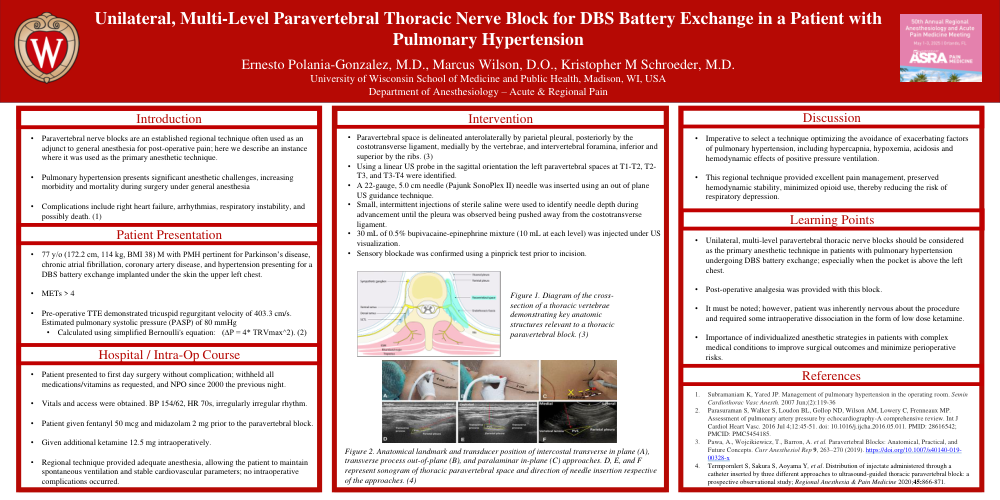
•Paravertebral space is delineated anterolaterally by parietal pleural, posteriorly by the costotransverse ligament, medially by the vertebrae, and intervertebral foramina, inferior and superior by the ribs. (3)
•Using a linear US probe in the sagittal orientation the left paravertebral spaces at T1-T2, T2-T3, and T3-T4 were identified.
•A 22-gauge, 5.0 cm needle (Pajunk SonoPlex II) needle was inserted using an out of plane US guidance technique.
•Small, intermittent injections of sterile saline were used to identify needle depth during advancement until the pleura was observed being pushed away from the costotransverse ligament.
•30 mL of 0.5% bupivacaine-epinephrine mixture (10 mL at each level) was injected under US visualization.
•Sensory blockade was confirmed using a pinprick test prior to incision.
Discusion:
•Imperative to select a technique optimizing the avoidance of exacerbating factors of pulmonary hypertension, including hypercapnia, hypoxemia, acidosis and hemodynamic effects of positive pressure ventilation.
•This regional technique provided excellent pain management, preserved hemodynamic stability, minimized opioid use, thereby reducing the risk of respiratory depression.
Learning Points:
•Unilateral, multi-level paravertebral thoracic nerve blocks should be considered as the primary anesthetic technique in patients with pulmonary hypertension undergoing DBS battery exchange; especially when the pocket is above the left chest.
•Post-operative analgesia was provided with this block.
•It must be noted; however, patient was inherently nervous about the procedure and required some intraoperative dissociation in the form of low dose ketamine.
•Importance of individualized anesthetic strategies in patients with complex medical conditions to improve surgical outcomes and minimize perioperative risks.