383 posters, 2 videos, 1 audios, 8 topics, 28 sessions, 328 authors, 225 institutions
ePostersLive by SciGen Technologies S.A. All rights reserved.
50th Annual Regional Anesthesiology and Acute Pain Medicine Meeting
May 1 - 3, 2025 | Orlando, Florida

6664
MANAGEMENT OF RAPID ATRIAL FIBRILLATION USING STELLATE GANGLION BLOCKADE
Poster Presenter
Part of Topic
Medically Challenging Cases
Management of Rapid Atrial Fibrillation Using Stellate Ganglion Blockade
For patients in the hospital with tachyarrhythmias refractory to medical management, regional anesthesia via stellate ganglion blockade (SGB) is an emerging solution.
Prior descriptions of stellate ganglion blockade focused specifically on treating recurrent ventricular tachyarrhythmias.[1] We present a case report of a patient with recurrent atrial fibrillation with rapid ventricular response (RVR) converted to normal sinus rhythm (NSR) with SGB.
A 73-year-old woman presented to the emergency department with several weeks of worsened dyspnea on exertion, cough, and substernal chest discomfort. Initial laboratory studies showed lactic acidosis, profoundly elevated brain natriuretic peptide, and borderline elevated troponin. She was found to be in atrial fibrillation with ventricular rates in the 130s, and transthoracic echocardiogram demonstrated left ventricular ejection fraction of 15%. Intravenous amiodarone was started for rapid atrial fibrillation. Inotropes and vasopressors were also started, and she was intubated for airway protection.
The patient had known nonobstructive coronary disease and was previously diagnosed with paroxysmal atrial fibrillation. She had predominantly been in NSR and was in NSR at her most recent regular follow-up visit while on metoprolol and apixaban.
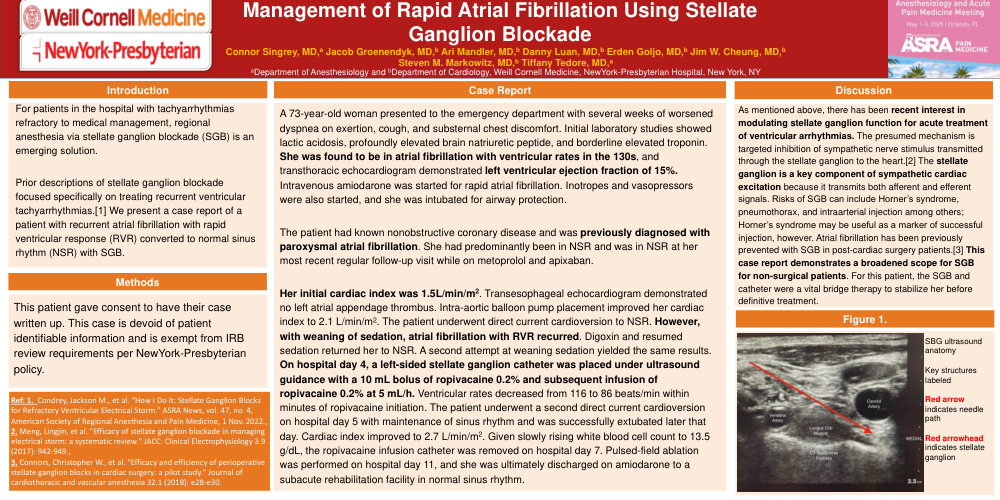
Her initial cardiac index was 1.5L/min/m2. Transesophageal echocardiogram demonstrated no left atrial appendage thrombus. Intra-aortic balloon pump placement improved her cardiac index to 2.1 L/min/m2. The patient underwent direct current cardioversion to NSR. However, with weaning of sedation, atrial fibrillation with RVR recurred. Digoxin and resumed sedation returned her to NSR. A second attempt at weaning sedation yielded the same results. On hospital day 4, a left-sided stellate ganglion catheter was placed under ultrasound guidance with a 10 mL bolus of ropivacaine 0.2% and subsequent infusion of ropivacaine 0.2% at 5 mL/h. Ventricular rates decreased from 116 to 86 beats/min within minutes of ropivacaine initiation. The patient underwent a second direct current cardioversion on hospital day 5 with maintenance of sinus rhythm and was successfully extubated later that day. Cardiac index improved to 2.7 L/min/m2. Given slowly rising white blood cell count to 13.5 g/dL, the ropivacaine infusion catheter was removed on hospital day 7. Pulsed-field ablation was performed on hospital day 11, and she was ultimately discharged on amiodarone to a subacute rehabilitation facility in normal sinus rhythm.
As mentioned above, there has been recent interest in modulating stellate ganglion function for acute treatment of ventricular arrhythmia. The presumed mechanism is targeted inhibition of sympathetic nerve stimulus transmitted through the stellate ganglion to the heart.[2] The stellate ganglion is a key component of sympathetic cardiac excitation because it transmits both afferent and efferent signals. Risks of SGB can include Horner’s syndrome, pneumothorax, and intraarterial injection among others; Horner’s syndrome may be useful as a marker of successful injection, however. Atrial fibrillation has been previously prevented with SGB in post-cardiac surgery patients.[3] This case report demonstrates a broadened scope for SGB for non-surgical patients. For this patient, the SGB and catheter were a vital bridge therapy to stabilize her before definitive treatment.