383 posters, 2 videos, 1 audios, 8 topics, 28 sessions, 328 authors, 225 institutions
ePostersLive by SciGen Technologies S.A. All rights reserved.
50th Annual Regional Anesthesiology and Acute Pain Medicine Meeting
May 1 - 3, 2025 | Orlando, Florida

6633
TREATMENT OF PAIN IN GUILLAIN-BARRE SYNDROME WITH LIDOCAINE INFUSION
Poster Presenter
Authors
Affiliations
Part of Topic
Medically Challenging Cases
Treatment of Pain in Guillain-Barre Syndrome with Lidocaine Infusion
Meredith T. Peck, DO
Department of Anesthesiology at Dartmouth-Hitchcock Medical Center, Lebanon, NH
BACKGROUND
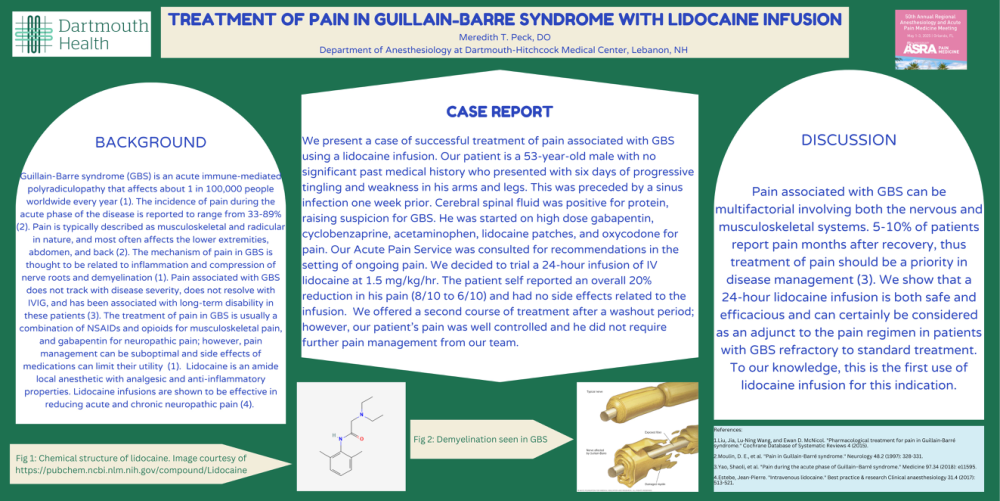
Guillain-Barre syndrome (GBS) is an acute immune-mediated polyradiculopathy that affects about 1 in 100,000 people worldwide every year (1). The incidence of pain during the acute phase of the disease is reported to range from 33-89% (2). Pain is typically described as musculoskeletal and radicular in nature, and most often affects the lower extremities, abdomen, and back (2). The mechanism of pain in GBS is thought to be related to inflammation and compression of nerve roots and demyelination (1). Pain associated with GBS does not track with disease severity, does not resolve with IVIG, and has been associated with long-term disability in these patients (3). The treatment of pain in GBS is usually a combination of NSAIDs and opioids for musculoskeletal pain, and gabapentin for neuropathic pain; however, pain management can be suboptimal and side effects of medications can limit their utility(1).Lidocaine is an amide local anesthetic with analgesic and anti-inflammatory properties. Lidocaine infusions are shown to be effective in reducing acute and chronic neuropathic pain (4).
CASE REPORT
We present a case of successful treatment of pain associated with GBS using a lidocaine infusion. Our patient is a 53-year-old male with no significant past medical history who presented with six days of progressive tingling and weakness in his arms and legs. This was preceded by a sinus infection one week prior. Cerebral spinal fluid was positive for protein, raising suspicion for GBS. He was started on high dose gabapentin, cyclobenzaprine, acetaminophen, lidocaine patches, and oxycodone for pain. Our Acute Pain Service was consulted for recommendations in the setting of ongoing pain. We decided to trial a 24-hour infusion of IV lidocaine at 1.5 mg/kg/hr. The patient self reported an overall 20% reduction in his pain (8/10 to 6/10) and had no side effects related to the infusion.We offered a second course of treatment after a washout period; however, our patient’s pain was well controlled and he did not require further pain management from our team.
DISCUSSION
Pain associated with GBS can be multifactorial involving both the nervous and musculoskeletal systems. 5-10% of patients report pain months after recovery, thus treatment of pain should be a priority in disease management (3). We show that a 24-hour lidocaine infusion is both safe and efficacious and can certainly be considered as an adjunct to the pain regimen in patients with GBS refractory to standard treatment. To our knowledge, this is the first use of lidocaine infusion for this indication.
References:
1.Liu, Jia, Lu‐Ning Wang, and Ewan D. McNicol. "Pharmacological treatment for pain in Guillain‐Barré syndrome." Cochrane Database of Systematic Reviews 4 (2015).
2.Moulin, D. E., et al. "Pain in Guillain-Barré syndrome." Neurology 48.2 (1997): 328-331.
3.Yao, Shaoli, et al. "Pain during the acute phase of Guillain–Barré syndrome." Medicine 97.34 (2018): e11595.
4.Estebe, Jean-Pierre. "Intravenous lidocaine." Best practice & research Clinical anaesthesiology 31.4 (2017): 513-521.