383 posters, 2 videos, 1 audios, 8 topics, 28 sessions, 328 authors, 225 institutions
ePostersLive by SciGen Technologies S.A. All rights reserved.
50th Annual Regional Anesthesiology and Acute Pain Medicine Meeting
May 1 - 3, 2025 | Orlando, Florida

6598
THE TWILIGHT ZONE: A CASE REPORT OF DELAYED EMERGENCE AFTER GENERAL ANESTHESIA FOR A ROUTINE CYSTOSCOPY
Poster Presenter
Authors
Affiliations
Part of Topic
Medically Challenging Cases
The Twilight Zone: A Case Report of Delayed Emergence after General Anesthesia for a Routine Cystoscopy
Shawn Chakraborty DO, Avetis Boyadzhyan MD, Ali Ahmed-Elamin MD
Department of Anesthesiology, HCA Healthcare / USF Morsani College of Medicine GME: Oak Hill Hospital, Brooksville, FL
•Delayed emergence (DE) is a well-known phenomenon in the field of anesthesia. Typically, emergence from anesthesia should occur within 60-90 minutes following even long periods of time under an anesthetic.
•While pharmacologic causes are the most common cause of delayed emergence, metabolic derangements and neurological causes also play an important role. While even less common, there are unexplained and unusual causes of DE that can present as difficult to diagnose clinical scenarios.
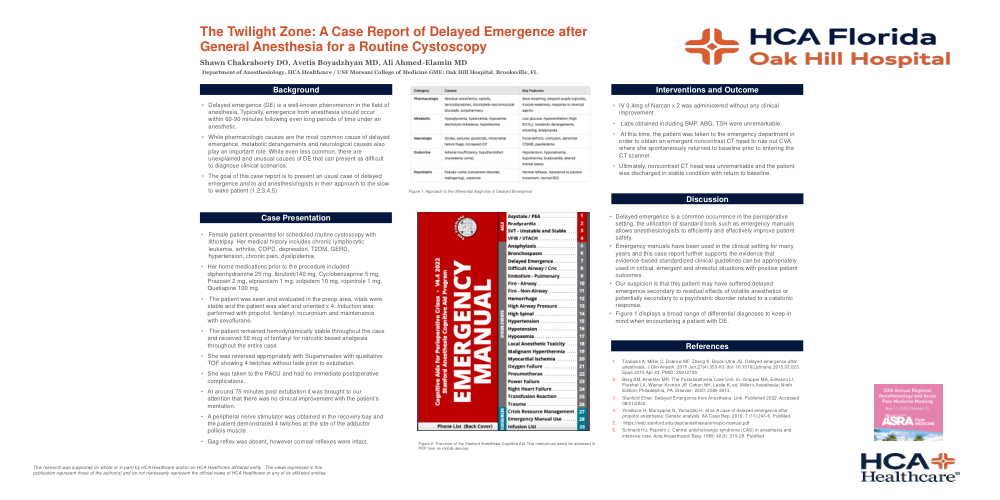
•The goal of this case report is to present an usual case of delayed emergence and to aid anesthesiologists in their approach to the slow to wake patient (1,2,3,4,5).
1.Tzabazis A, Miller C, Dobrow MF, Zheng K, Brock-Utne JG. Delayed emergence after anesthesia. J Clin Anesth. 2015 Jun;27(4):353-60. doi: 10.1016/j.jclinane.2015.03.023. Epub 2015 Apr 23. PMID: 25912729.
2.Berg SM, Braehler MR. The Postanesthesia Care Unit. In: Gropper MA, Eriksson LI, Fleisher LA, Wiener-Kronish JP, Cohen NH, Leslie K, ed. Miller’s Anesthesia; Ninth Edition; Philadelphia, PA. Elsevier; 2020: 2586-2613.
3.Stanford Ether. Delayed Emergence from Anesthesia. Link. Published 2022. Accessed 08/01/2022.
4.Yonekura H, Murayama N, Yamazaki H, et al. A case of delayed emergence after propofol anesthesia: Genetic analysis. AA Case Rep. 2016; 7 (11):243-6. PubMed
5. https://web.stanford.edu/dept/anesthesia/em/epic-manual.pdf
6.Schneck HJ, Rupreht J. Central anticholinergic syndrome (CAS) in anesthesia and intensive care. Acta Anaesthesiol Belg. 1989; 40(3): 219-28. PubMed