383 posters, 2 videos, 1 audios, 8 topics, 28 sessions, 328 authors, 225 institutions
ePostersLive by SciGen Technologies S.A. All rights reserved.
50th Annual Regional Anesthesiology and Acute Pain Medicine Meeting
May 1 - 3, 2025 | Orlando, Florida

6556
CERVICAL SYMPATHETIC CHAIN BLOCK AT C5 TO SUCCESSFULLY TREAT REVERSIBLE CEREBRAL VASOCONSTRICTION SYNDROME
Poster Presenter
Authors
Affiliations
Part of Topic
Medically Challenging Cases
Cervical Sympathetic Chain Block at C5 to Successfully Treat Reversible Cerebral Vasoconstriction Syndrome
Patrick LeFevre, Gabriel Sheena, Antoun Nader
Northwestern University
Introduction:
•The cervical sympathetic chain is responsible for sympathetic autonomic outflow
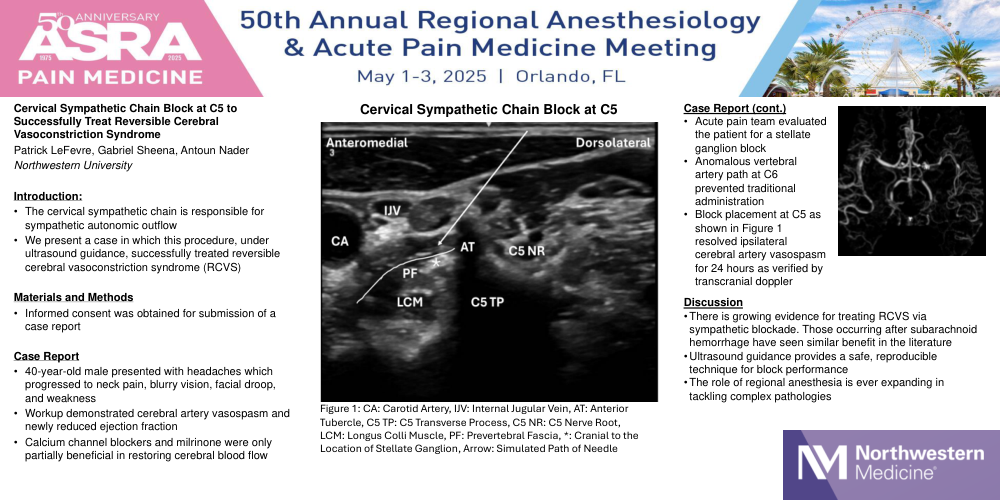
•We present a case in which this procedure, under ultrasound guidance, successfully treated reversible cerebral vasoconstriction syndrome (RCVS)
•
Materials and Methods
•Informed consent was obtained for submission of a case report
Case Report
•40-year-old male presented with headaches which progressed to neck pain, blurry vision, facial droop, and weakness
•Workup demonstrated cerebral artery vasospasm and newly reduced ejection fraction
•Calcium channel blockers and milrinone were only partially beneficial in restoring cerebral blood flow
Case Report (cont.)
•Acute pain team evaluated the patient for a stellate ganglion block
•Anomalous vertebral artery path at C6 prevented traditional administration
•Block placement at C5 as shown in Figure 1 resolved ipsilateral cerebral artery vasospasm for 24 hours as verified by transcranial doppler
Discussion
•There is growing evidence for treating RCVS via sympathetic blockade. Those occurring after subarachnoid hemorrhage have seen similar benefit in the literature
•Ultrasound guidance provides a safe, reproducible technique for block performance
•The role of regional anesthesia is ever expanding in tackling complex pathologies