383 posters, 2 videos, 1 audios, 8 topics, 28 sessions, 328 authors, 225 institutions
ePostersLive by SciGen Technologies S.A. All rights reserved.
50th Annual Regional Anesthesiology and Acute Pain Medicine Meeting
May 1 - 3, 2025 | Orlando, Florida

6554
LIPOSOMAL BUPIVACAINE FOR SUPRACLAVICULAR NERVE BLOCK IN A PEDIATRIC PATIENT ON CRRT: A CASE REPORT
Poster Presenter
Authors
Affiliations
Part of Topic
Medically Challenging Cases
LIPOSOMAL BUPIVICAINE FOR SUPRACLAVICULAR NERVE BLOCK IN A PEDIATRIC PATIENT ON CRRT: A CASE REPORT
INTRODUCTION
Continuous renal replacement therapy (CRRT) is commonly used to manage critically ill patients. Despite postoperative pain, many patients are not considered suitable for nerve due to coexisting conditions, coagulopathies, and uncertain pharmacokinetics of local anesthetics in CRRT settings [1].
A liposomal formulation of bupivacaine provides extended pain relief postoperatively via its prolonged-release mechanism. However, its safety and pharmacokinetic profile in CRRT patients remains unclear.
This report describes a case of a CRRT patient who received a left supraclavicular block using liposomal bupivacaine, with a focus on clinical outcomes and monitoring of bupivacaine serum levels.
CASE PRESENTATION
The patient is a 16 year old male (54.6kg), paraplegic due to C7/T1 spinal cord injury.
He was admitted to the intensive care unit with septic shock and evolving multisystem organ failure. Intubation was performed and CRRT initiated.
Disease course was complicated by multi-limb ischemia, requiring transhumeral amputation of the left upper extremity. Supraclavicular nerve block with ropivacaine was performed before the procedure, after general anesthesia induction.
The patient’s pain appeared to be well-prepared until POD 1, where the patient’s behavior suggested a rise in pain intensity.
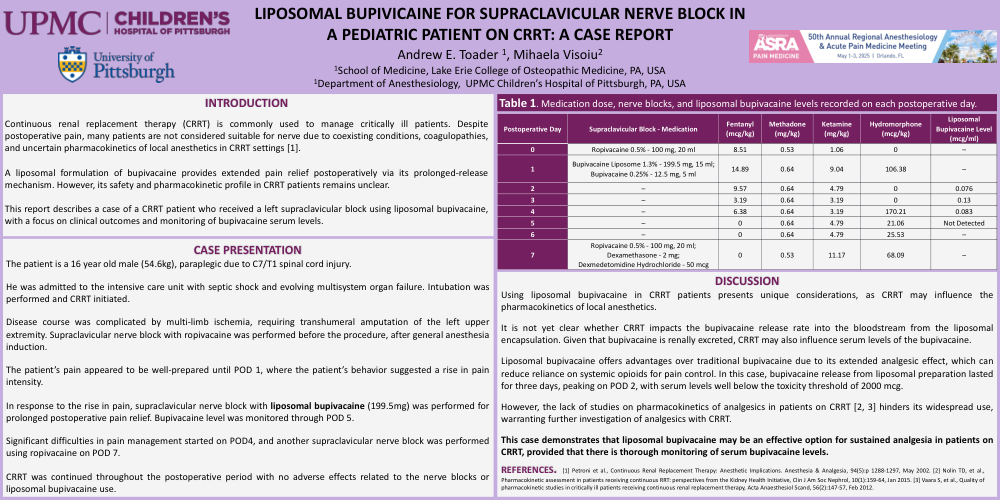
In response to the rise in pain, supraclavicular nerve block with liposomal bupivacaine (199.5mg) was performed for prolonged postoperative pain relief. Bupivacaine level was monitored through POD 5.
Significant difficulties in pain management started on POD4, and another supraclavicular nerve block was performed using ropivacaine on POD 7.
CRRT was continued throughout the postoperative period with no adverse effects related to the nerve blocks or liposomal bupivacaine use.
DISCUSSION
Using liposomal bupivacaine in CRRT patients presents unique considerations, as CRRT may influence the pharmacokinetics of local anesthetics.
It is not yet clear whether CRRT impacts the bupivacaine release rate into the bloodstream from the liposomal encapsulation. Given that bupivacaine is renally excreted, CRRT may also influence serum levels of the bupivacaine.
Liposomal bupivacaine offers advantages over traditional bupivacaine due to its extended analgesic effect, which can reduce reliance on systemic opioids for pain control. In this case, bupivacaine release from liposomal preparation lasted for three days, peaking on POD 2, with serum levels well below the toxicity threshold of 2000 mcg.
However, the lack of studies on pharmacokinetics of analgesics in patients on CRRT [2, 3] hinders its widespread use, warranting further investigation of analgesics with CRRT.
This case demonstrates that liposomal bupivacaine may be an effective option for sustained analgesia in patients on CRRT, provided that there is thorough monitoring of serum bupivacaine levels.