383 posters, 2 videos, 1 audios, 8 topics, 28 sessions, 328 authors, 225 institutions
ePostersLive by SciGen Technologies S.A. All rights reserved.
50th Annual Regional Anesthesiology and Acute Pain Medicine Meeting
May 1 - 3, 2025 | Orlando, Florida

6548
CONTINUOUS SPINAL ANESTHESIA FOR TOTAL KNEE ARTHROPLASTY REVISION IN A PATIENT WITH SEVERE PULMONARY HYPERTENSION
Poster Presenter
Authors
Affiliations
Part of Topic
Medically Challenging Cases
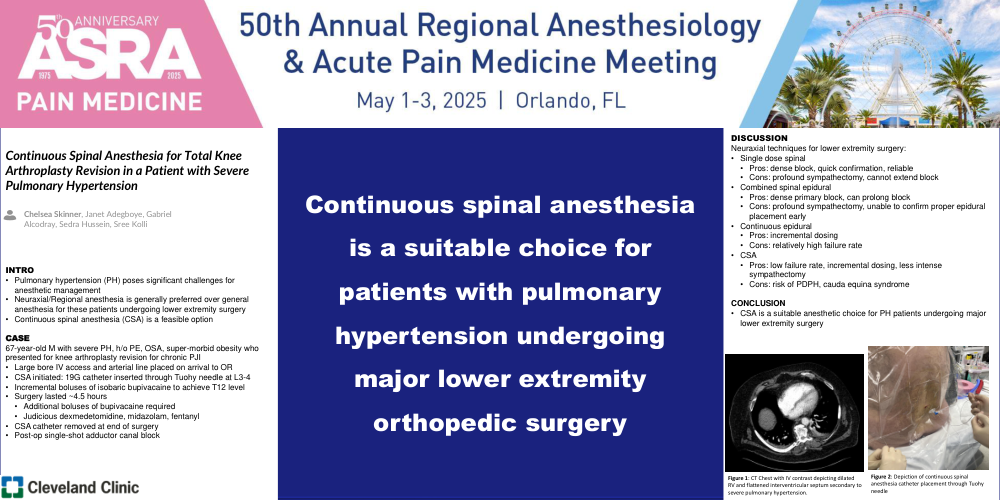
Continuous Spinal Anesthesia for Total Knee Arthroplasty Revision in a Patient with Severe Pulmonary Hypertension
Chelsea Skinner, Janet Adegboye, Gabriel Alcodray, Sedra Hussein, Sree Kolli
INTRO
• Pulmonary hypertension (PH) poses significant challenges for anesthetic management
• Neuraxial/Regional anesthesia is generally preferred over general anesthesia for these patients undergoing lower extremity surgery
• Continuous spinal anesthesia (CSA) is a feasible option
CASE
67-year-old M with severe PH, h/o PE, OSA, super-morbid obesity who presented for knee arthroplasty revision for chronic PJI
• Large bore IV access and arterial line placed on arrival to OR
• CSA initiated: 19G catheter inserted through Tuohy needle at L3-4
• Incremental boluses of isobaric bupivacaine to achieve T12 level
• Surgery lasted ~4.5 hours
• Additional boluses of bupivacaine required
• Judicious dexmedetomidine, midazolam, fentanyl
• CSA catheter removed at end of surgery
• Post-op single-shot adductor canal block
DISCUSSION
Neuraxial techniques for lower extremity surgery:
Single dose spinal
• Pros: dense block, quick confirmation, reliable
• Cons: profound sympathectomy, cannot extend block
Combined spinal epidural
• Pros: dense primary block, can prolong block
• Cons: profound sympathectomy, unable to confirm proper epidural placement early
Continuous epidural
• Pros: incremental dosing
• Cons: relatively high failure rate
CSA
• Pros: low failure rate, incremental dosing, less intense sympathectomy
• Cons: risk of PDPH, cauda equina syndrome
CONCLUSION
• CSA is a suitable anesthetic choice for PH patients undergoing major lower extremity surgery