383 posters, 2 videos, 1 audios, 8 topics, 28 sessions, 328 authors, 225 institutions
ePostersLive by SciGen Technologies S.A. All rights reserved.
50th Annual Regional Anesthesiology and Acute Pain Medicine Meeting
May 1 - 3, 2025 | Orlando, Florida

6522
A GRAVID MARFAN SYNDROME PATIENT PRESENTS WITH AORTIC DISSECTION UNDERGOING CESAREAN SECTION
Poster Presenter
Authors
Affiliations
Part of Topic
Medically Challenging Cases
Marfan syndrome is a connective tissue disorder. It is an autosomal dominant genetic condition that
affects the FBN1 gene on chromosome 15 and fibrillin-1 production. It can affect many different organ
systems but is commonly associated with cardiovascular, musculoskeletal, and ocular issues. Marfan
syndrome may also be associated with local anesthetic resistance although the exact mechanism
remains unknown. One hypothesis is that local anesthetic resistance may be the result of dural ectasia
that can form in Marfan syndrome patients leading to increased cerebrospinal fluid and irregular spread
of local anesthetic.
We present the case of a 38-year-old gravid female 5'10" tall weighing 85.5 kg and BMI of 27 with a past medical
history of Marfan syndrome, atrial septal defect status post repair, and aortic root aneurysm status post valve sparing
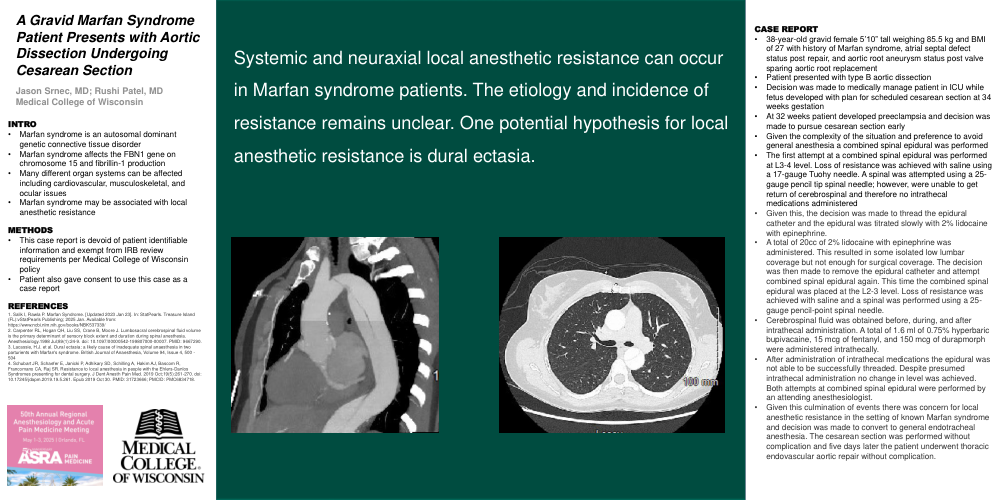
aortic root replacement presenting with severe back pain at 28 weeks gestation. Patient was found to have a type B
aortic dissection originating from distal left subclavian artery extending into the abdominal aorta and terminating below
the renal arteries. The decision was made to medically manage the patient in the intensive care unit while giving the
fetus time to develop. The plan was to perform scheduled cesarean section at 34 weeks of gestation. However, at 32
weeks, the patient developed preeclampsia and decision was made to purse cesarean section early. It was
determined that performing the cesarean section under spinal anesthesia would be the safest. Given the complexity
of the situation and preference to avoid general anesthesia a combined spinal epidural was performed. On the first
attempt a combined spinal epidural was performed at the L3-4 level. Loss of resistance was achieved with saline
using a 17 gauge Tuohy needle. A spinal was attempted using a 25 gauge pencil tip spinal needle; however, were
unable to get return of cerebrospinal fluid and therefore no intrathecal medications were administered. Given this the
decision was made to thread the epidural catheter and epidural was titrated slowly with 2% lidocaine with epinephrine.
A total of 20cc of 2% lidocaine with epinephrine was administered. This resulted in some isolated low lumbar coverage
but not enough for surgical coverage. The decision was then made to remove the epidural catheter and attemptcombined spinal epidural again. This time the combined spinal epidural was placed at the L2-3 level. Loss of
resistance was achieved with saline and a spinal was performed using a 25 gauge pencil-point spinal needle.
Cerebrospinal fluid was obtained before, during, and after intrathecal administration. A total of 1.6 ml of 0.75%
hyperbaric bupivacaine, 15 mcg of fentanyl, and 150 mcg of durapmorph were administered intrathecally. After
administration of intrathecal medications the epidural was not able to be successfully threaded. Despite presumed
intrathecal administration no change in level was achieved. Both attempts at combined spinal epidural were
performed by an attending anesthesiologist. Given this culmination of events there was concern for local anesthetic
resistance in the setting of known Marfan syndrome and decision was made to convert to general endotracheal
anesthesia. The cesarean section was performed without complication and five days later the patient underwent
thoracic endovascular aortic repair without complication.
Management of the gravid Marfan syndrome patient is complex with no ideal management defined.
Although in many instances neuraxial anesthesia is the preferred method, there should be consideration
about the possibility of local anesthetic resistance and a backup plan developed. Systemic and neuraxial
local anesthetic resistance have been described. Given the rarity of connective tissues disorders and
local resistance resistance the etiology and incidence of local anesthetic resistance remains unclear. In
this patient dural ectasia is one hypothesis for the local anesthetic resistance possibly observed. Review
of previous lumbar imaging pre-operatively evaluating for dural ectasia may provide insight into potential
resistance. Further research and investigation are needed into the management of these complex
patients.